API 570 Injection Point Circuits: Limits, CMLs and Inspection
How API 570 defines and inspects injection point circuits: upstream and downstream limits, where to place CMLs, the scan zone, and the 3-year interval.
By Asjad Imam28 Oct 20263 min read
Part 2 of our API 570 cluster covers the locations most likely to surprise a piping inspector. Where wash water, corrosion inhibitor, caustic or other chemicals are injected into a process stream, corrosion can be fast and highly localised. API 570 therefore treats injection points as their own inspection circuits, with defined boundaries and a shorter maximum interval.
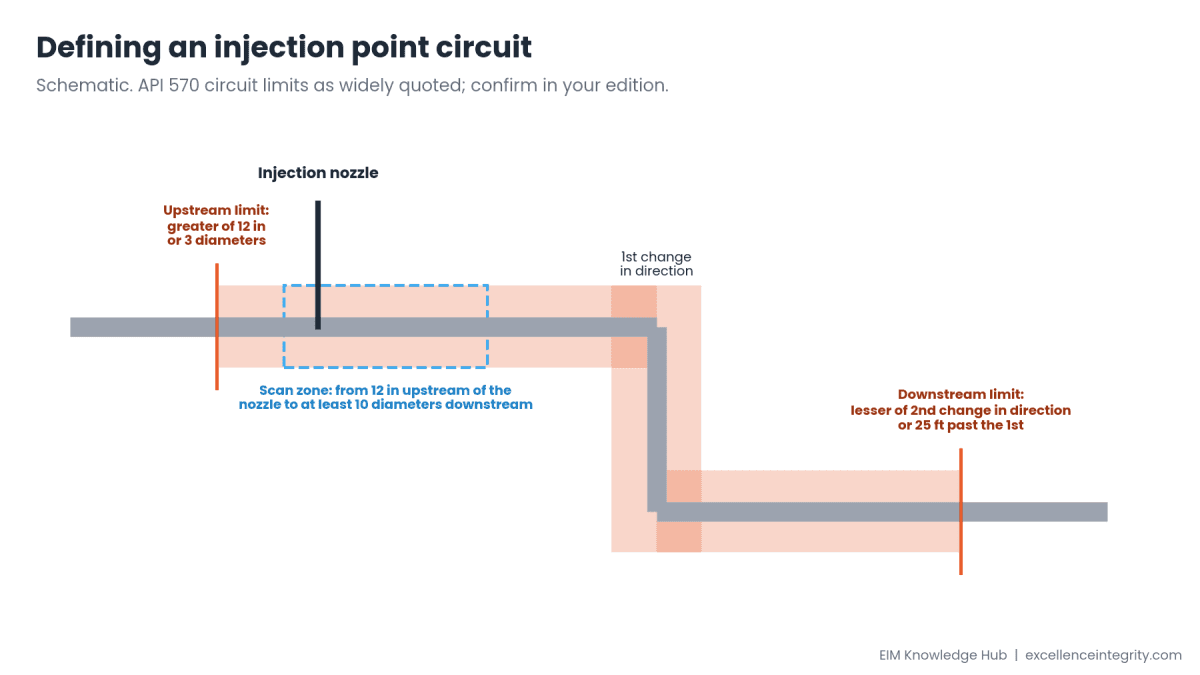
Short answer: API 570 recommends an injection point circuit running from the greater of 12 in or three pipe diameters upstream of the injection point to the lesser of the second change in flow direction past it, or 25 ft beyond the first change in flow direction. CMLs go on fittings, at expected impingement points and at both limits, and the preferred inspection is scanning from 12 in upstream of the nozzle to at least 10 pipe diameters downstream. Thickness inspection is due at least every 3 years.
Defining the circuit
Why injection points corrode
An injected stream rarely mixes instantly. Until it does, the pipe wall may see concentrated chemical, a different temperature, or impingement of droplets. Wash water can carry salts; inhibitors can be corrosive before dilution; caustic can concentrate. Add thermal cycling from intermittent injection and you have both corrosion and thermal fatigue at the same spot.
Where to put CMLs

Inspection methods
- UT scanning or profile radiography across the scan zone, rather than spot readings.
- Internal visual inspection of the nozzle or quill when the line is opened.
- Thickness measurements at the CMLs within the circuit at least every 3 years, or more often if rates are high.
- Check the injection itself: rate, design of the quill, and whether injection has been intermittent.
Common mistakes
- Treating the injection point as part of the main circuit, diluting its corrosion rate with the rest.
- Spot readings only, which miss localised attack.
- Ignoring changes to the injection (chemical, rate, quill design) that move the damage.
- Forgetting thermal fatigue at intermittent cold injections.
Learn more with EIM
EIM is an independent training provider; API certifies piping inspectors. Our API 570 exam page explains the certification, its eligibility and the codebooks. The EIM Calculator includes corrosion rate, remaining life, MAWP and retirement thickness tools. For operators, EIM's inspection services include in-service piping inspection and CML rationalisation.
Frequently asked questions
What is an injection point circuit?
A separately managed inspection circuit around a point where chemicals or water are injected into a process stream, because corrosion there can be faster and more localised.
What is the upstream limit?
The greater of 12 in or three pipe diameters upstream of the injection point.
What is the downstream limit?
The lesser of the second change in flow direction past the injection point, or 25 ft beyond the first change in flow direction.
What is the preferred inspection area?
From 12 in upstream of the injection nozzle to at least 10 pipe diameters downstream, typically by UT scanning or profile radiography.
How often must injection points be inspected?
At least every 3 years for thickness measurement under API 570's default intervals.
Sources
- API 570, Piping Inspection Code, and API RP 574, Inspection Practices for Piping System Components: injection points. Summarised, not quoted.
- Checked 7 October 2026.