Buried Piping Inspection: What API 570 Expects
How buried process piping is inspected: surveillance, CP and coating surveys, guided wave and in-line tools, excavation and soil-to-air interfaces.
By Syed Hasan30 Oct 20262 min read
Part 4 of our API 570 cluster covers the piping nobody can see. Buried process lines corrode from the outside, often without warning, and a leak may go unnoticed until it reaches the surface. API 570 and API RP 574 set out how to manage them, and the answer is always a combination of methods.
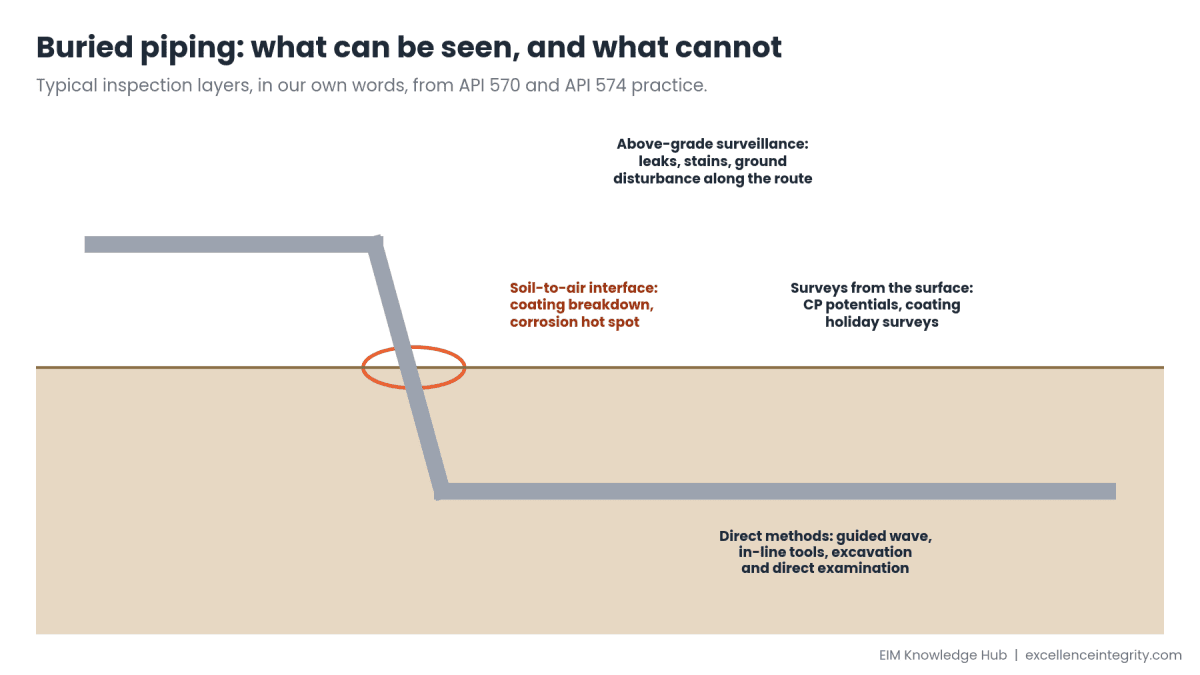
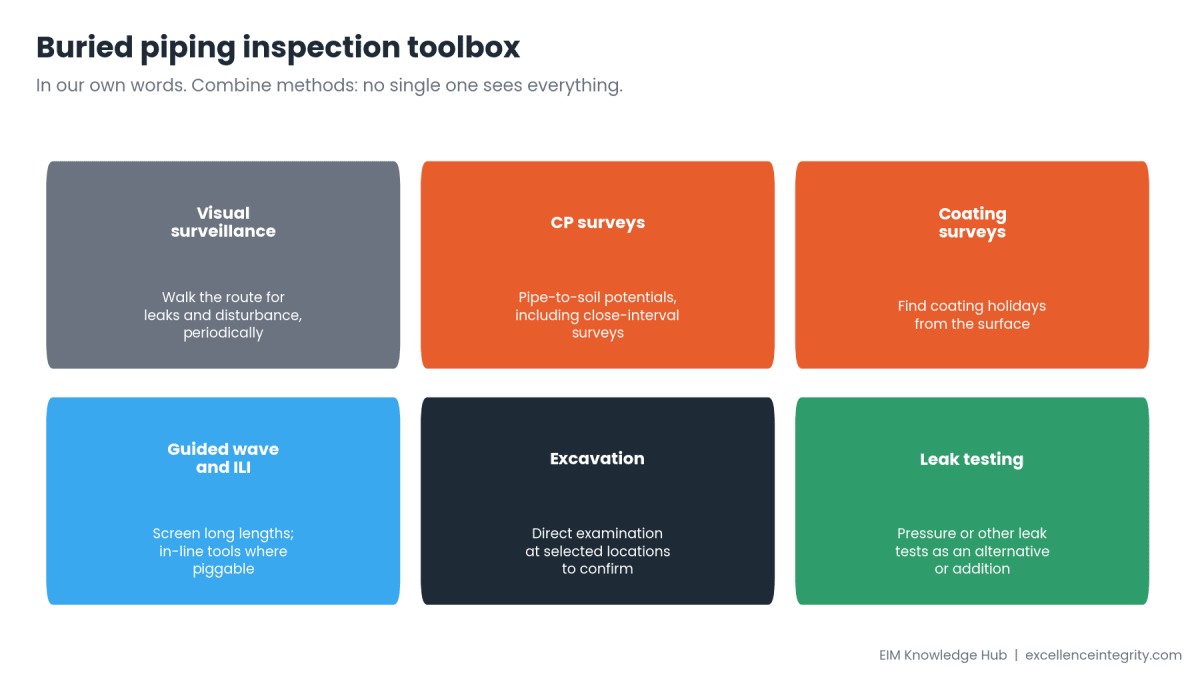
Short answer: Buried piping is managed in layers: regular above-grade surveillance of the route for leaks and disturbance, cathodic protection and coating surveys from the surface, screening by guided wave or in-line inspection where possible, excavation and direct examination at selected points, and leak testing as an alternative or addition. The soil-to-air interface, where the pipe enters the ground, is a corrosion hot spot needing particular attention.
What can be seen, and what cannot
The toolbox
Soil-to-air interfaces
Where a pipe enters the ground, coatings are often damaged, water collects and oxygen is plentiful. This short zone is one of the most common places for buried and partially buried piping to corrode. Inspect it as part of the circuit, with excavation of a few inches around the interface where needed.
Making a buried piping programme work
- Know what you have: route, material, coating, CP status and service of each line.
- Rank by risk: fluid, location, age, soil corrosivity and history.
- Use CP where it exists, and check it works; see AMPP cathodic protection path for the people who test it.
- Excavate smartly: choose dig sites from survey results, not just convenience.
- Record findings and adjust intervals as data improves.
Common pitfalls
- Assuming coated pipe is protected without coating or CP surveys.
- Ignoring the soil-to-air interface.
- Relying on a single method, such as one guided wave shot, for long buried lengths.
- Losing records of where the pipe runs and what was found.
Learn more with EIM
EIM is an independent training provider; API certifies piping inspectors. Our API 570 exam page explains the certification, its eligibility and the codebooks. The EIM Calculator includes corrosion rate, remaining life, MAWP and retirement thickness tools. For operators, EIM's inspection services include in-service piping inspection and CML rationalisation.
Frequently asked questions
How is buried piping inspected?
By combining above-grade surveillance, CP and coating surveys, guided wave or in-line inspection, excavation and direct examination, and leak testing.
Why is the soil-to-air interface important?
Coating damage, moisture and oxygen make it a common corrosion hot spot.
Can guided wave inspect buried pipe?
It can screen lengths of pipe from an access point, though range and sensitivity are reduced by coatings and soil. Findings are usually confirmed by direct examination.
Is cathodic protection required?
Not always, but where it is installed it should be monitored and maintained, and it significantly affects corrosion risk.
Where are buried piping requirements?
In API 570 (including its section on buried piping) and API RP 574.
Sources
- API 570, Piping Inspection Code (buried piping) and API RP 574. Summarised, not quoted.
- Checked 7 October 2026.