When to Update an RBI Assessment: Reassessment Triggers
When to update an RBI assessment: inspection results, process changes, IOW exceedances, equipment changes, incidents and time. RBI is a cycle.
By Syed Hasan1 Nov 20263 min read
The final post in our API 580 cluster is about keeping RBI alive. An RBI study is only as good as the assumptions in it, and assumptions age: processes change, inspections find surprises, and corrosion rates drift. API RP 580 treats RBI as a cycle, and knowing what should trigger an update is as important as the first assessment.
Short answer: Update an RBI assessment when its inputs change: new inspection results (especially unexpected ones), process or feed changes, integrity operating window exceedances, repairs, rerates or material changes, incidents here or at similar units, and simply the passage of time. Inspection codes also cap the time between reviews. Treat RBI as a cycle, not a one-off study.
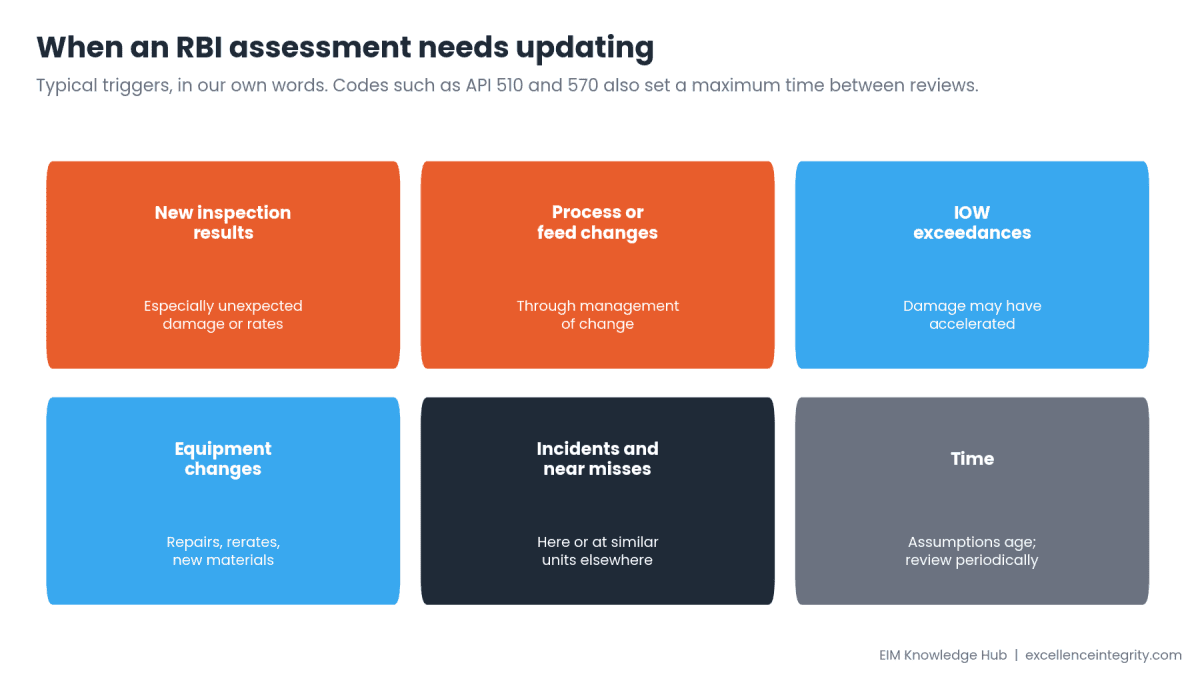
Typical triggers
- New inspection results, especially unexpected damage, rates or locations.
- Process or feed changes through management of change: a new crude, higher throughput, different temperatures.
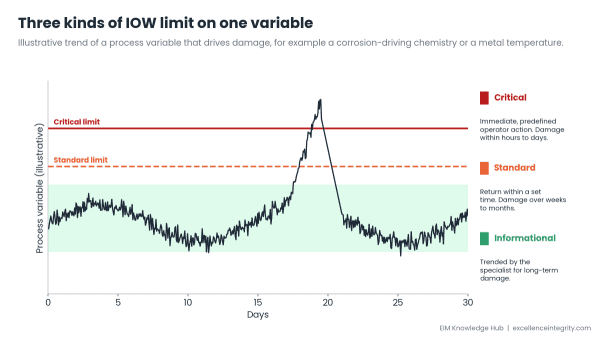
- IOW exceedances: damage may have accelerated; see integrity operating windows.
- Equipment changes: repairs, replacements, rerates and new materials.
- Incidents and near misses, at the site or at similar units elsewhere.
- Time: even without obvious triggers, assumptions age and should be reviewed periodically.
RBI as a cycle
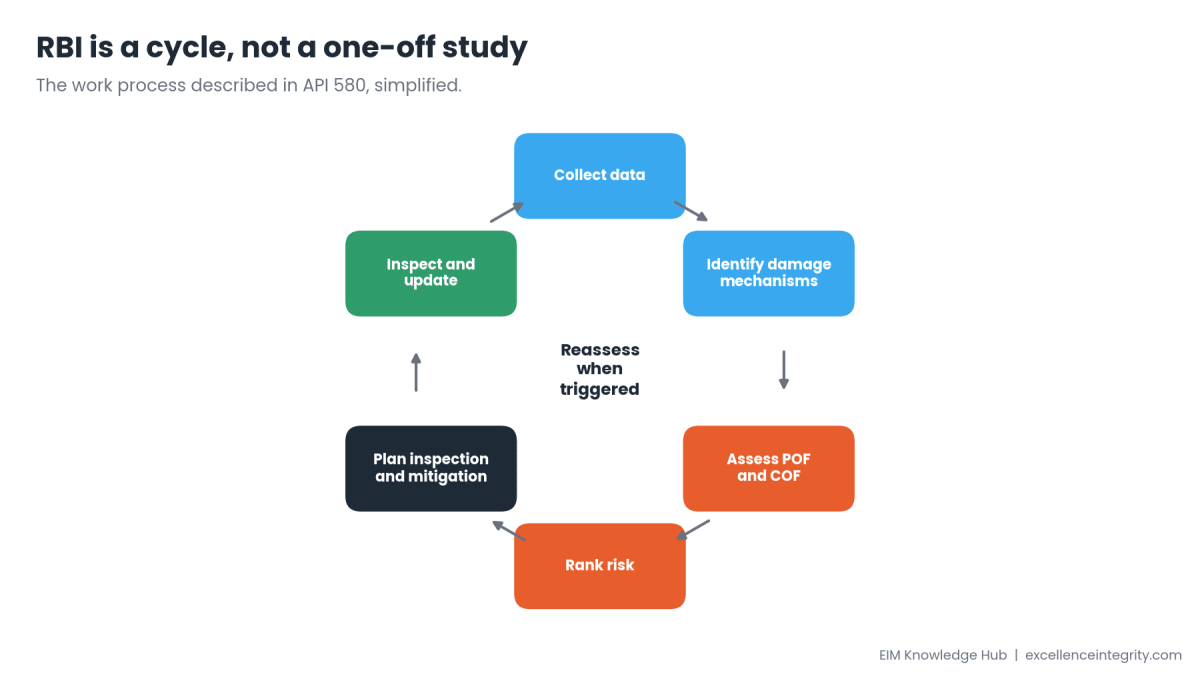
API RP 580 describes RBI as a work process: collect data, identify damage mechanisms, assess probability and consequence, rank risk, plan inspection and mitigation, carry them out, and feed the results back. The loop closes only if inspection results actually update the model.
Maximum review intervals
Inspection codes that allow RBI-based intervals, such as API 510 and API 570, also set a maximum time between RBI reviews, regardless of triggers. Check the interval in the code and edition you work to, and record each review.
Making it work
- Link MOC to RBI: every process change should ask whether the RBI needs updating.
- Feed inspection data back quickly, not at the next scheduled review.
- Keep the corrosion control documents current; they feed damage mechanism identification.
- Assign ownership: someone must be responsible for keeping each unit's RBI current.
Learn more with EIM
EIM is an independent training provider; API certifies inspectors. The API 580 certification exam is based on API RP 580 (4th edition, with Addendum 1) and is closed book; holders of API 510, 570 or 653 qualify automatically. EIM's self-paced API 580 preparation includes a question bank, practice mode with explanations, timed mock tests, study notes and flashcards, with one year of access. See the API 580 page. EIM's live Risk-Based Inspection (RBI) Techniques course with Mr. Deepak Rawtal covers RBI methodology and inspection planning, with an EIM certificate of completion; check the course page for the next batch.
Frequently asked questions
When should an RBI assessment be updated?
When its inputs change: new inspection results, process or feed changes, IOW exceedances, equipment changes or incidents, and at least at the maximum review interval set by the applicable code.
Is RBI a one-off study?
No. API RP 580 describes it as a continuing work process in which inspection results feed back into the assessment.
Why do IOW exceedances matter for RBI?
An exceedance may have accelerated damage, changing the probability of failure the RBI assumed.
How does MOC relate to RBI?
Process and equipment changes managed through MOC can change damage mechanisms, rates or consequences, so they should trigger an RBI review.
Do codes set a maximum RBI review interval?
Yes. Codes such as API 510 and API 570 cap the time between RBI reviews. Check the code and edition you work to.
Sources
- API RP 580, Risk-Based Inspection, 4th edition with Addendum 1. Concepts summarised, not quoted.
- API 510 and API 570 (RBI review requirements). Cited, not quoted.
- Checked 7 October 2026.