Types of Valves and Where Each Is Used in Process Plants
Types of valves in process plants explained: gate, globe, ball, plug, butterfly and check valves, where each is used, and a simple way to choose the right one.
By Syed Hasan29 Nov 20269 min read
Open the valve list for a small process unit and you can easily find several hundred tags. Some are there to shut a line for maintenance, some to set a flow rate, some to stop a pump running backwards when it trips. Pick the wrong valve for the job and it will work for a while, then it will pass when you need it shut, wear its seat out, or slam hard enough to shake a pipe rack.
This post goes through the common types of valves in oil, gas and process plants: what each one does well, where it is normally used, and where it gets misused. It goes further than the two short valve sections in our guide to carbon steel piping components, and it ends with a simple way to choose and a list of what an inspector checks on a valve in service.
Start with the job: isolate, regulate or stop backflow
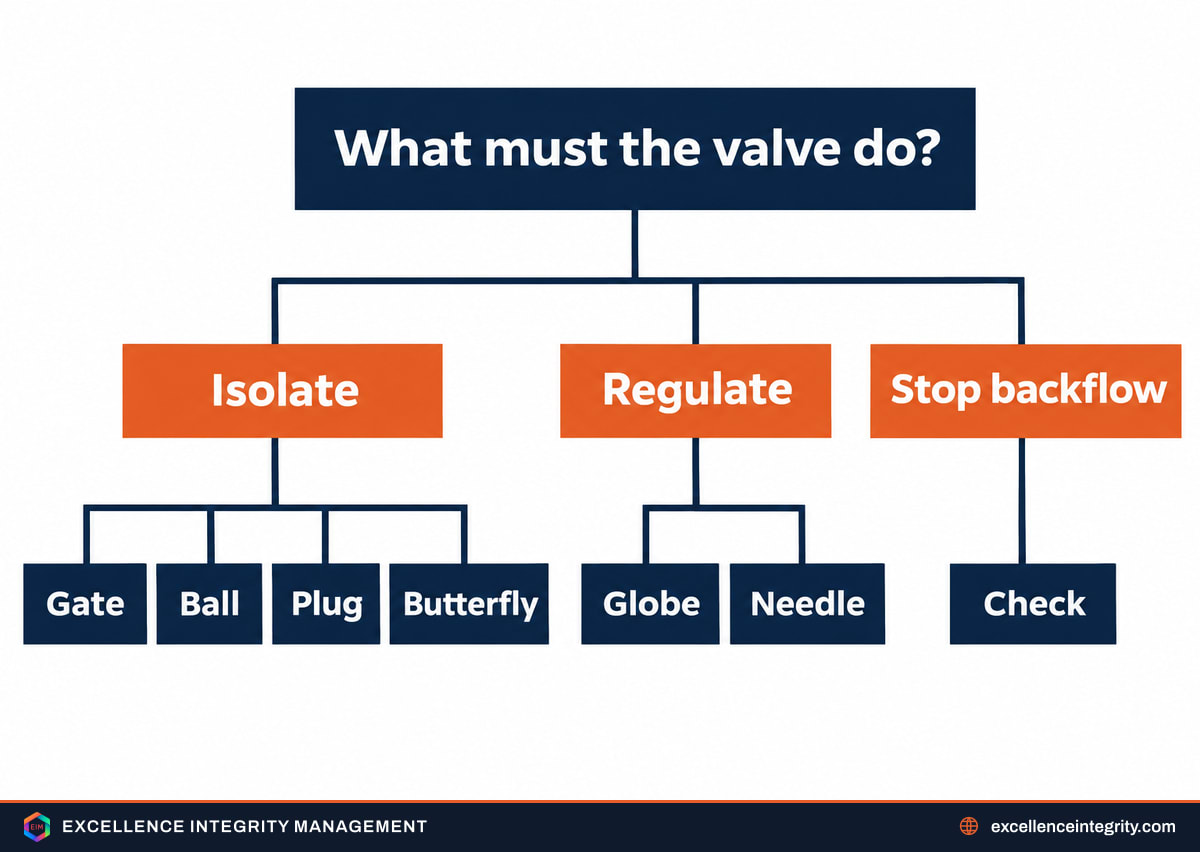
Every valve in a plant is doing one of three jobs. It isolates (fully open or fully shut, nothing in between), it regulates (sits part-open to set flow or pressure), or it stops flow going the wrong way. A few special valves do something else, such as relieving overpressure, but those three cover most of the list.
Each design is shaped for one of those jobs, and asking a valve to do another's job is the most common valve mistake on site.
Isolation valves: gate, ball, plug and butterfly
Gate valve
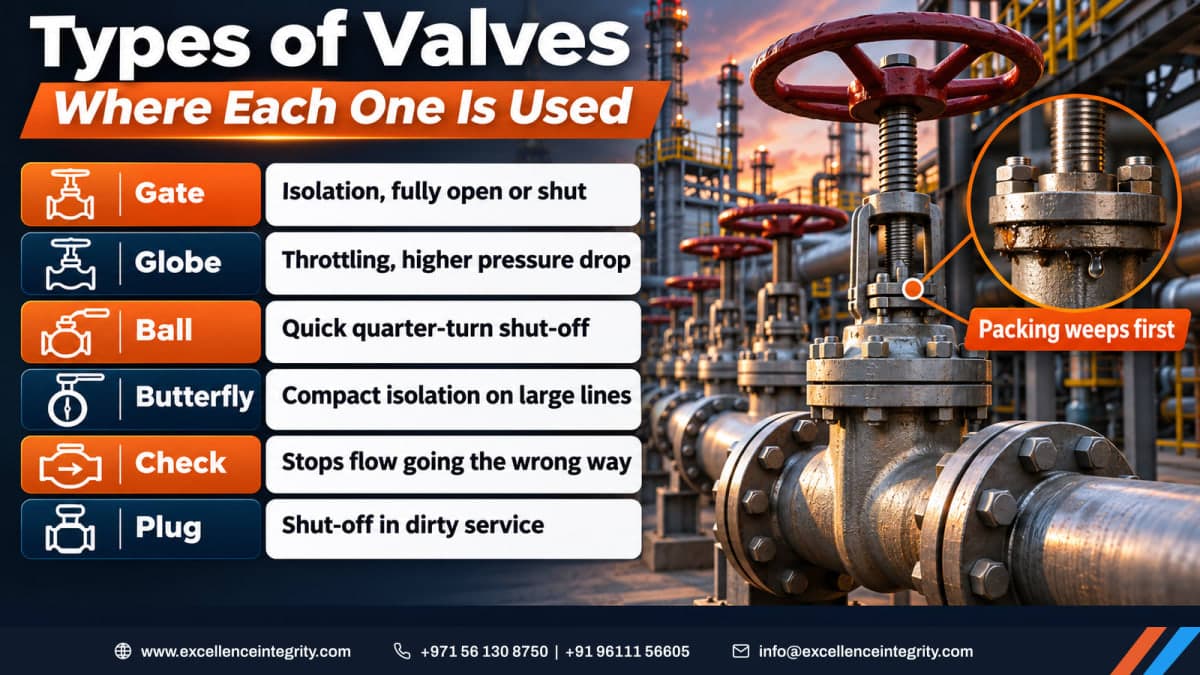
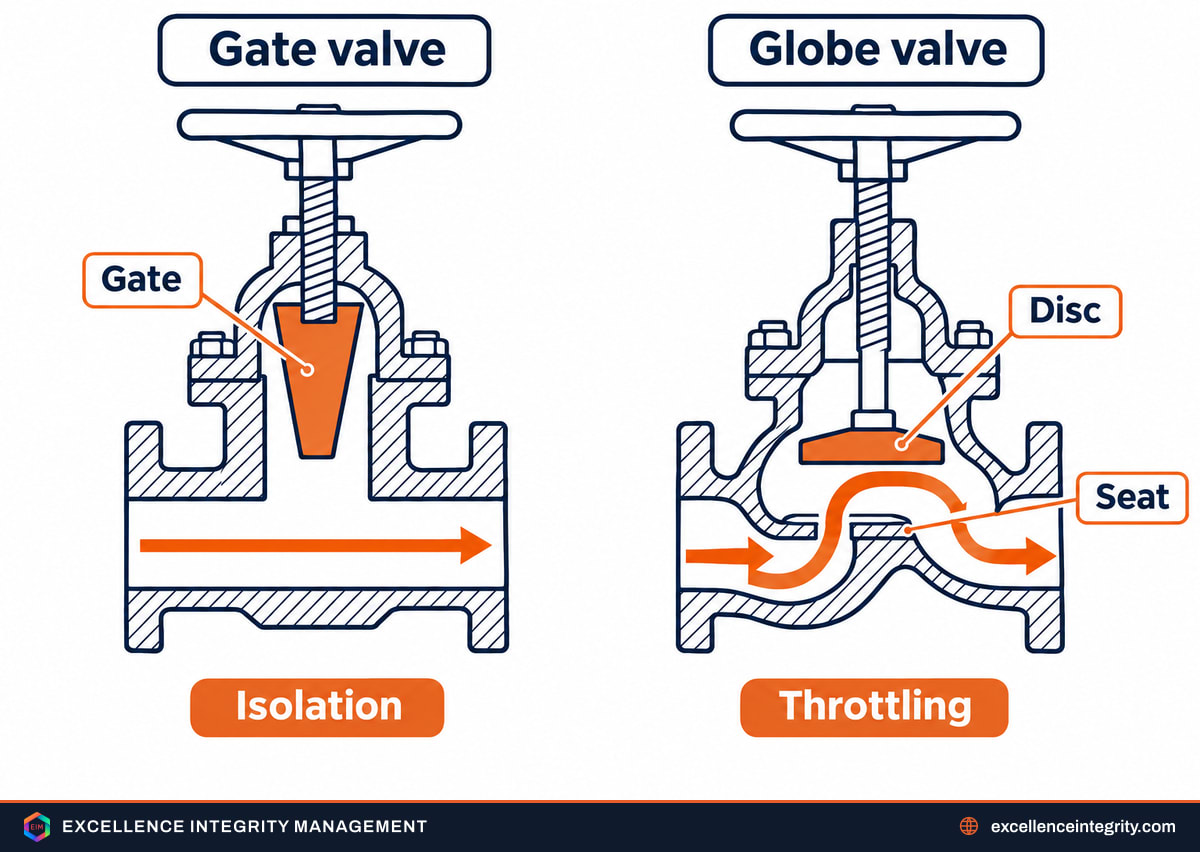
A gate valve has a flat or wedge-shaped gate that slides across the flow path. Fully open, the gate lifts clear of the bore, so the pressure drop is very low and the line can be drained or cleaned through it.
Gate valves are the traditional choice for isolation on process lines, utilities and steam. They are not meant to throttle. Left part-open, the gate vibrates and the high-velocity flow under its edge cuts the seats, so the valve stops sealing.
Ball valve
A ball valve shuts with a quarter turn of a ball that has a hole through it. It is quick to operate, and the handle position tells you at a glance whether it is open or shut. Full-bore ball valves have a hole the same size as the pipe, which matters where lines are pigged; reduced-bore ones are smaller and cheaper.
Soft seats seal very tightly in clean service, within the seat material's temperature limit; metal seats suit hot or abrasive service.
Plug valve
A plug valve is the older cousin of the ball valve: a tapered or cylindrical plug with a port, turned a quarter turn. Lubricated and sleeved types handle dirty, viscous and some chemical services well.
Butterfly valve
A butterfly valve uses a disc that rotates a quarter turn on a shaft across the pipe. It is short, light and cheap in large sizes, which is why you see it on cooling water, firewater and large utility lines. Simple concentric designs seal against a rubber liner; double-offset and triple-offset designs suit higher pressures and temperatures, and triple-offset valves can give metal-to-metal tight shut-off.
The disc always sits in the flow, so a butterfly valve cannot be pigged through and adds some pressure drop even when fully open.
Regulating valves: globe, needle and control valves
A globe valve has a disc or plug that moves straight down onto a seat, with the flow turning through an S-shaped path inside the body. That path gives a higher pressure drop than a gate valve, but it also means a turn of the handwheel gives a steady, controllable change in flow. Globe valves are the manual choice for throttling, control valve bypasses and small drains and vents.
Globe valves are usually fitted with the flow coming up under the seat, so the packing is not under full pressure when the valve is shut. The arrow cast on the body is there for a reason; check it at installation.
Needle valves are very small globe valves with a fine tapered stem, used on instrument lines and sample points where you need fine control of a small flow. Automatic control valves are usually globe, ball or butterfly bodies fitted with an actuator.
Check valves: stopping flow going the wrong way
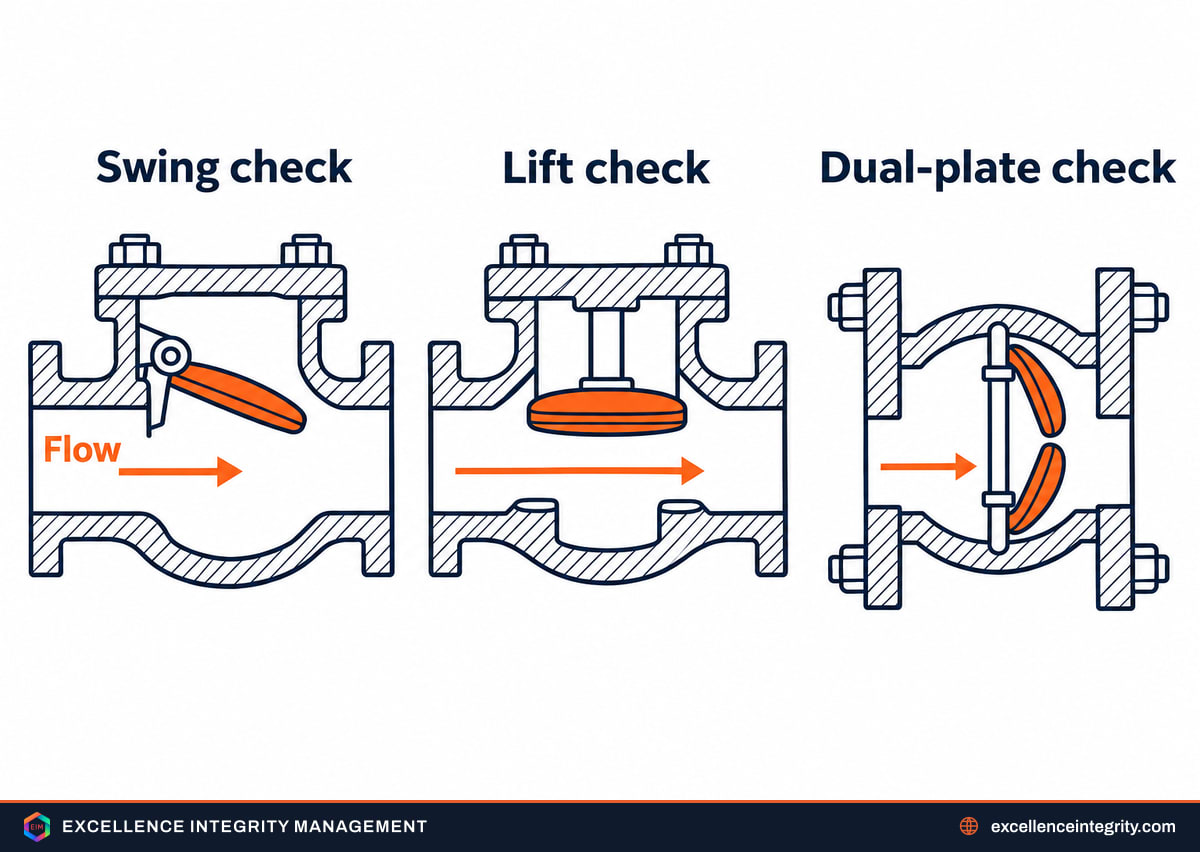
A check valve opens with forward flow and closes on its own when flow tries to reverse. There is no handwheel. They sit on pump discharges, compressor outlets, and anywhere a reverse flow could drain a system, spin a machine backwards or push one fluid into another.
| Check valve type | How it closes | Typical use and watch-out |
|---|---|---|
| Swing check | A hinged disc swings shut | General liquid service; can slam on a fast reversal |
| Lift check | A disc or piston lifts off the seat and drops back | Small-bore and higher-pressure lines; orientation matters |
| Dual-plate (wafer) check | Two spring-loaded half discs fold shut | Compact, light, fast closing; fits between flanges |
| Non-slam or nozzle check | A spring-assisted disc closes before flow reverses | Pump and compressor discharges where slam is a problem |
Check valves are the valves most often installed the wrong way round or in the wrong orientation. A check valve is also not an isolation valve: it is not designed to hold tight against pressure for maintenance, so you still need a proper isolation valve alongside it.
Special-duty valves: diaphragm, pinch and pressure relief
A diaphragm valve closes by pressing a flexible diaphragm down onto a weir. The fluid touches only the body lining and the diaphragm, which suits slurries, corrosive chemicals and water treatment, within the diaphragm's pressure and temperature limits.
Pressure relief valves are a family of their own. A pressure safety valve (PSV) opens automatically when pressure passes its set point and closes again when it falls. It is the last line of defence against overpressure, and how often it should be tested is covered in PSV inspection and test intervals. The wider system it protects is the subject of the PSV and flare system integrity programme.
How to choose between the types of valves
Once you know the job, the choice narrows quickly. This table is a starting point, not a substitute for the piping class, which sets the valve type, rating and materials for each service on a real project.
| Valve | Best at | Pressure drop open | Throttling | Typical services |
|---|---|---|---|---|
| Gate | Isolation | Very low | No | Process lines, steam, utilities |
| Globe | Regulation | High | Yes | Bypasses, drains, vents, manual control |
| Ball | Quick tight shut-off | Very low (full bore) | Limited | Hydrocarbons, gas, piggable lines |
| Plug | Shut-off in dirty service | Low | Limited | Viscous, dirty or chemical duties |
| Butterfly | Large-line isolation | Low to moderate | Some designs | Cooling water, firewater, large utilities |
| Check | Preventing backflow | Low to moderate | No | Pump and compressor discharges |
Then check three things the table does not show: the pressure-temperature rating of the body (valve ratings for flanged, threaded and welding-end steel valves are set in ASME B16.34), the end connection that matches the line, and the shut-off tightness the service needs.
What inspectors look for on valves in service
On a walkdown, valves give themselves away in a few predictable places. Stem packing weeps first, so look for staining and drips at the gland; the types of packing and how they fail are in our guide to gland packing.
Inside, seats and gates erode when a valve has been used to throttle, and the pipe just downstream of a throttling valve often thins faster than the rest of the line, so it belongs on the thickness reading list. Check valves need their orientation and flow arrow checked against the drawing.
New and repaired valves are pressure tested for shell strength and seat leakage before installation, commonly to API 598. On an operating plant the API 570 piping inspection code expects valves to be part of the piping system's inspection, not treated as a separate item that nobody owns.
Frequently asked questions
What are the main types of valves used in piping?
The main valves on process piping are gate, globe, ball, plug, butterfly and check valves, with diaphragm, pinch, needle and pressure relief valves for special duties. Gate, ball, plug and butterfly valves mostly isolate, globe and needle valves regulate, and check valves stop flow going the wrong way. The piping class sets which ones a given service uses.
What is the difference between a gate valve and a globe valve?
A gate valve slides a gate clear of the bore, so pressure drop is very low, but it should only be fully open or fully shut. A globe valve moves a disc straight onto a seat through an S-shaped path, which gives a higher pressure drop but steady, controllable throttling. Use a gate valve to isolate and a globe valve to regulate.
Which valve is best for throttling?
A globe valve is the usual manual choice for throttling, because a small movement of the disc gives a small, predictable change in flow. Needle valves do the same on small instrument lines. Automatic control valves are often globe-pattern bodies with an actuator. Gate valves should never be used to throttle, because the flow under the gate erodes the seats.
Can a check valve be used for isolation?
No. A check valve closes on its own when flow tries to reverse, but it is not designed to hold tight against pressure while a line is opened for maintenance. Fit a proper isolation valve next to it. Check valves also need the right orientation for their type, so check the flow arrow and the drawing at installation.
What to do next
Take one P&ID from your own unit and mark every valve by its job: isolate, regulate or non-return. Any gate valve on a regulating duty, or any check valve standing in as an isolation valve, is worth raising. Valves, their testing and their place in the piping inspection plan are part of the API 570 piping inspector certification preparation, and the wider fabrication and inspection life of pressure equipment is covered in the pressure vessel fabrication, inspection and lifecycle management course.
Exam preparation
Preparing for API 570?
Practise with exam-style questions, timed mocks and study notes. 1,841 questions in the bank.