Types of Pumps in Process Plants and How to Choose the Right One
The main types of pumps in process plants, centrifugal and positive displacement, where each is used and how to choose by flow, head, viscosity and duty.
By Harish Haseeb28 Nov 20269 min read
Ask a new graduate to pick a pump for a duty and they usually reach for a centrifugal pump, because that is the one they saw at university. Often that is the right answer. Sometimes it is badly wrong: a heavy crude transfer, a chemical injection skid or a sludge line will punish a centrifugal pump that was never meant for the job, and the first sign is a seal that keeps failing or a flow that will not stay put.
This post sorts the main types of pumps you meet in refineries, gas plants and utilities into their two families, says where each one earns its place, and ends with a simple way to choose between them by flow, head, viscosity and duty.
The two families: dynamic and positive displacement
Almost every pump does one of two things to the liquid. A dynamic (or rotodynamic) pump gives it velocity with a spinning impeller and then turns that velocity into pressure. A positive displacement pump traps a fixed volume of liquid and pushes it out, stroke after stroke or turn after turn.
That difference decides how the pump behaves in a real system. A centrifugal pump delivers less flow as the system pushes back harder, and it settles wherever its curve crosses the system curve. A positive displacement pump keeps delivering roughly the same flow almost whatever the discharge pressure, so the pressure simply rises until something gives. That is why a positive displacement pump always needs a relief valve on the discharge, and why you never start one against a closed valve.
| Family | How it moves liquid | Flow when the pressure rises | Typical strengths |
|---|---|---|---|
| Dynamic (centrifugal, axial, mixed flow) | Impeller adds velocity, casing converts it to pressure | Falls along the pump curve | High flow, thin liquids, smooth steady output |
| Positive displacement (reciprocating, rotary) | Traps and pushes a fixed volume | Stays roughly constant | High pressure, viscous liquids, accurate dosing |
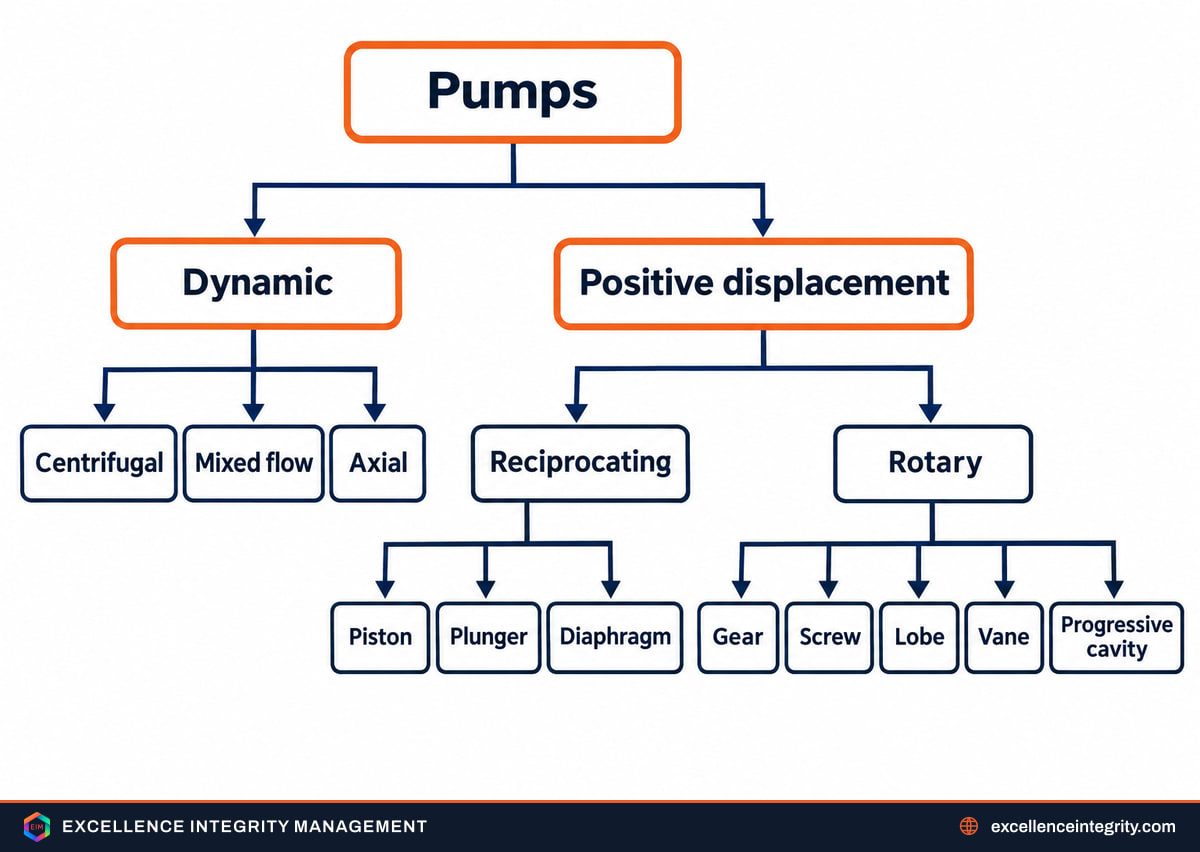
Centrifugal pumps and their variants
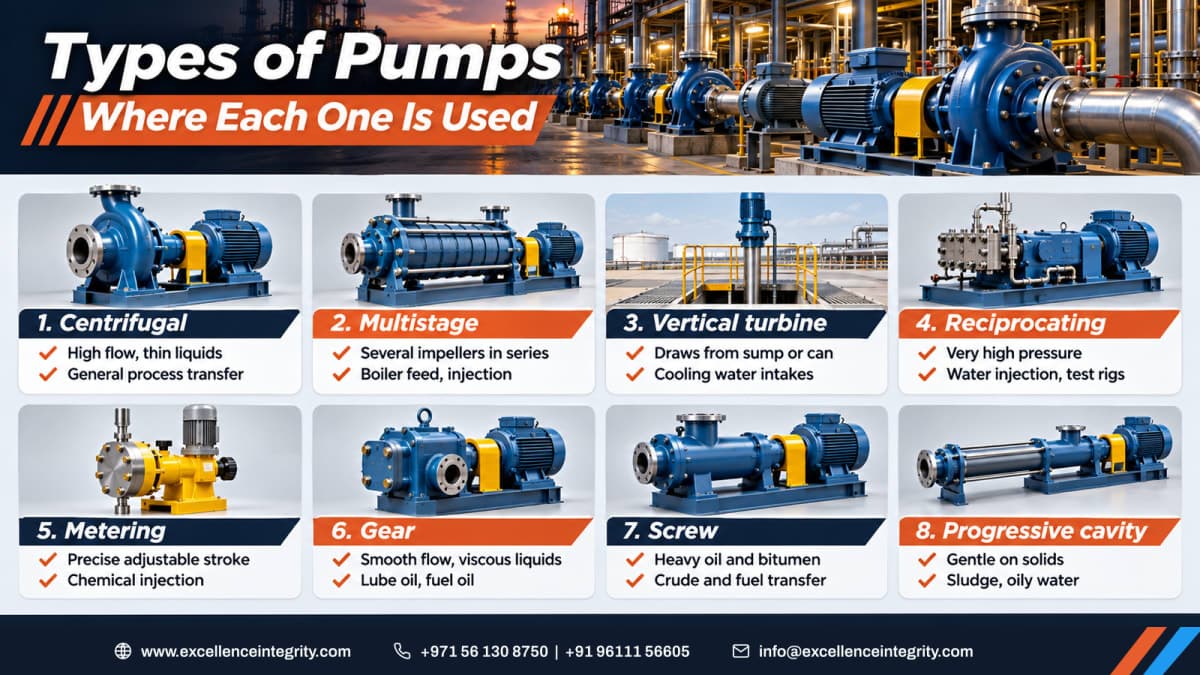
The centrifugal pump is the workhorse of the process industry. A rotating impeller flings liquid outwards into a volute or diffuser casing, and the pump is simple, compact and happy running continuously. In oil, gas and petrochemical service, heavy-duty centrifugal pumps are commonly specified to API 610 (also published as ISO 13709).
Within the family you will meet several layouts:
- Overhung, single stage: the impeller sits on the end of the shaft beyond the bearings. This is the familiar end-suction process pump on general transfer and circulation duties.
- Between bearings: the impeller is carried between two bearing housings, often with a split casing. Used for larger flows and for multistage machines.
- Multistage: several impellers in series, each adding head. Boiler feed water, pipeline and high-pressure injection duties use them.
- Vertical turbine and can pumps: long vertical machines that draw from a sump, a tank or a can sunk below grade. Useful where suction head is tight, such as cooling water intakes.
- Axial and mixed flow: the liquid leaves along or partly along the shaft line. Very large flows at low head, such as cooling water circulation.
A centrifugal pump is happiest near its best efficiency point. Run it far from that point, with too little or too much flow, and you invite recirculation, vibration and short seal and bearing life. Suction conditions matter just as much: if the liquid starts to boil in the impeller eye you get cavitation, which is explained with worked examples in pump cavitation and NPSH explained.
Reciprocating positive displacement pumps
Reciprocating pumps move liquid with a piston, a plunger or a flexing diaphragm, with check valves on the suction and discharge. They can generate very high pressures at modest flows, which is why you see plunger pumps on high-pressure water injection, glycol circulation on some gas dehydration units, and pressure testing rigs. Reciprocating process pumps for the petroleum industry are covered by API 674.
Controlled volume, or metering, pumps are a special case. A plunger or diaphragm pump with an adjustable stroke delivers a precise, repeatable volume, so it is the standard choice for dosing corrosion inhibitor, biocide, scale inhibitor or methanol. API 675 covers controlled volume pumps. Diaphragm designs keep the process liquid away from the plunger seals, which suits toxic or aggressive chemicals.
The trade-offs are pulsating flow, more wearing parts (valves, packing, plungers) and the need for pulsation dampers. They are not the pump for a large, steady flow.
Rotary positive displacement pumps
Rotary pumps trap liquid between turning parts and the casing and carry it from suction to discharge. Flow is smoother than a reciprocating pump, and they handle viscous liquids well. API 676 covers rotary positive displacement pumps for the industry. The common types are:
- Gear pumps (external or internal): lube oil systems, fuel oil and viscous chemicals.
- Screw pumps (two or three screws): heavy fuel oil, crude and bitumen, and multiphase duties in some upstream fields.
- Progressive cavity pumps: a single helical rotor in an elastomer stator, gentle on sludge, oily water and liquids carrying solids.
- Lobe and vane pumps: transfer of viscous products, loading and unloading.
- Peristaltic (hose) pumps: slurries and dosing where the liquid must only touch the hose.
Most rotary pumps rely on close clearances, so they dislike running dry and abrasive solids wear them quickly, progressive cavity and peristaltic pumps being the tolerant exceptions.
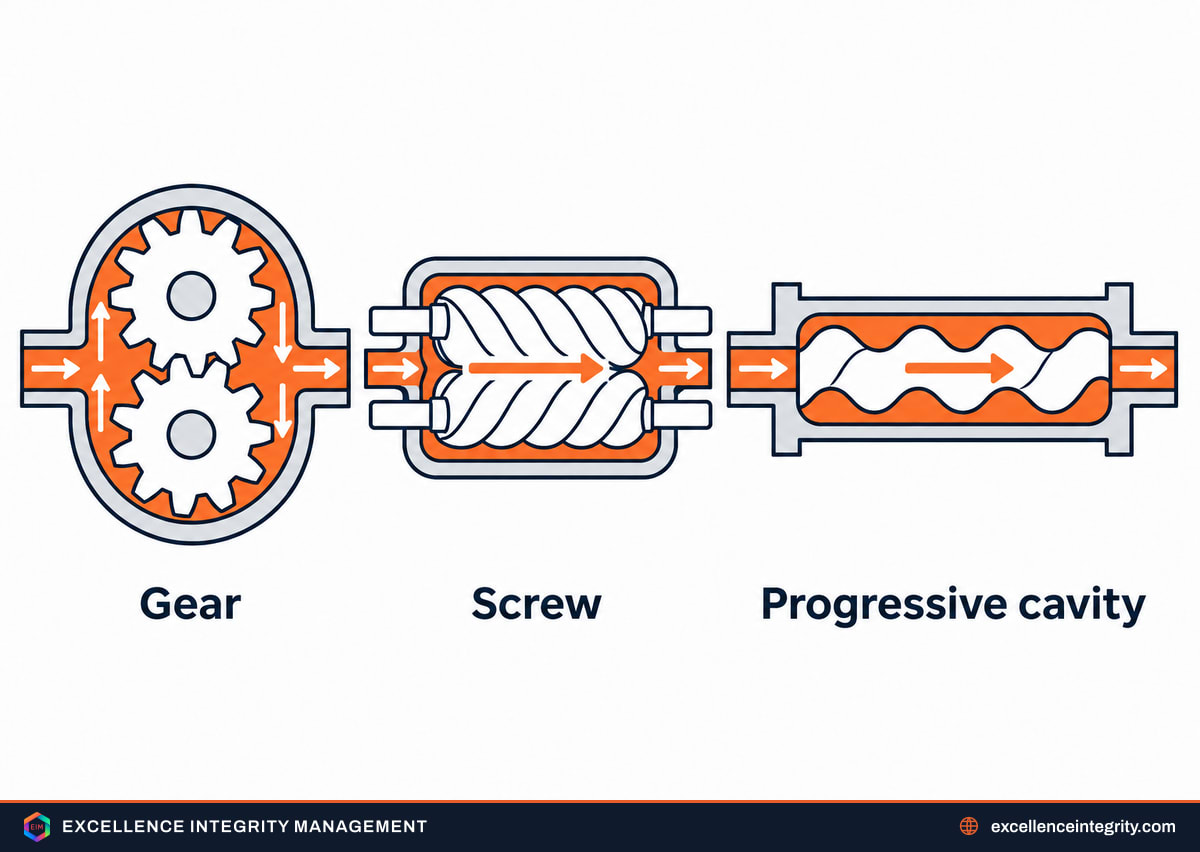
Other types of pumps worth knowing
Three more are worth recognising. Sealless pumps, either magnetic drive or canned motor, remove the shaft seal altogether and are used where any leak is unacceptable, such as toxic or very hazardous liquids; API 685 covers sealless centrifugal pumps. Regenerative turbine pumps are dynamic pumps that build a high head at low flow and tolerate some vapour. Jet pumps and eductors have no moving parts at all: a motive fluid entrains the pumped liquid, which makes them handy for sump stripping and draining.
How to choose: flow, head, viscosity and duty
Choosing between the types of pumps is mostly a matter of asking the right questions in the right order. Here is the sequence experienced engineers run through, before any vendor is called.
| Question | Points towards centrifugal | Points towards positive displacement |
|---|---|---|
| Flow | Large, steady flows | Small flows, or a flow that must stay fixed |
| Head or pressure | Low to moderate head per stage (multistage for more) | Very high pressure at modest flow |
| Viscosity | Thin liquids such as water and light hydrocarbons | Thick liquids: heavy oil, bitumen, polymers |
| Accuracy | Flow set by a control valve | Exact dosing set by stroke or speed |
| Solids or shear | Clean liquids (slurry designs exist) | Progressive cavity or peristaltic for solids and gentle handling |
| Leak consequence | Sealless versions for hazardous service | Diaphragm pumps keep the liquid off the seals |
Viscosity is the one people most often get wrong. As a liquid gets thicker, a centrifugal pump loses head, flow and efficiency, and the corrected curve can look very different from the water curve on the datasheet. A positive displacement pump does the opposite and usually works better with a thicker liquid. If your liquid is far thicker than water, ask for the viscosity correction, or ask whether a rotary pump would be the better choice.
Then check the suction side. Available NPSH must comfortably exceed what the pump needs across the whole operating range, not just at the rated point. Finally, think about spares, seal type and access: a cheaper pump that nobody can maintain is not cheaper.

Common selection mistakes
The same few errors cause most bad pump experiences:
- Sizing a centrifugal pump with a generous margin "just in case", so it spends its life throttled far left of its best efficiency point.
- Specifying a centrifugal pump for a viscous liquid using the water curve.
- Leaving out the relief valve on a positive displacement pump, or setting it where nobody can test it.
- Forgetting minimum flow protection on a centrifugal pump that may run against a closed control valve.
A pump that keeps failing is often one of these, not a bad pump. A structured root cause analysis usually finds it faster than replacing parts.
Frequently asked questions
What are the main types of pumps?
Pumps fall into two families. Dynamic pumps, mainly centrifugal, add velocity with an impeller and turn it into pressure. Positive displacement pumps trap a fixed volume and push it out, either with a reciprocating piston, plunger or diaphragm, or with rotating gears, screws, lobes, vanes or a progressive cavity rotor. Sealless, regenerative turbine and jet pumps are smaller groups.
What is the difference between a centrifugal and a positive displacement pump?
A centrifugal pump delivers less flow as the discharge pressure rises, settling where its curve meets the system curve. A positive displacement pump keeps delivering roughly the same flow almost whatever the pressure, so the pressure rises until something gives. That is why a positive displacement pump always needs a relief valve and must never start against a closed valve.
Which pump is best for viscous liquids?
Usually a rotary positive displacement pump such as a gear, screw, lobe or progressive cavity pump. As a liquid gets thicker, a centrifugal pump loses head, flow and efficiency, while a positive displacement pump usually works better. If a centrifugal pump is still considered for a thick liquid, ask the vendor for the viscosity correction rather than trusting the water curve.
Which pump is used for chemical injection?
A controlled volume, or metering, pump: a plunger or diaphragm pump with an adjustable stroke that delivers a precise, repeatable volume. It is the standard choice for dosing corrosion inhibitor, biocide, scale inhibitor or methanol. Diaphragm designs keep the chemical away from the plunger seals, which suits toxic or aggressive liquids.
What to do next
Knowing the pump families is the first step; keeping them running is where most of the work sits. The rotating equipment maintenance and troubleshooting course covers pumps alongside compressors and their seals, bearings and alignment, and rotating equipment maintenance in oil and gas gives the wider maintenance picture. If you are building a career in plant reliability, the SMRP CMRP exam preparation puts equipment knowledge like this into a maintenance and reliability framework.
Exam preparation
Preparing for SMRP CMRP?
Practise with exam-style questions, timed mocks and study notes. 1,448 questions in the bank.