Hydrogen Induced Cracking (HIC): How It Forms, Testing and Prevention
Hydrogen induced cracking explained step by step: how HIC forms in wet H2S, which steels are at risk, NACE TM0284 testing, inspection and prevention.
By Siddique28 Nov 20268 min read
Hydrogen induced cracking is one of the few damage mechanisms that can crack a steel plate with no load on it at all. The vessel can be sitting at modest pressure, the welds can be sound and the hardness can be fine, and the plate still splits inside its own wall. Nothing shows on the outside until the cracks are well advanced or a blister pushes up the surface.
This post is the deep dive on HIC alone. You will see how HIC forms step by step, which steels and services are at risk, how steel is tested for resistance before it is bought, how the damage is found in service and what actually prevents it. The wider family of wet H2S damage, including SOHIC and sulfide stress cracking, is covered in wet H2S damage explained.
What HIC is, and why it needs no stress
HIC is internal cracking of carbon and low-alloy steel caused by hydrogen gas building up inside the metal. It happens in wet hydrogen sulfide service: process water, sour water, sour gas condensate or produced water carrying dissolved H2S, in contact with the steel at temperatures where liquid water is present.
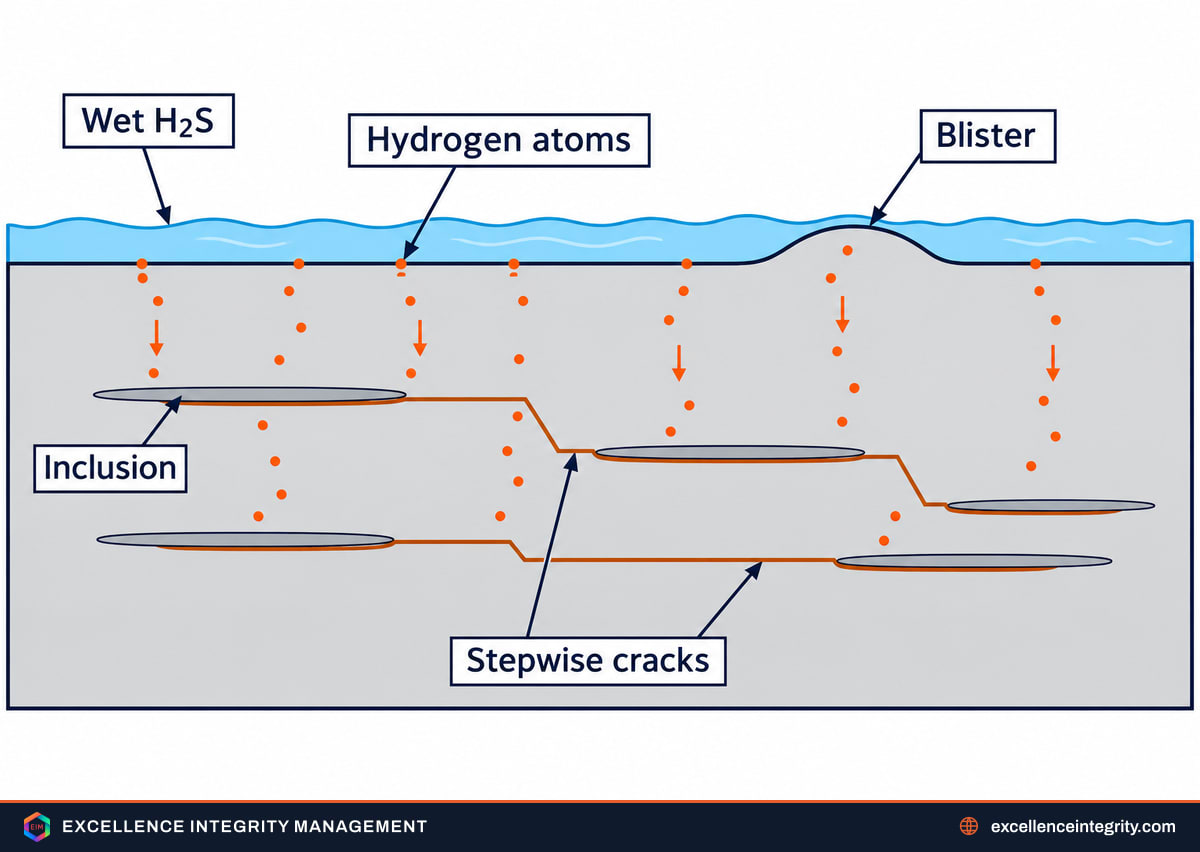
The cracks run roughly parallel to the plate surface, in the rolling direction, not through the wall like a fatigue crack. Separate cracks on slightly different planes link up through short steps, which is why HIC is also called stepwise cracking. When the same process happens close to the surface, the trapped gas lifts a dome of metal and you get a hydrogen blister. Blistering and HIC are two faces of one mechanism.
The defining point, and the one exam questions like to test, is that HIC needs no applied or residual stress. The pressure that drives the cracks comes from the hydrogen itself. That separates it from sulfide stress cracking, which needs stress and hard material, and from SOHIC, which is HIC driven by stress, usually near welds.
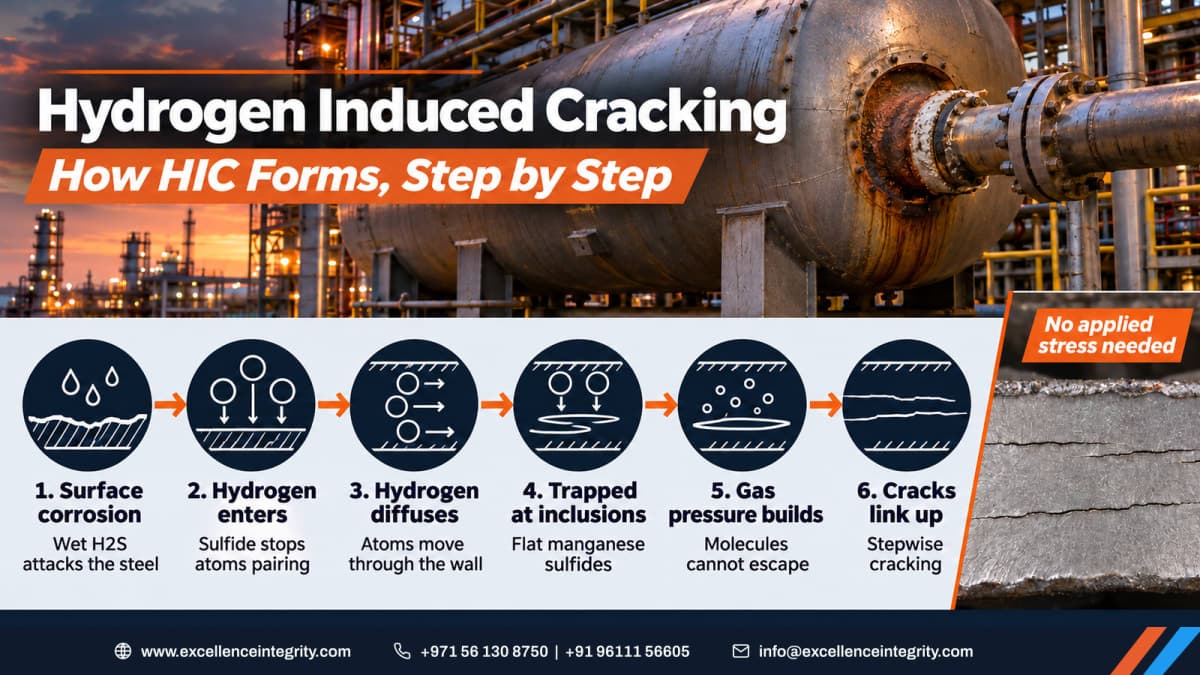
How hydrogen induced cracking forms, step by step
The sequence is worth knowing in order, because every prevention method breaks one link in it.
- Surface corrosion. Wet H2S corrodes the steel surface slowly. Iron goes into solution and hydrogen ions are reduced to hydrogen atoms at the surface.
- Hydrogen enters the steel. Normally most of those atoms pair up into hydrogen gas and bubble away. Sulfide on the surface slows that pairing, so far more single atoms soak into the metal. Cyanides, found in some refinery streams, make the charging worse.
- Hydrogen diffuses. Atomic hydrogen is small enough to move through the steel lattice and wander through the wall.
- Hydrogen gets trapped. It collects at internal discontinuities: elongated manganese sulfide inclusions, laminations, and bands of segregated material near the centre of the plate.
- Atoms become molecules. At the trap, two atoms combine into a hydrogen molecule, which is too large to diffuse back out. Pressure in the trap keeps rising as more hydrogen arrives.
- Cracks form and link. The pressure tears the metal along the inclusion, the crack grows, and neighbouring cracks join through stepwise links.
Which steels and services are at risk
Susceptibility comes mostly from the steel's cleanliness and how it was made, not from its strength or hardness. That is a real difference from sulfide stress cracking, where hardness is the first thing you check.
| Factor | Why it matters for HIC |
|---|---|
| Sulfur content | More sulfur means more manganese sulfide inclusions to trap hydrogen |
| Inclusion shape | Long, flat inclusions from rolling make ideal crack starters |
| Centreline segregation | Banded, harder material at mid-thickness concentrates cracking there |
| Product form | Rolled plate, and pipe made from plate, are the main concern |
| Water chemistry | H2S level, pH and cyanides decide how much hydrogen enters |
| Temperature | Damage is driven by liquid water, so it is a low and moderate temperature problem |
Typical places to suspect it are refinery sour water systems, amine regenerator overheads, fractionator overhead drums, FCC gas plant equipment, and sour gas and oil production lines and vessels. Old plate steels, bought before HIC-resistant grades were common, are the usual worry in older units.
How HIC resistance is tested: NACE TM0284
The established laboratory test for HIC resistance is NACE TM0284, the test method for the HIC resistance of pipeline and pressure vessel steels. NACE standards are now maintained by AMPP after the two associations merged, so you may see it under either name.
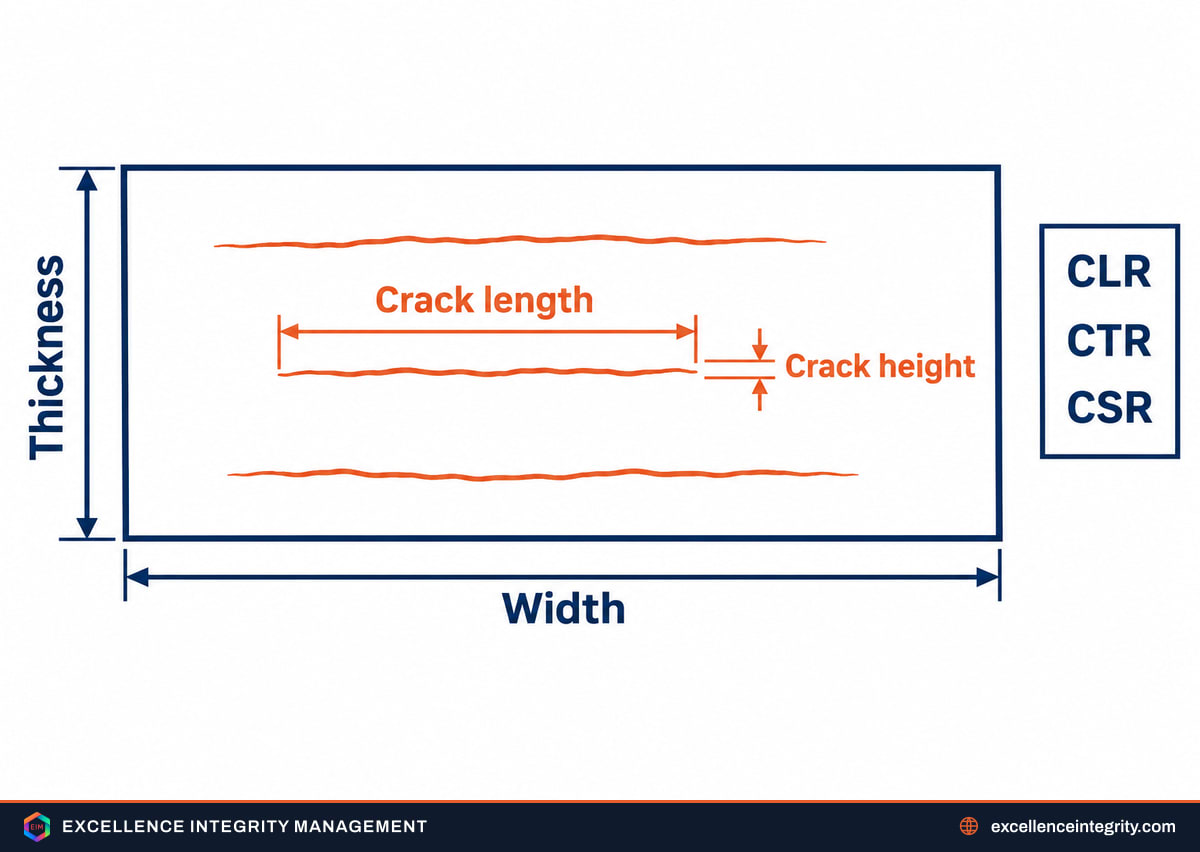
In outline, specimens cut from the plate or pipe are immersed, unstressed, in an H2S-saturated test solution for a set period. The standard offers more than one test solution, including an acidified solution and a synthetic seawater one, and the purchaser chooses which applies. The specimens are then sectioned and examined, and the cracks found on each section are measured and expressed as three ratios:
- CLR, crack length ratio: total crack length against the section width.
- CTR, crack thickness ratio: total crack height against the section thickness.
- CSR, crack sensitivity ratio: crack area against the section area.
The acceptance limits for those ratios are not fixed by the test method. They come from the purchase specification or the project's material requirements, so always read them from the document that applies to your order. A test report with ratios and no stated acceptance criteria tells you very little.
For sour service materials more broadly, NACE MR0175/ISO 15156 is the reference, and it deals mostly with sulfide stress cracking. See NACE MR0175/ISO 15156 in plain English for how that standard is organised.
How to prevent hydrogen induced cracking
Prevention works on three fronts: better steel, a barrier between steel and water, and less aggressive water.
HIC-resistant steel. This is the main defence for new equipment. Steelmakers reduce sulfur to very low levels, treat the melt with calcium so that the remaining inclusions are small and rounded instead of long and flat, and control rolling and cooling to reduce centreline segregation. The steel is then tested to TM0284 against the purchaser's acceptance limits. Specify it in the purchase order; it is not the default.
Barriers. Internal linings, coatings, and cladding or weld overlay in a corrosion-resistant alloy keep the wet H2S off the carbon steel. They only work if they stay intact, so lining and overlay condition becomes part of the inspection plan.
Process controls. Water washing dilutes the corrosive species, and in some refinery services polysulfide injection is used to deal with cyanides. Corrosion inhibitors can lower the corrosion rate at the surface and with it the hydrogen charging, though they do not make a susceptible plate safe on their own.
One common mistake: post-weld heat treatment does not prevent HIC. It reduces residual stress and hardness, which helps against SOHIC and sulfide stress cracking, but HIC does not need stress in the first place.
How HIC is found and assessed in service
Internal laminar cracking is invisible from the outside, so inspection relies on the right method in the right place.
- Visual inspection during internal entry finds blisters on the inside surface, often the first clue.
- Straight-beam ultrasonic scanning picks up cracking parallel to the surface. Mapping with automated or phased array UT shows the extent and whether cracks are stepping through the wall.
- Thickness surveys sometimes flag HIC by accident: a reading well below the expected wall, with no corrosion on the surface, can be the UT reflecting off a mid-wall crack.
- Wet fluorescent magnetic particle testing finds surface-breaking cracks near welds, which matters when HIC has developed into SOHIC.
Once damage is found, the question is whether the equipment can keep running. API 579-1/ASME FFS-1 has a dedicated part for hydrogen blisters and HIC and SOHIC damage, covering the size of the damaged area, its distance from welds and other damage, and whether cracks break the surface. The API 579-1 fitness-for-service programme works through assessments of this kind.
Frequently asked questions
What is the difference between HIC and SSC?
Both happen in wet H2S service, but HIC needs no applied or residual stress: hydrogen gas building up at inclusions drives the cracks, which run parallel to the plate surface. Sulfide stress cracking needs stress and hard material, so hardness control and PWHT help against it. HIC depends mostly on steel cleanliness and how the plate was made.
What is a HIC test?
A HIC test, normally to NACE TM0284, exposes unstressed specimens of plate or pipe to an H2S-saturated solution for a set period. The specimens are then sectioned, and the cracks are measured as crack length, thickness and sensitivity ratios. The acceptance limits come from the purchase specification, not from the test method itself.
Does PWHT prevent hydrogen induced cracking?
No. Post-weld heat treatment lowers residual stress and hardness, which helps against SOHIC and sulfide stress cracking, but HIC does not need stress. The pressure that drives it comes from hydrogen trapped inside the steel. HIC-resistant steel, linings or cladding, and less aggressive process water are what prevent it.
What makes a steel HIC-resistant?
Very low sulfur, calcium treatment that leaves small rounded inclusions instead of long flat ones, and controlled rolling and cooling that reduce centreline segregation. Those changes remove the traps where hydrogen collects. The steel is then tested to TM0284 against the purchaser's acceptance limits, so it has to be specified in the order.
What to do next
If your unit runs wet H2S, start by finding out which equipment was bought as HIC-resistant and which was not; that list is the backbone of a sensible inspection plan. HIC sits alongside related hydrogen mechanisms such as hydrogen embrittlement, and telling them apart is a core skill in the API 571 corrosion and materials certification preparation.
Exam preparation
Preparing for API 571?
Practise with exam-style questions, timed mocks and study notes. 3,357 questions in the bank.