Types of Agitators and How to Choose One by Flow Pattern
Types of agitators explained: propeller, turbine, pitched blade, anchor, helical ribbon and more, how to choose by flow and viscosity, and what to check.
By Harish Haseeb25 Nov 20269 min read
An agitator looks simple: a motor, a gearbox, a shaft and some blades in a tank. Yet a badly chosen one shows up everywhere. Solids settle in one corner, a batch takes twice as long to blend, a heat-transfer jacket fouls because the product near the wall never moves, or a perfectly good mechanical seal keeps failing because the shaft is whipping.
This post covers the main types of agitators used in chemical, petrochemical, water treatment, paint and food plants, and what each one actually does to the liquid. More usefully, it shows how to narrow the choice by flow pattern and viscosity, what tends to go wrong in service, and what a maintenance team should check on its rounds.
Start with the flow pattern, not the impeller name
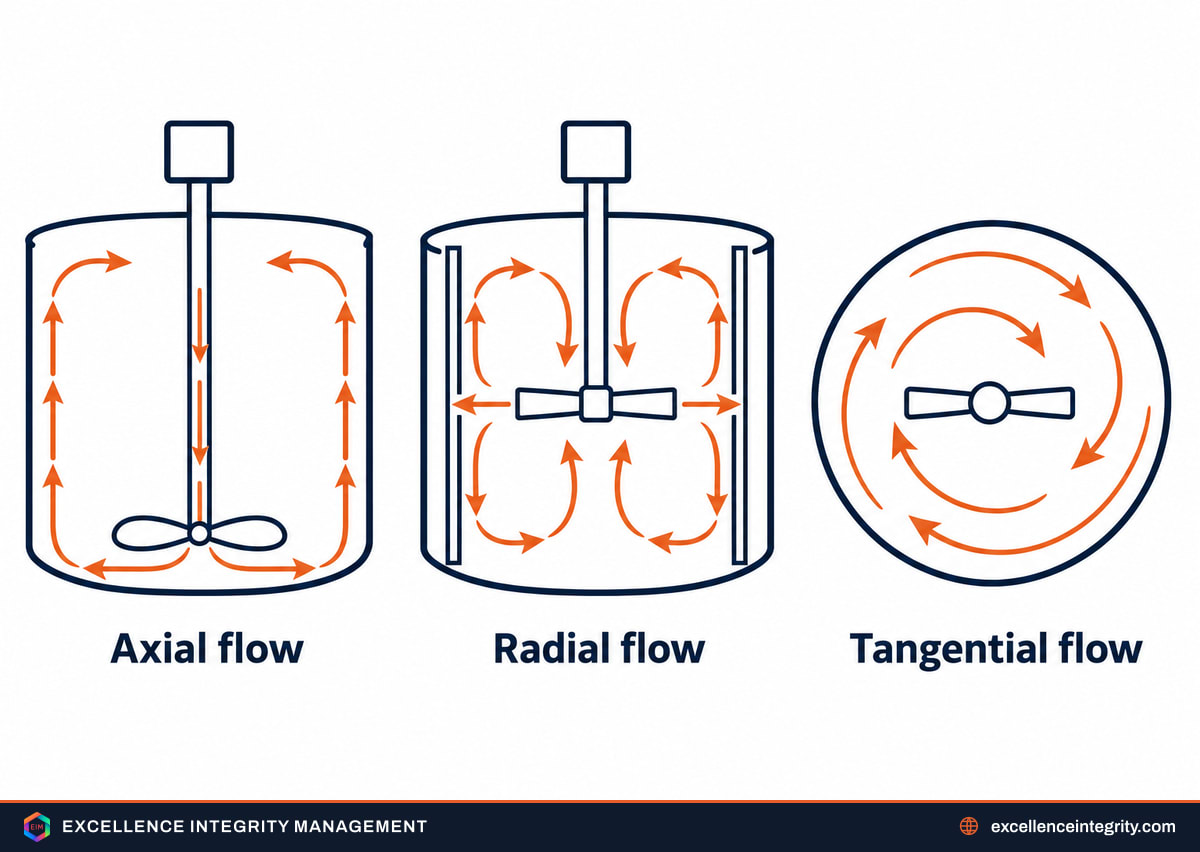
Every agitator moves liquid in one of three basic ways, and the impeller names make more sense once you know which way each one works.
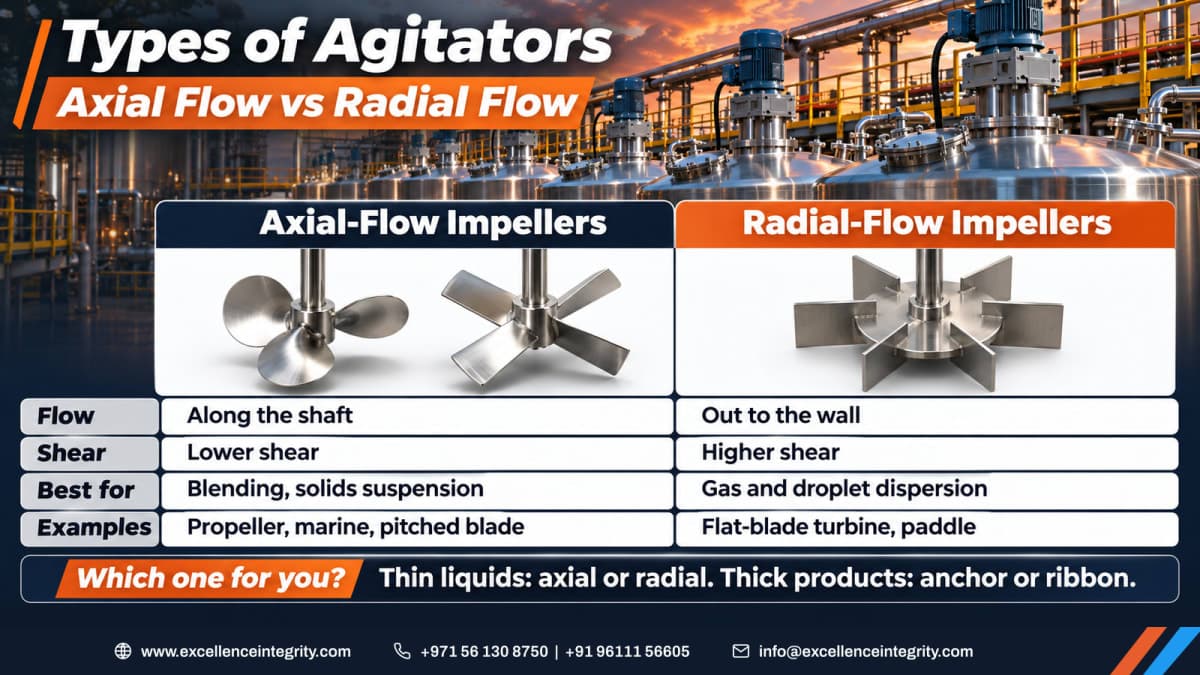
Axial flow pushes liquid along the shaft, usually down towards the tank bottom, where it turns and rises up the walls. It gives good top-to-bottom circulation for the power used, which suits blending and keeping solids off the floor.
Radial flow throws liquid outwards from the impeller towards the wall, where it splits into two loops, one above the impeller and one below. It creates more shear near the blades, which helps when you need to break up gas bubbles or droplets.
Tangential flow moves liquid round the tank with the blades, like stirring a cup. On its own it mixes poorly in thin liquids, which is why baffles are fitted to break the swirl. In thick products, slow close-clearance impellers use this sweeping motion deliberately to keep material moving at the wall.
Axial-flow agitators: propeller, marine and pitched blade
Propeller agitators give mainly axial flow along the shaft and rapid circulation at fairly high speed. They are a common choice for thin liquids in small and medium tanks, often mounted at an angle or off-centre in smaller vessels.
Marine agitators are a form of propeller with blades shaped like a ship's screw. They give efficient axial circulation, and how well they do depends on blade pitch, diameter, speed and the tank geometry, so a marine impeller moved to a different tank will not necessarily behave the same.
Pitched blade turbines have flat blades set at an angle, usually in four- or six-blade versions. The angle gives a combined axial and radial flow, which makes them one of the most versatile general-purpose choices for blending, solids suspension and heat transfer.
Radial-flow and shear agitators: paddle, turbine, retreat curve and high shear
Paddle agitators are the simplest: two or more flat blades turning at low to moderate speed. They give radial or tangential flow and are used when intense shear is not needed, for gentle mixing or keeping a product moving.
Turbine agitators give radial or axial flow depending on the blade shape. A flat-blade turbine is the classic radial impeller, used where controlled mixing intensity, dispersion and mass transfer matter, such as feeding gas into a liquid.
Retreat curve impellers have backward-curved blades, a design long used in glass-lined reactors. In suitable conditions they give favourable hydraulics at relatively low power.
High shear mixers are a different animal. A rotor turns inside a close-fitting stator, creating intense local velocity gradients that give a much finer dispersion of droplets or particles. They are used for emulsions and dispersing powders, not for moving the whole tank, and they are often paired with a slower bulk agitator.
Close-clearance agitators for viscous products
As viscosity rises, an axial or radial impeller stops pushing the whole tank. It moves the liquid close to the blades and leaves the rest almost still. That is where wall-sweeping designs take over.
Anchor agitators have blades shaped to the tank bottom and walls, sweeping close to the wall. They improve bulk circulation, reduce stagnant regions and help heat transfer through a jacket. Wall-scraping elements can be added where product builds up on the wall.
Gate agitators are a framed version, with gate-style blades that sweep a large part of the tank cross-section. How well they mix depends on the clearance, the geometry and the speed.
Helical ribbon agitators use one or two ribbons wound around the shaft close to the wall. They move material along the wall and back through the centre, and the close wall clearance cuts down poorly mixed zones. They are a common answer for pastes and very thick liquids.
Helical screw agitators use helical flights on the shaft to give axial movement, often inside a draft tube. The pumping direction depends on the hand of the helix and the direction of rotation, so a reversed motor connection after maintenance reverses the flow.
Helical anchors combine an anchor's wall coverage with a helical element that adds top-to-bottom flow. Their performance depends on the actual blade design and the product viscosity.
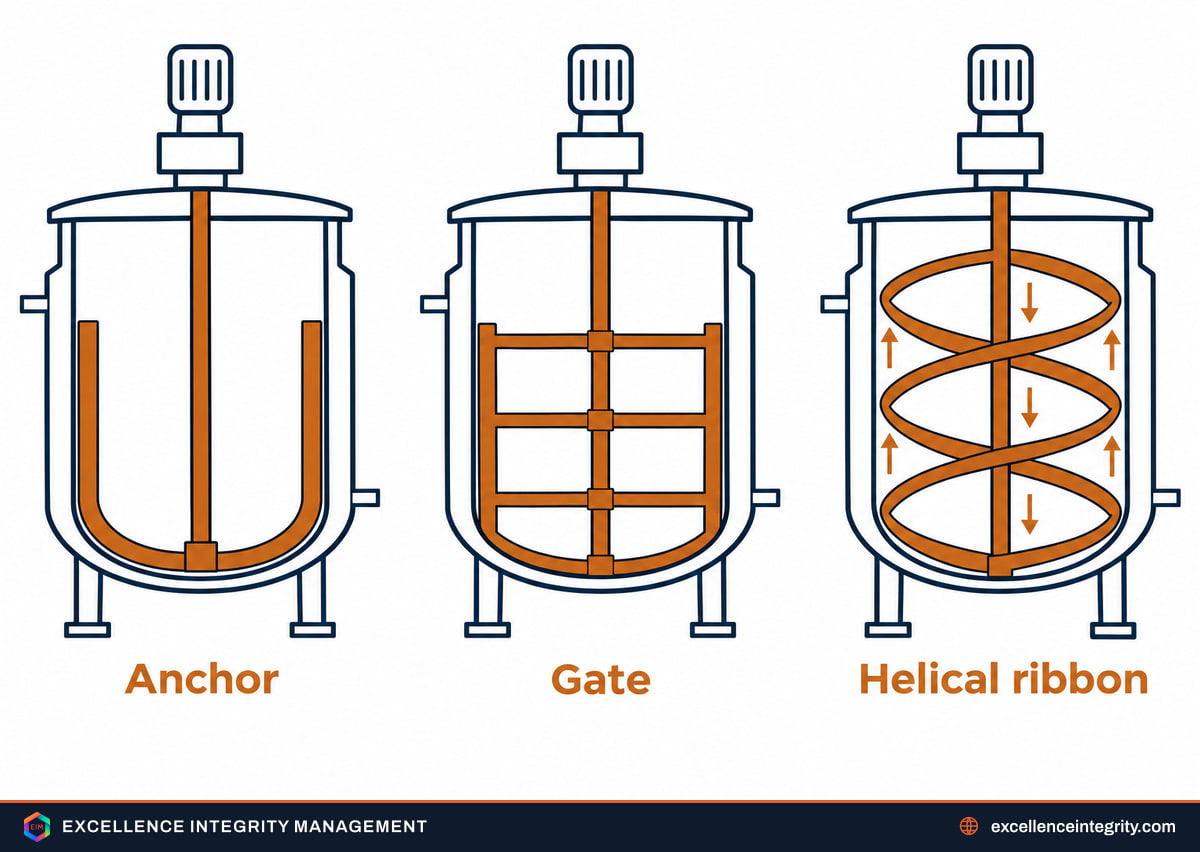
How to choose between the types of agitators
Real selection is done with the process duty, the tank drawing and the supplier's calculations. As a general rule of thumb, though, the first cut of agitator types and uses looks like this:
| Duty | Usually starts with | Why |
|---|---|---|
| Blending thin liquids | Propeller, marine, pitched blade | Good circulation for the power |
| Keeping solids suspended | Pitched blade, marine | Axial flow sweeps the tank floor |
| Gas dispersion, mass transfer | Flat-blade turbine | Radial flow and shear at the blades |
| Emulsions, fine dispersion | High shear rotor-stator | Intense local shear |
| Gentle mixing, low shear | Paddle, retreat curve | Moves product without damaging it |
| Viscous products, jacket heat transfer | Anchor, gate, helical ribbon, helical anchor | Sweeps the wall, reduces dead zones |
Two questions sharpen it. First, does the viscosity change during the batch? A product that starts thin and thickens may need a combination, such as an anchor with a faster inner impeller. Second, is the tank baffled? Thin liquids in an unbaffled tank tend to swirl and form a vortex instead of mixing, while close-clearance agitators in viscous service often run without baffles.
What goes wrong with agitators in service
Most agitator failures are mechanical, and most of them start at the shaft. A long shaft carrying an impeller at its end acts like a lever, so imbalance or a hydraulic load on the blades shows up as bending at the seal and bearings.
- Shaft seal and gland leakage, often a symptom of shaft run-out rather than a seal fault. See types of gland packing for the packed version.
- Bearing and gearbox wear from overhung loads, wrong oil or contaminated oil.
- Shaft deflection or whip, especially with long shafts or when running through a low liquid level.
- Imbalance from a bent, eroded or fouled blade, or one lost blade.
- Blade erosion and corrosion in abrasive slurries or aggressive chemistry.
- Fouling build-up on blades and walls, which adds weight and kills mixing.
- Loose hubs and keys; worn keyways are covered in types of shaft keys.
- Baffle problems: cracked welds, loose clips or baffles that were removed and never refitted.
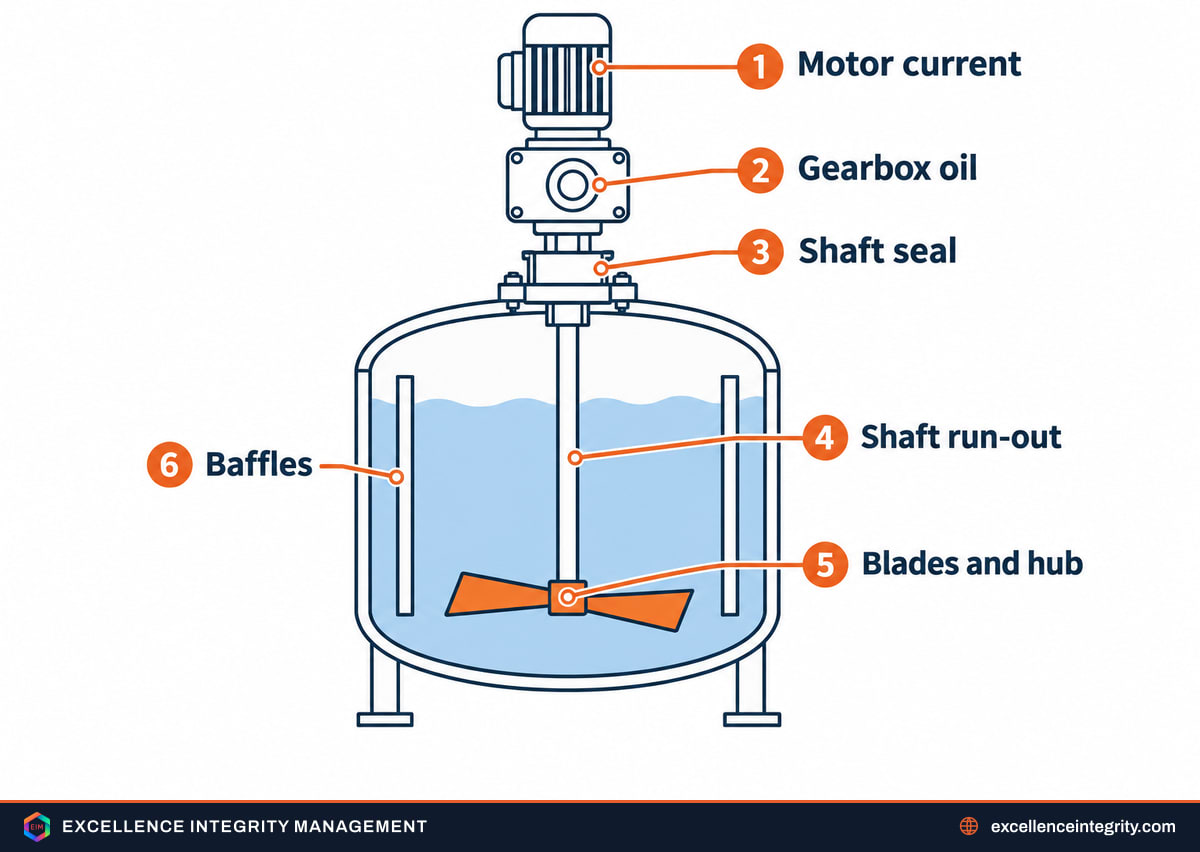
What to check on your rounds
The useful checks are quick. Trend vibration at the gearbox and motor. Watch motor current: a steady rise can mean thickening product or fouling, and a sudden drop can mean a lost blade or a broken coupling. Look at the seal for weeping and the shaft for visible run-out. Check gearbox oil level and condition. At shutdowns, inspect the blades, hubs, keys and baffles, and measure shaft run-out against the manufacturer's limits.
Also confirm the operating instructions give a minimum liquid level for running, and that operators follow it. Running an impeller while it breaks the surface is one of the quickest ways to bend a shaft.
Keep a simple record for each agitator: run-out readings, seal changes, gearbox oil results and blade condition at every opening. When the same seal fails three times in a year, that history is what tells you the real cause is a bent shaft or a worn steady bearing, not the seal supplier. It also tells you when a blade is losing metal steadily, so a replacement can be planned for the next shutdown instead of found during one.
Frequently asked questions
What are the different types of agitators?
They are easiest to group by flow. Axial-flow types are the propeller, marine and pitched blade turbine. Radial-flow and shear types are the paddle, flat-blade turbine, retreat curve and high shear rotor-stator. Close-clearance types for viscous products are the anchor, gate, helical ribbon, helical screw and helical anchor.
What is the difference between an axial flow impeller and a radial flow impeller?
An axial flow impeller pushes liquid along the shaft, usually down to the tank bottom and back up the walls, giving good circulation for blending and solids suspension. A radial flow impeller throws liquid outwards to the wall in two loops, with more shear at the blades, which helps break up gas bubbles or droplets.
Which agitator is best for high viscosity liquids?
A close-clearance design that sweeps the wall, because an axial or radial impeller only moves the liquid near its blades once viscosity rises. Anchors and gates suit thick products and jacket heat transfer, while helical ribbons are a common answer for pastes and very thick liquids. A product that thickens during the batch may need a combination.
Why are baffles used in an agitator tank?
To break the swirl. In thin liquids an impeller tends to spin the whole contents round the tank like stirring a cup, which forms a vortex and mixes poorly; baffles turn that motion into real circulation. Close-clearance agitators in viscous service often run without baffles, and a baffle removed and never refitted is a common fault.
Next steps
Whichever of the types of agitators you run, they reward the same habits as any rotating machine: trend the basics, find the root cause of repeat failures and do not just replace the seal again. The rotating equipment maintenance and troubleshooting course covers that approach in depth, and the SMRP CMRP exam preparation places it within maintenance and reliability management as a whole. If you are setting up condition monitoring and failure analysis across a whole site rather than one tank, the reliability and asset integrity programme is the wider view.
Related reading: Types of Bearings, Their Lubrication and Common Failures, Types of Oil Seals and Their Uses: A Maintenance Guide, Types of Couplings and Their Uses: How to Choose and Inspect Them, Shaft Alignment Tools and Methods: From Straight Edge to Laser.
Exam preparation
Preparing for SMRP CMRP?
Practise with exam-style questions, timed mocks and study notes. 1,448 questions in the bank.