Heat Exchanger Selection: How to Choose the Right Type
Heat exchanger selection made practical: the questions that decide the type, twelve types compared by service and fouling, and a simple order of thinking.
By Syed Hasan24 Nov 20268 min read
Ask which heat exchanger is best and the honest answer is "for what?". A shell and tube unit that is perfect for a high-pressure refinery service can be oversized and awkward for a food plant, and a plate exchanger that is ideal on clean water can block in weeks on a dirty slurry. Choosing the type is a trade-off, and the trade-off is different for every duty.
This post is a heat exchanger selection guide. It sets out the questions that decide the type, compares the common types on the points that matter, and gives a simple order of thinking on how to choose a heat exchanger before you talk to a designer or vendor. If you want the parts of a shell and tube exchanger, or how fouling builds up, those have their own posts linked below; here the question is only which type, and why.
First, size the job: the duty
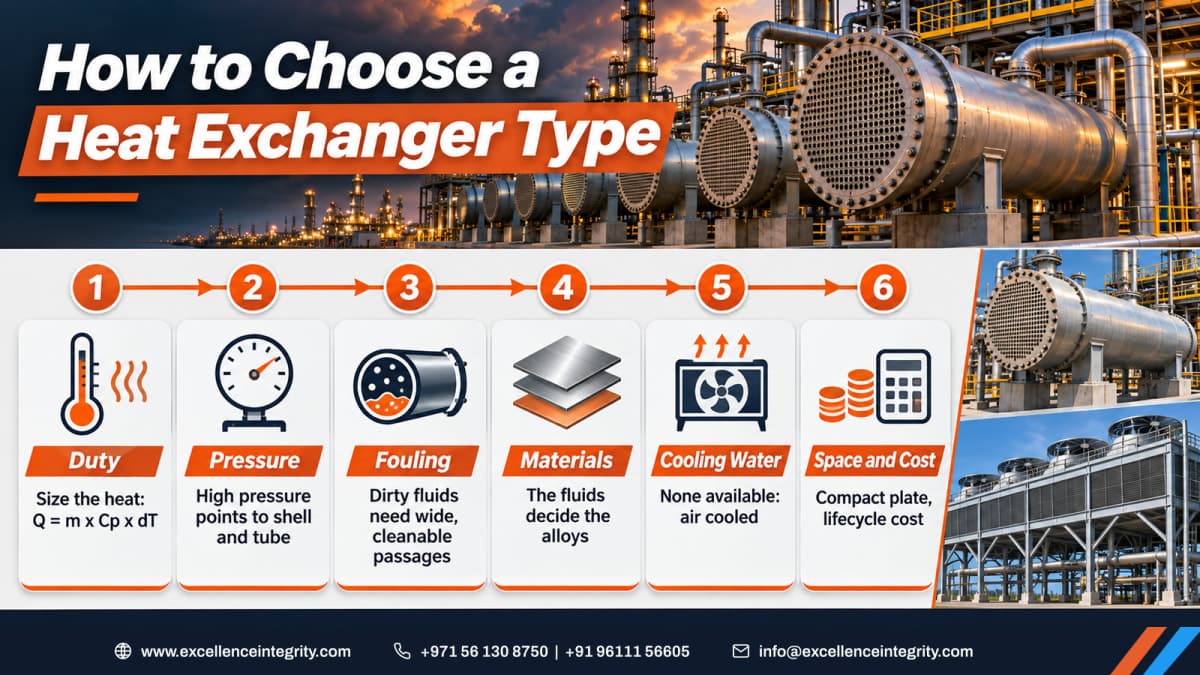
Every selection starts with the duty, the heat that must move from one fluid to the other. For a fluid that only changes temperature, the heat exchanger duty calculation is:
Q = m x Cp x dT, where Q is the duty in kW, m is the mass flow in kg/s, Cp is the specific heat in kJ/kg.K and dT is the temperature change in K.
A worked example: cooling 10 kg/s of water (Cp about 4.18 kJ/kg.K) by 20 K needs a duty of 10 x 4.18 x 20 = 836 kW. The exchanger then has to provide enough surface to move that heat, from Q = U x A x LMTD: U is the overall heat transfer coefficient, A the area and LMTD the log mean temperature difference between the fluids. Types differ in how much U they achieve and how much area they can pack into a given space, which is a large part of why one type beats another for a given job.
Heat moves by conduction through the wall and by convection in each fluid, with radiation important mainly in fired equipment. A type that keeps fluid velocity high near the wall usually achieves a higher U.
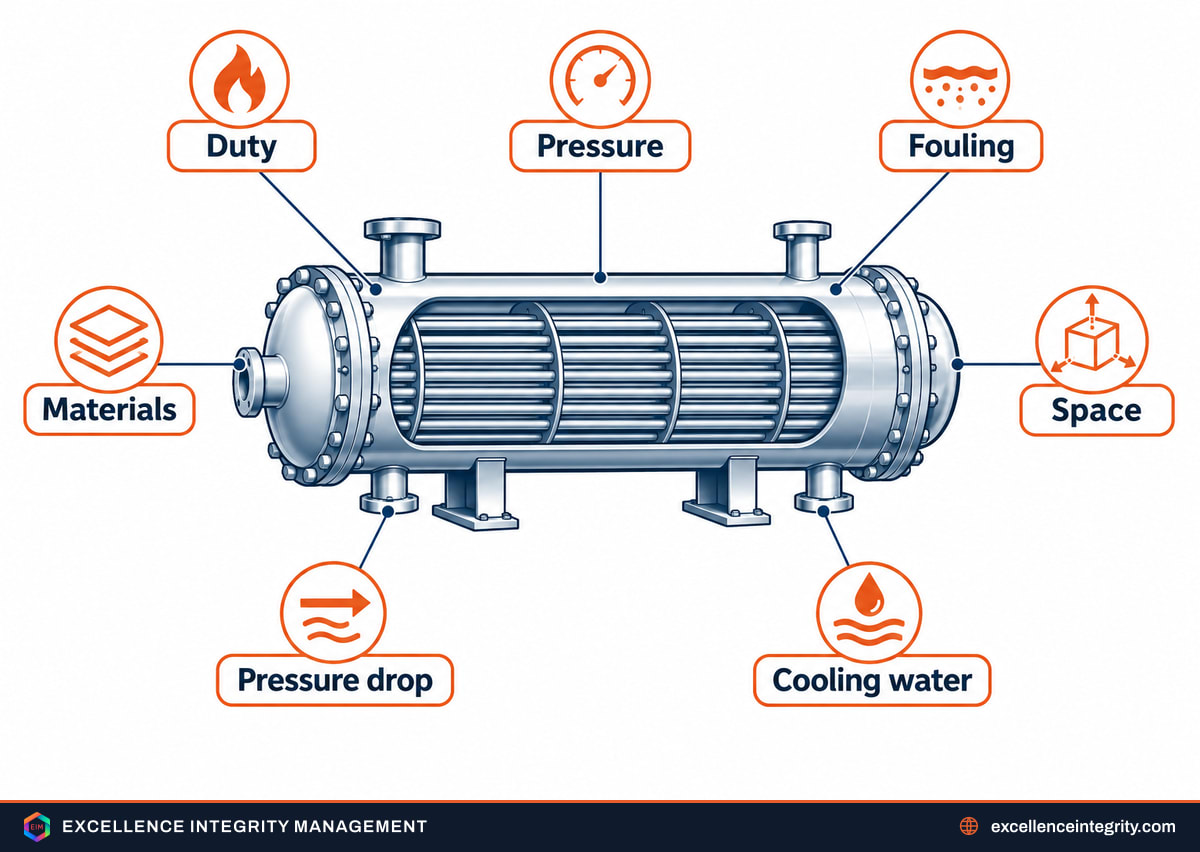
Heat exchanger selection: the questions that decide the type
- Duty and temperatures. How much heat, and how close do the outlet temperatures need to come to each other? A close approach favours types with true counter-current flow, such as plate and double pipe.
- Design pressure and temperature. High pressure pushes toward shell and tube, double pipe or, for very high pressure in compact form, printed circuit exchangers. Gasketed plate units are limited by their gaskets.
- Fouling and cleaning. Dirty, viscous or crystallising fluids need wide passages and access for cleaning: spiral, scraped surface, or a shell and tube unit with the dirty fluid on the tube side. Narrow-channel types need clean fluids.
- Corrosion and materials. The fluids decide the materials. Some types are easy to make in special alloys; others are only practical in a few.
- Allowable pressure drop. A higher pressure drop allowed means higher velocities, better heat transfer and less fouling, at the cost of pumping power.
- Is cooling water available? If not, or if it is scarce or of poor quality, air-cooled exchangers become the natural choice.
- Space, weight and cost. Offshore and remote sites value compact, light designs. Lifecycle cost, including cleaning and downtime, matters as much as purchase price.
- Codes and standards. Pressure equipment is designed to codes such as ASME BPVC Section VIII, with TEMA standards widely used for shell and tube construction. In the petroleum and process industries, API 660 covers shell and tube and API 661 air-cooled exchangers.
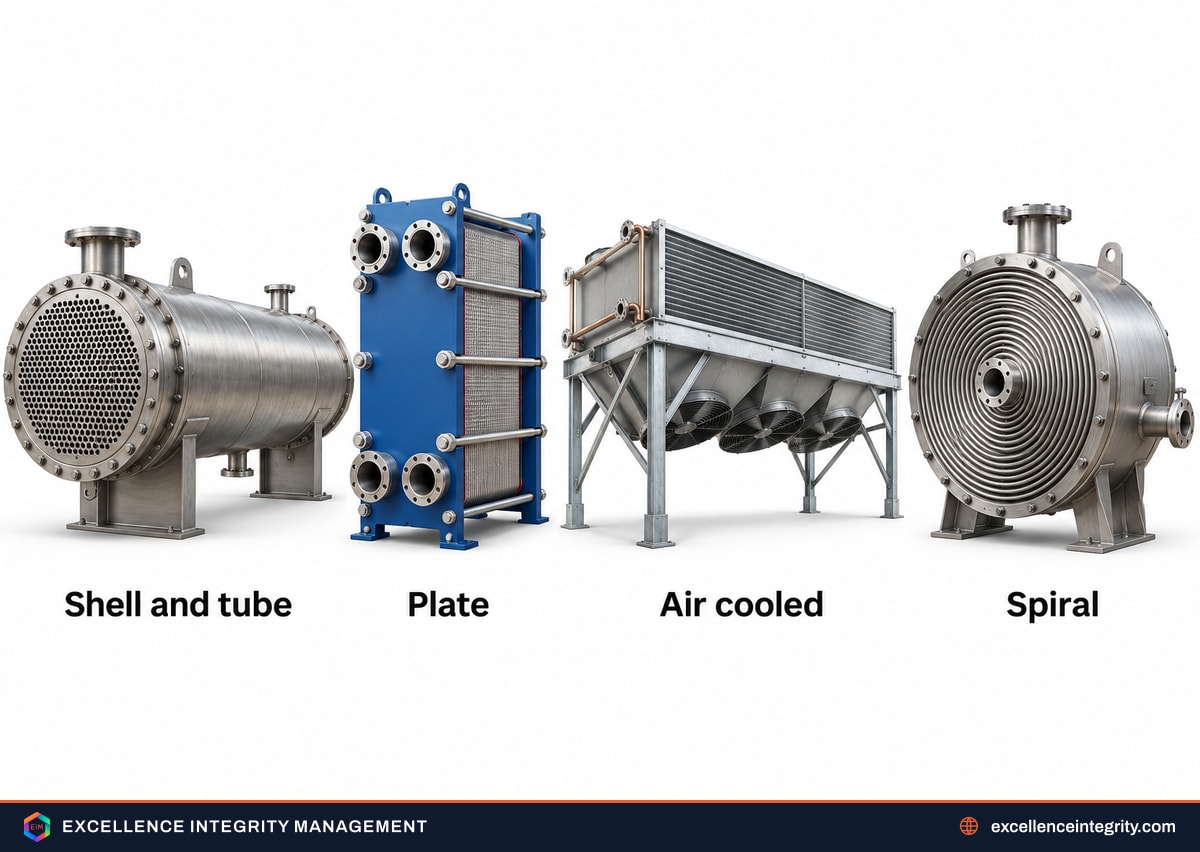
The twelve common types compared
| Type | Typical services | Handles dirty fluids? | Main reason to choose it |
|---|---|---|---|
| Shell and tube | Refineries, condensers, boilers, chemical plants, cooling | Moderately, with the dirty fluid in the tubes | High pressure and temperature, durable, cleanable, well understood |
| Plate | HVAC, district heating, food, pharma | Poorly | High efficiency and close approach in a small space |
| Double pipe | Small processes, oil heating, pilot plants | Reasonably | Simple, true counter-flow, small duties |
| Finned tube | Air coolers, radiators, refrigeration | Gas side needs clean air | Extended surface where one fluid is a gas |
| Air cooled | Refineries, gas plants, compressor stations, remote sites | Tube side, moderately | No cooling water needed |
| Spiral | Wastewater, sludge, viscous fluids | Well | Single channel resists fouling and self-scours |
| Plate-fin | Cryogenic, LNG, aerospace, compact gas service | No | Very high area per volume |
| Shell and coil | Thermal storage, water and process heating, refrigeration | Shell side, moderately | Simple coil in a vessel |
| Scraped surface | Viscous or crystallising products | Yes, by design | Scrapers keep the surface clear |
| Printed circuit (PCHE) | Supercritical CO2, advanced power cycles, hydrogen | No | Very high pressure in a compact block |
| Bayonet | Specialised heating, waste-heat recovery | Varies | Nested tubes for particular thermal layouts |
| Regenerative | Furnaces, glass, gas turbines, air preheaters | Depends on the matrix | Thermal mass stores and returns heat |
Treat this heat exchanger types comparison as a starting point. "Handles dirty fluids" is a rough guide to how forgiving each type is, not a rating. The real answer depends on the fluid, the velocity and how often you can clean.
A simple order of thinking
When the list of types feels long, these steps narrow it quickly:
- Is one fluid a gas at low pressure? Start with finned tube or air-cooled designs, or plate-fin for compact clean gas service.
- Is the pressure or temperature high? Start with shell and tube; look at PCHE only for very high pressure in limited space.
- Are both fluids clean and the pressure moderate? A plate exchanger will usually be the most compact and efficient.
- Is a fluid dirty, viscous or crystallising? Look at spiral or scraped surface designs, or shell and tube with good cleaning access.
- Is the duty small? Double pipe or shell and coil may be all you need.
- Is there no cooling water? Air cooled.
Then check the shortlist against materials, pressure drop, space and lifecycle cost, and take it to the designer or vendor with the full process data.
Do not forget maintenance when you choose
The type you pick decides how the exchanger will be looked after for its whole life. Ask, before buying, how the unit will be cleaned, how tubes or plates will be inspected, and how much downtime that needs. In service, the routine is similar for most types: monitor temperatures, flows, pressure drop and duty; inspect for leakage, corrosion, erosion, vibration and gasket deterioration; clean fouled surfaces; and trend thermal performance so you clean on evidence, not on a calendar. Air coolers add fan, motor current, vibration and fin cleanliness to the list.
Safety points apply to every type: isolate, verify zero pressure, lock out and let hot equipment cool before opening; protect against thermal expansion, water hammer, overpressure and cross-contamination between fluids; make sure relief protection is in place; and carry out a site risk assessment for hazardous services.
There is no universal best
Good heat exchanger selection finds the exchanger that balances duty, pressure drop, fouling, material compatibility, safety, maintainability and lifecycle cost for your specific service. Shell and tube remains the default in refining because it covers the widest range of pressures and temperatures and is easy to clean and inspect, but it is a starting point, not an automatic answer.
Frequently asked questions
What factors affect heat exchanger selection?
The duty and how close the outlet temperatures must come, design pressure and temperature, how dirty the fluids are and how they will be cleaned, corrosion and materials, allowable pressure drop, whether cooling water is available, space, weight and lifecycle cost, and the codes that apply. Together they usually leave a short list to take to a designer or vendor.
Shell and tube vs plate heat exchanger: which is better?
Neither in general. A plate exchanger gives high efficiency and a close approach in a small space, but it needs clean fluids and moderate pressure, because its gaskets limit it. Shell and tube handles high pressure and temperature, is durable and cleanable, and copes better with a dirty fluid on the tube side, which is why it stays the default in refining.
When should you use an air cooled heat exchanger?
When cooling water is not available, is scarce or is of poor quality, which is common at gas plants, compressor stations and remote sites. An air cooler needs no cooling water, but its maintenance adds fan, motor current, vibration and fin cleanliness checks to the usual routine. In the petroleum and process industries, API 661 covers air-cooled exchangers.
How do you calculate heat exchanger duty?
For a fluid that only changes temperature, multiply the mass flow by the specific heat and the temperature change: Q = m x Cp x dT. Cooling 10 kg/s of water by 20 K needs 10 x 4.18 x 20 = 836 kW. The surface needed then follows from Q = U x A x LMTD.
Where to go from here
For how the common types are used across oil and gas, see heat exchangers in oil and gas. The components of the most common type are covered in inside a shell and tube heat exchanger, and the problem that drives most cleaning in heat exchanger fouling. For inspection and maintenance skills, the heat exchanger inspection and maintenance course and the heat exchanger integrity and tube bundle assessment programme go further. Exchanger shells are pressure vessels, so the API 510 pressure vessel inspector preparation also applies.
Exam preparation
Preparing for API 510?
Practise with exam-style questions, timed mocks and study notes. 2,549 questions in the bank.