API 653 Tank Bottom Repairs and the Critical Zone
How API 653 governs tank bottom repairs: welded-on patches, the 3 in critical zone, tombstone patches, plate replacement, annular plates, new bottoms.
By Syed Hasan17 Nov 20264 min read
When an internal inspection finds bottom damage, the next question is how to repair it. API 653 9.10 gives a set of options, from a small welded-on patch to a complete new bottom, and one area gets special treatment: the strip of bottom plate right next to the shell, called the critical zone. This guide explains the options, the critical zone rules, and where annular plates fit in.
Short answer: Away from the shell, small damage can be repaired with welded-on patch plates sized and spaced from existing laps and seams as API 653 Figure 9.13 shows. The critical zone, within 3 in of the inside of the shell, allows only limited, specially detailed patches; more extensive damage there means cutting out and replacing the bottom plate, including a length of the shell-to-bottom weld. Annular plates have their own minimum thickness rules.
The critical zone
API 653 defines the critical zone as the part of the bottom or annular plate within 3 in of the inside edge of the shell, measured radially inward. Earlier editions used a much wider zone. This strip carries the bending and restraint from the shell-to-bottom joint, so repairs there must preserve its flexibility and avoid adding stress raisers.
- No ordinary lap patches or welded attachments inside the critical zone.
- Limited patch plates are allowed there under specific conditions, with a maximum width and minimum spacing between patches, and with examination of the existing shell-to-bottom weld nearby.
- More extensive damage means cutting out the bottom plate welded to the shell and installing a new one, with the shell-to-bottom weld removed and replaced for at least 12 in on each side of the new plate.
Welded-on patch plates outside the critical zone
For isolated damage away from the shell, a welded-on (lap) patch plate is the usual repair. API 653 Figure 9.13 sets the details. In our summary of the main points:
- Minimum size: 12 in where the patch overlaps a bottom seam or an existing patch; 6 in where it does not.
- Spacing: minimum distances from existing lap welds, three-plate laps and other patches.
- Crossing seams: patches that cross existing lap welds must meet extra conditions on angle and extension.
- Testing: new bottom welds are tested, typically by vacuum box or tracer gas.
Choosing a bottom repair
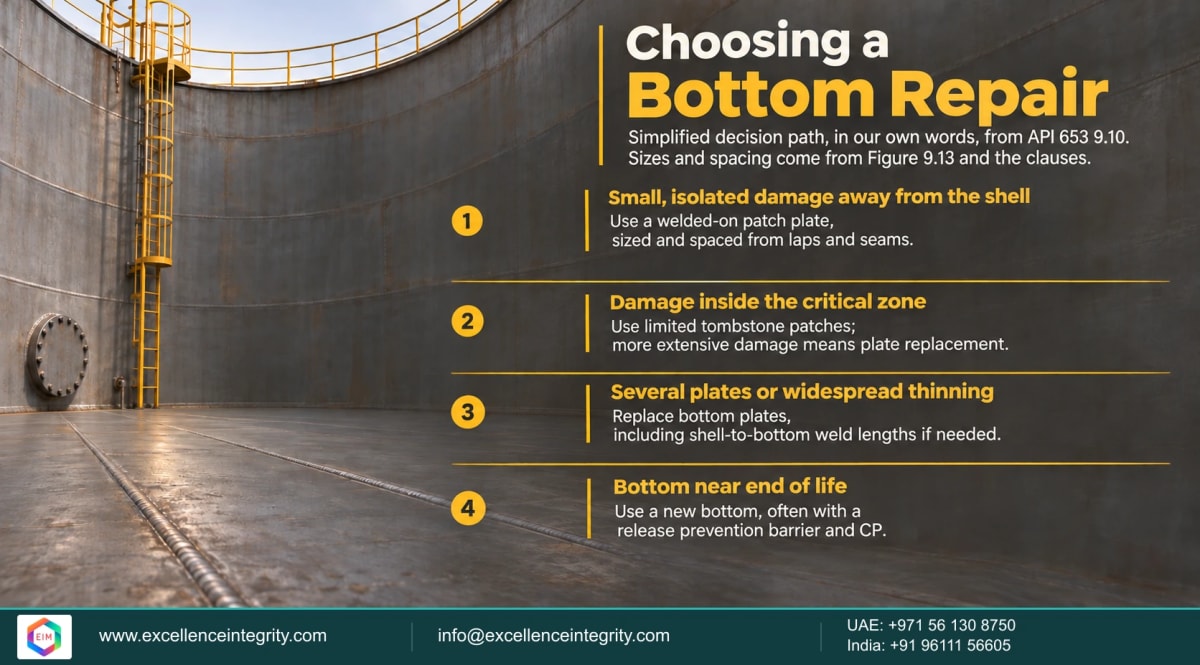
- Small, isolated damage away from the shell: welded-on patch plates.
- Damage inside the critical zone: limited patches, or replacement of the plate welded to the shell.
- Several plates or widespread thinning: replace bottom plates.
- A bottom near the end of its life: install a new bottom. Owners often add a release prevention barrier and cathodic protection at the same time, which also earns longer inspection intervals. See cathodic protection under API RP 651.
Large bottom work, such as replacing the annular ring or lengths of the shell-to-bottom weld, can be a major repair that triggers a hydrotest or a documented exemption; see hydrotest after repairs.
Annular plates
Larger or more highly stressed tanks have a ring of thicker annular plates under the shell, butt-welded to each other, because the bottom plate there carries more load. API 653 sets the annular plate's minimum thickness from a table (Table 4.5) based on the thickness of the first shell course and the stress in it, and the result is usually more than the 0.10 in general bottom minimum. The API 653 Body of Knowledge lists this as an exam calculation.
Before you repair
- Know why it corroded. Product-side or soil-side? Without fixing the cause, the repair will corrode too. See tank floor inspection.
- Check settlement near the repair, especially at the edge; see Annex B settlement.
- Use qualified procedures and welders, and examine the existing welds the repair affects.
Preparing for API 653
Bottom repair rules and the annular plate calculation are listed in API's Body of Knowledge for the API 653 exam. EIM is an independent training provider; EIM's self-paced API 653 preparation includes a question bank, practice mode with explanations, timed mock tests, study notes and flashcards, with one year of access. See the API 653 page
Frequently asked questions
What is the critical zone in API 653?
The part of the tank bottom or annular plate within 3 in of the inside edge of the shell, measured radially inward.
Can patch plates be used in the critical zone?
Only limited, specially detailed patches, with restrictions on size and spacing. More extensive damage requires replacing the bottom plate welded to the shell.
What is the minimum size of a bottom patch plate?
12 in where it overlaps a bottom seam or existing patch, and 6 in where it does not, with spacing rules from API 653 Figure 9.13.
What is the minimum annular plate thickness?
It comes from API 653 Table 4.5, based on the first shell course thickness and stress, and is usually more than 0.10 in.
When should a whole new bottom be installed?
When damage is widespread or the bottom is near the end of its life. Owners often add a release prevention barrier and cathodic protection at the same time.
Sources
- API 653, 9.10, Figure 9.13 and Table 4.5. Rules paraphrased; figure and table not reproduced.
- Hendrix Group: API 653 update (critical zone definition and bottom patch plates)
- API: API 653 Body of Knowledge, March 2027
- Checked 7 October 2026.
Exam preparation
Preparing for API 653?
Practise with exam-style questions, timed mocks and study notes. 1,317 questions in the bank.