Hot Tapping Storage Tanks: API 653 9.15 Explained
Hot tapping in-service storage tanks under API 653 9.15: size vs shell thickness, the √(RT) spacing rule, liquid level, testing and sequence.
By Syed Hasan16 Nov 20264 min read

Sometimes a new connection is needed on a tank that cannot be taken out of service. Hot tapping is the answer: a nozzle is welded to the shell while the tank is full, a valve and a tapping machine are fitted, and the shell is cut through the valve. It saves the cost and downtime of emptying the tank, but welding on an in-service tank carries real risks. API 653 9.15 sets the conditions, and the API 653 exam includes a hot-tap spacing calculation.
Short answer: API 653 limits the hot-tap connection size by the measured shell thickness (Table 9.1), requires shell thickness to be measured at four or more points around the location, keeps at least 3 ft of liquid above the tap, prohibits hot tapping in the vapour space, and requires a minimum spacing from existing nozzles, commonly expressed as √(RT). The nozzle and reinforcement are tested before the machine is mounted, and API Publication 2201 covers safe hot tapping practice.
The main conditions
- Size vs thickness: API 653 Table 9.1 pairs each permitted connection size with the minimum shell thickness needed. Thinner shells limit the size of the tap.
- Measured thickness: shell thickness is measured at a minimum of four places around the proposed nozzle location.
- Liquid level: at least 3 ft of liquid above the tap during the operation, so the shell is cooled and there is no vapour at the weld.
- No vapour space: hot tapping above the liquid level is not permitted.
- Temperature and toughness: the shell must be at or above its minimum design metal temperature throughout, and the shell material must meet the toughness conditions in 9.15.
- Service limits: API 653 lists services and situations where hot tapping is not permitted; check them before planning.
- Safe practice: API Publication 2201 gives detailed guidance on planning and executing hot taps safely.
Spacing from existing nozzles
The minimum spacing between a new hot tap and an adjacent nozzle, measured from toe of weld to toe of weld, is commonly applied as the square root of R × T, where R is the tank shell radius and T the shell thickness, both in inches. The API 653 Body of Knowledge lists this as an exam calculation under 9.15.3.
Minimum spacing = √(R × T)
Worked example: a 100 ft diameter tank has R = 50 ft = 600 in. With a 0.50 in shell, the minimum spacing is √(600 × 0.50) = √300 = 17.3 in. Note how the spacing grows with tank size: on a 200 ft tank with a 1.0 in shell, it would be √(1,200 × 1.0) = 34.6 in.
The sequence
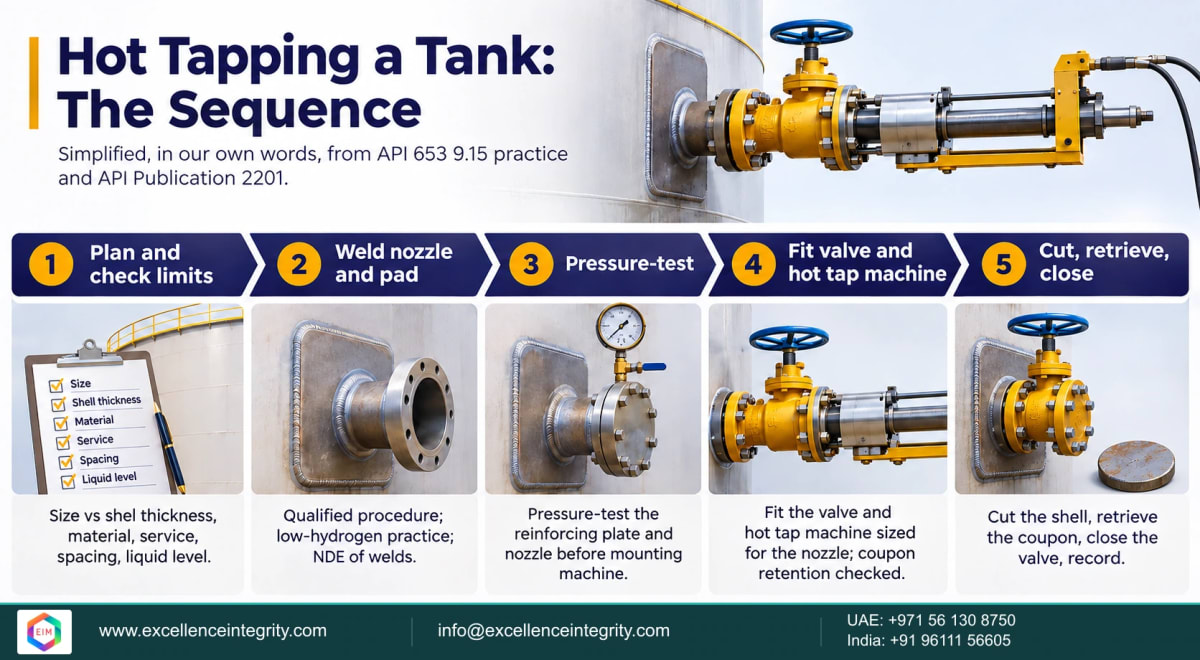
- Plan and check limits: connection size against measured thickness, material and toughness, service restrictions, spacing, and liquid level.
- Weld the nozzle and reinforcing plate using a qualified procedure suitable for welding on an in-service tank, typically low-hydrogen practice, with NDE of the welds.
- Test the reinforcing plate and the nozzle before the tapping machine is mounted.
- Fit the valve and tapping machine, confirming the machine suits the nozzle size and will retain the coupon.
- Cut, retrieve and close: cut through the shell, retrieve the coupon, close the valve, remove the machine, and record the work.
Common mistakes
- Relying on nominal thickness instead of measuring at the actual location.
- Ignoring nearby nozzles and welds when choosing the location.
- Letting the liquid level drop during the job.
- Using a procedure qualified for normal welding without considering the cooling effect of the contents.
- Losing the coupon into the tank.
Preparing for API 653
Hot tapping requirements and the spacing calculation are listed in API's Body of Knowledge for the API 653 exam. EIM is an independent training provider; EIM's self-paced API 653 preparation includes a question bank, practice mode with explanations, timed mock tests, study notes and flashcards, with one year of access. See the API 653 page. For welding procedure review, see WPS and PQR review.
Frequently asked questions
Can you hot tap a storage tank in service?
Yes, under API 653 9.15, within limits on connection size versus shell thickness, liquid level, spacing, material, temperature and service.
How much liquid must be above a hot tap?
At least 3 ft during the hot tapping operation. Hot tapping in the vapour space is not permitted.
How is the minimum spacing calculated?
It is commonly applied as √(R × T), with R the tank shell radius and T the shell thickness in inches, measured toe of weld to toe of weld. Check 9.15.3 in your edition.
How many thickness readings are needed?
Shell thickness is measured at a minimum of four places around the proposed nozzle location.
What other document covers hot tapping?
API Publication 2201, Safe Hot Tapping Practices in the Petroleum and Petrochemical Industries.
Sources
- API: API 653 Body of Knowledge, March 2027 (hot tapping, 9.15 and 9.15.3)
- API 653, 9.15 and Table 9.1; API Publication 2201. Paraphrased; table not reproduced.
- Worked example prepared by EIM. Checked 7 October 2026.
Exam preparation
Preparing for API 653?
Practise with exam-style questions, timed mocks and study notes. 1,317 questions in the bank.