Dead Legs in Piping: Why They Corrode and How to Manage Them
Why dead legs corrode differently from active lines, where to inspect them, the damage mechanisms to expect, and when to remove them instead.
By Siddique16 Nov 20264 min read
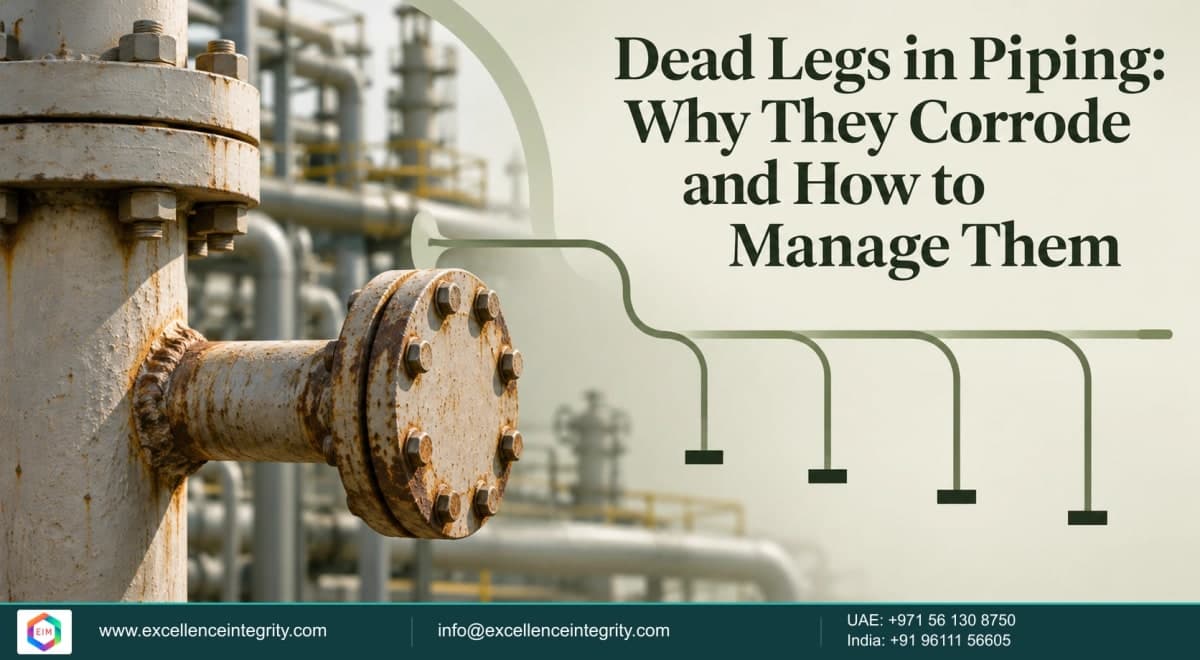
Every process unit has them: a branch that used to feed something no longer there, a bypass around a control valve that is never opened, a connection to a standby pump, a drain or sample point. Dead legs are lengths of piping with little or no flow, and they behave very differently from the active line beside them. They are a classic source of unexpected leaks, precisely because they are easy to forget.
Short answer: Without flow, water and solids settle, chemistry changes, and inhibitors and biocides do not reach. Corrosion in a dead leg can be much faster, or simply different, from the active line. Find every dead leg, remove the ones with no purpose through management of change, and inspect the rest at both the stagnant end and the junction with the active line, using scanning rather than single spot readings.
What counts as a dead leg
- Abandoned branches left after equipment was removed or a process changed.
- Bypasses around control valves, meters or equipment that are normally closed.
- Standby connections, such as the suction and discharge of a spare pump, which flow only occasionally.
- Drains, vents and sample points, and instrument connections.
- Relief and start-up lines that see flow only during upsets or start-up.
Why dead legs corrode differently
- Water and solids settle, creating under-deposit corrosion at low points.
- Bacteria thrive in stagnant water; MIC is a major dead-leg mechanism. See our MIC field guide.
- Inhibitors and biocides do not reach the stagnant section in useful concentrations.
- Temperature changes. A dead leg on a hot line runs cooler than the active pipe, which can bring it into the CUI temperature range or allow water to condense. See corrosion under insulation.
- Concentration effects: corrosive species can accumulate where nothing flushes them out.
- At the junction, turbulence and mixing between active and stagnant fluid can cause localised attack.
API 570 recognises that corrosion rates in dead legs can vary significantly from the active piping, and calls for inspection of both the stagnant end and the connection to the active line. It also encourages consideration of removing dead legs that no longer serve a process purpose.
Managing dead legs
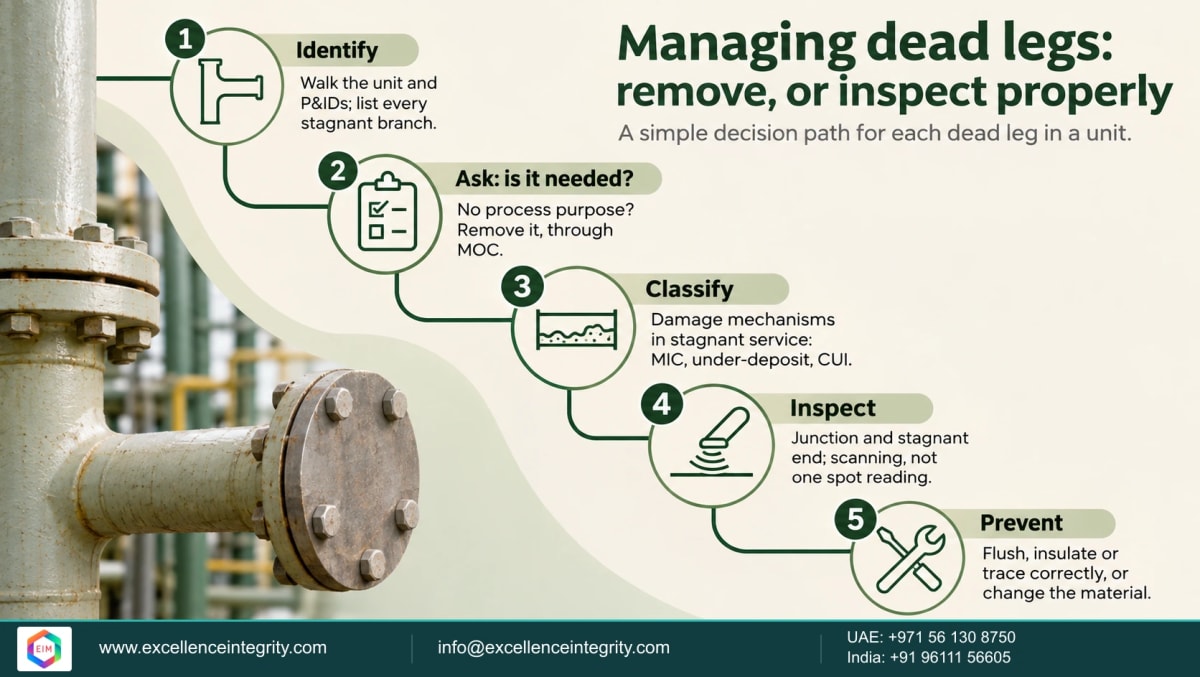
- Identify. Walk the unit with the P&IDs and isometrics, and list every dead leg. Many are not obvious from drawings.
- Ask whether it is needed. If it serves no process or safety purpose, remove it, or blind it as close to the active line as practical, through management of change.
- Classify the damage. For each remaining dead leg, identify the likely mechanisms: MIC, under-deposit corrosion, CUI, or something specific to the service.
- Inspect properly. Include the junction and the stagnant end in the inspection plan, with scanning or grids rather than a single spot reading, and set intervals that reflect the dead leg's own corrosion rate, not the active line's.
- Prevent. Where a dead leg must stay, consider periodic flushing, correct insulation or tracing, a different material, or changes so that it flows.
Common mistakes
- Assuming the dead leg corrodes at the active line's rate.
- Inspecting only the junction and missing damage at the stagnant end, or the reverse.
- Leaving abandoned dead legs "in case" they are needed again.
- Not updating drawings after dead legs are created by process changes.
- Forgetting dead legs in RBI and corrosion control documents.
Learn more with EIM
Dead legs are a standard topic for piping inspectors; our API 570 exam page explains the certification. For internal corrosion, EIM's self-paced Internal Corrosion Management programme covers MIC, under-deposit corrosion and monitoring blind spots. For operators, EIM's asset integrity services include corrosion review and CML rationalisation, where dead legs are a routine finding. See also CML optimisation. EIM is an independent training provider.
Frequently asked questions
What is a dead leg in piping?
A length of piping with little or no flow, such as an abandoned branch, a normally closed bypass, a standby connection, or a drain, vent or sample point.
Why do dead legs corrode faster?
Without flow, water and solids settle, bacteria grow, inhibitors do not reach, and temperatures can differ from the active line. The result can be faster or different corrosion.
Where should dead legs be inspected?
At both the stagnant end and the junction with the active line, ideally with scanning rather than single spot readings.
Should dead legs be removed?
Where they serve no process or safety purpose, removing them, through management of change, is the most reliable solution.
Does API 570 cover dead legs?
Yes. API 570 addresses dead legs as a special concern for piping inspection, including where to inspect them and considering removal of those no longer needed.
Sources
- API 570, Piping Inspection Code: dead legs. Summarised, not quoted.
- Diagrams prepared by EIM. Checked 7 October 2026.
Exam preparation
Preparing for API 570?
Practise with exam-style questions, timed mocks and study notes. 1,841 questions in the bank.