Fired Heater Tubes: Creep, Metal Temperature and Remaining Life
How creep consumes fired heater tube life, why tube metal temperature matters, a Larson-Miller illustration, and how inspectors assess remaining life.
By Syed Hasan16 Nov 20265 min read
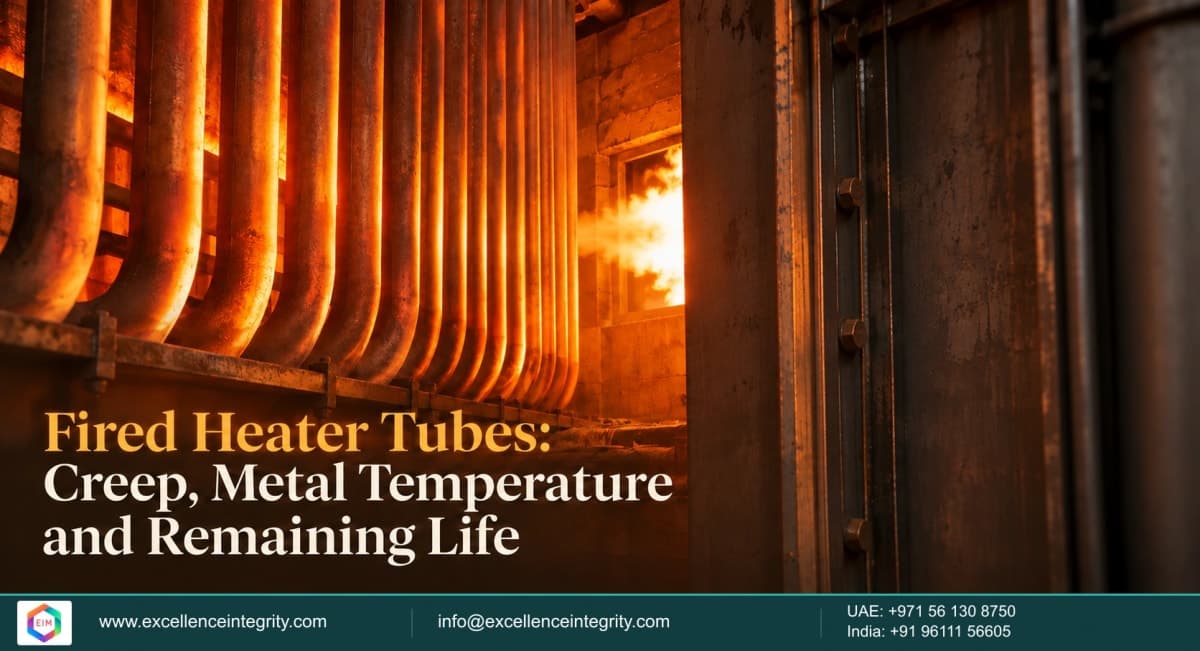
Fired heater tubes live in one of the harshest places in a refinery: high temperature, high pressure, and a flame on one side. At those temperatures steel slowly deforms under stress, a process called creep, and every hour of operation uses up a little of the tube's life. How fast depends above all on one number: the tube metal temperature. A small rise in that temperature can consume tube life far faster than most people expect.
Short answer: Creep is slow, time-dependent deformation at high temperature that eventually ends in rupture. Its rate rises steeply with temperature, so a tube running hotter than design can lose much of its life. In our illustration, running about 10 °C hotter roughly halves creep life. Inspectors manage it by tracking tube metal temperatures, measuring diameter growth and thickness, and assessing remaining life with methods such as those in API 530 and API 579-1 Part 10.
What creep is
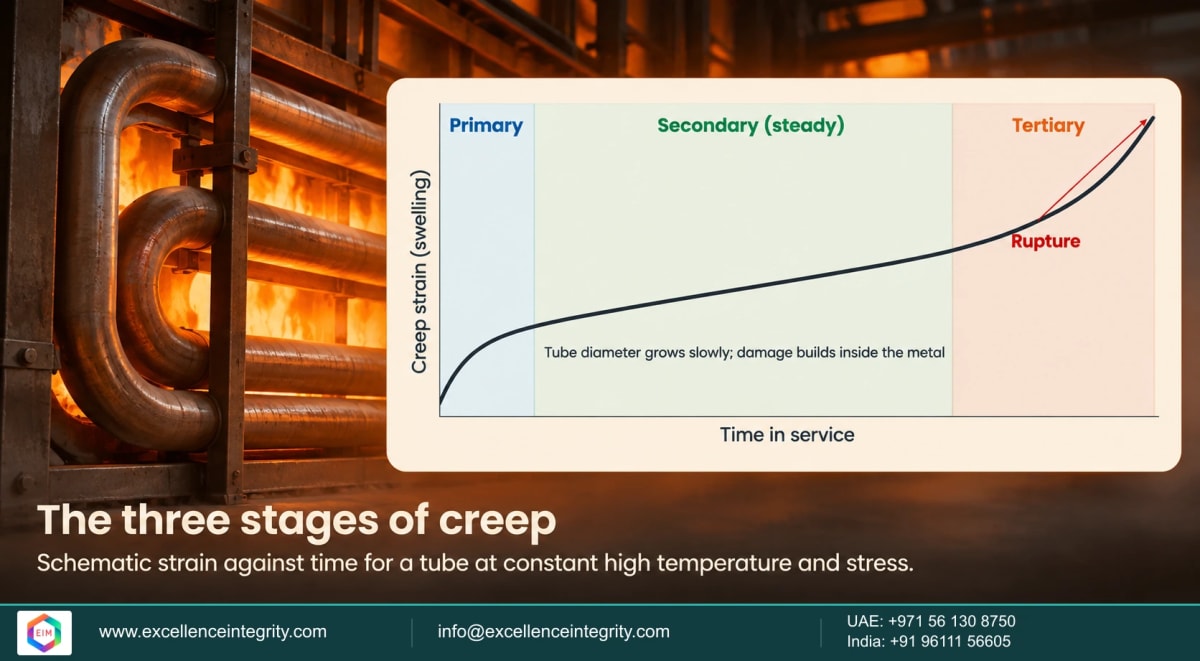
Under constant stress at high temperature, creep proceeds in three stages. Primary creep starts fast and slows down. Secondary creep proceeds at a slow, steady rate for most of the tube's life, as the tube very gradually swells. Tertiary creep accelerates as internal voids link up, ending in rupture. By the time damage is obvious from the outside, a tube may be close to the end.
Why tube metal temperature matters so much
Creep life is often related to temperature and time through the Larson-Miller parameter, LMP = T (C + log t), where T is absolute temperature, t is time to rupture in hours, and C is a material constant often taken as about 20. At the same stress, a material reaches the same LMP whatever the combination of temperature and time.
As an illustration: if a tube is designed for 100,000 hours at 600 °C, the same LMP at 610 °C gives about 52,000 hours, and at 625 °C about 20,000 hours. That is why a heater running only slightly above its design tube metal temperature, perhaps because of coke inside the tubes or flame impingement outside, can use up its tubes years early.
What raises tube metal temperature
- Internal coke or fouling, which insulates the tube and forces the metal hotter to deliver the same heat.
- External scale and oxidation, especially on the fire side.
- Flame impingement from poorly adjusted or damaged burners.
- Higher firing rates to push throughput.
- Low or uneven flow in a pass, starving the tube of cooling.
How inspectors assess heater tubes
- Track tube metal temperature continuously with tube-skin thermocouples, and survey with infrared thermography to find hot spots between them.
- Measure diameter growth (creep swelling) at turnarounds with gauges or strapping, and compare against the limits in the owner's procedure.
- Measure wall thickness, since thinning from oxidation, sulfidation or erosion raises stress and speeds creep.
- Inspect visually for bulging, sagging, scaling, discolouration and flame impingement.
- Use advanced methods where justified, such as automated internal inspection tools that map diameter and thickness along the coil, and metallographic replication or hardness checks on suspect tubes.
- Assess remaining life, using the operating history of temperature and pressure, measured thickness and the material's creep data.
API RP 573 (4th edition, 2021) covers inspection of fired boilers and heaters. API Standard 530 covers the design thickness of heater tubes and includes, in an annex, a technique for estimating remaining tube life, though it does not set retirement thickness. API 579-1/ASME FFS-1 Part 10 provides creep assessment methods for fitness-for-service.
Extending tube life
- Control tube metal temperature: decoke when needed, balance pass flows, maintain burners and prevent flame impingement.
- Monitor continuously, and treat sustained high readings as consumption of life, not a nuisance alarm.
- Upgrade metallurgy for higher-temperature or more corrosive service where justified.
- Keep records: remaining life assessments depend on a reliable history of operating temperature and pressure.
Heater reliability also depends on the refractory that protects the casing; see our guide to API 936 refractory personnel.
Learn more with EIM
EIM's self-paced API 579-1 / ASME FFS-1 Fitness-For-Service programme covers Level 1 to 3 assessments and remaining life, for inspectors and engineers making run-repair-replace decisions; it is EIM training, not an API credential. See the programme. For operators, EIM's inspection services include in-service inspection and turnaround support. EIM is an independent training provider.
Frequently asked questions
What is creep in heater tubes?
Slow, time-dependent deformation of the tube metal at high temperature under stress, which gradually swells the tube and eventually leads to rupture.
Why does tube metal temperature matter so much?
Creep rate rises steeply with temperature. In our Larson-Miller illustration, about 10 °C above design roughly halves creep life.
What is the Larson-Miller parameter?
LMP = T (C + log t), relating absolute temperature and time to rupture at a given stress, with C often taken as about 20. It lets engineers compare life at different temperatures.
Which API documents cover heater tubes?
API RP 573 for inspection of fired boilers and heaters, API Standard 530 for tube thickness design and remaining-life estimation, and API 579-1 Part 10 for creep assessment.
How do inspectors detect creep damage?
By monitoring tube metal temperature, measuring diameter growth and wall thickness, visual inspection, and, where justified, advanced internal inspection, replication or hardness testing.
Sources
- Accuris store: API RP 573, Inspection of Fired Boilers and Heaters, 4th edition (January 2021)
- Standards listing: API Standard 530, Calculation of Heater-Tube Thickness in Petroleum Refineries
- API 579-1/ASME FFS-1 (2021), Part 10 (creep). Cited, not quoted.
- Larson-Miller illustration calculated by EIM. Checked 7 October 2026.
Free mock tests
Preparing for an API, AMPP (NACE), CSWIP or CMRP exam?
Choose your certification and try a free mock test.
SMRP