API 936 Refractory Personnel Certification: What It Covers and Who Needs It
API 936 explained: what refractory personnel certification covers, who it is for, the exam format and publications, and how to prepare.
By Syed Hasan14 Nov 20264 min read

Refractory linings protect the steel shells of fired heaters, FCC reactors and regenerators, sulfur recovery units, reformers and many other hot units. When a lining fails, the shell overheats, sometimes glowing red on the outside, and a unit may have to shut down. Most of those failures trace back to what happened during installation: the wrong material, poor mixing, bad installation technique or a rushed dryout. API 936 is the standard for getting installation quality control right, and API certifies the people who apply it.
Short answer: API 936 certifies personnel in the installation, inspection, testing and repair of refractory linings. The exam has 85 multiple-choice questions (75 scored), lasts 3 hours 15 minutes and is closed book. It is open to applicants with any level of experience, the certification is valid for three years, and holders recertify by online quiz every six years.
Why refractory quality control matters
Monolithic refractories (castables, gunned and rammed materials) are, in effect, specialised concretes installed on site. Their final properties depend heavily on how they are handled: water content, mixing, placement, curing and the first heat-up. A material that meets its data sheet in the laboratory can still fail in service if any of those steps goes wrong, which is why quality control focuses on the whole installation, not just the product.
What API 936 covers
- Material qualification: testing materials against the specification before they are used.
- Installer qualification: applicators and crews demonstrate they can install the material correctly with the chosen method.
- Installation: gunning, casting and ramming or hand-packing techniques, anchoring, and the quality control steps around each, with test samples taken during installation.
- Testing: properties such as strength, density and abrasion resistance measured on samples, using ASTM methods.
- Dryout, inspection and repair: controlled heat-up to remove water safely, and inspection and repair of defects.
The standard also sets out the responsibilities of the owner, the installer and the inspector, and the documentation each must keep.
The exam
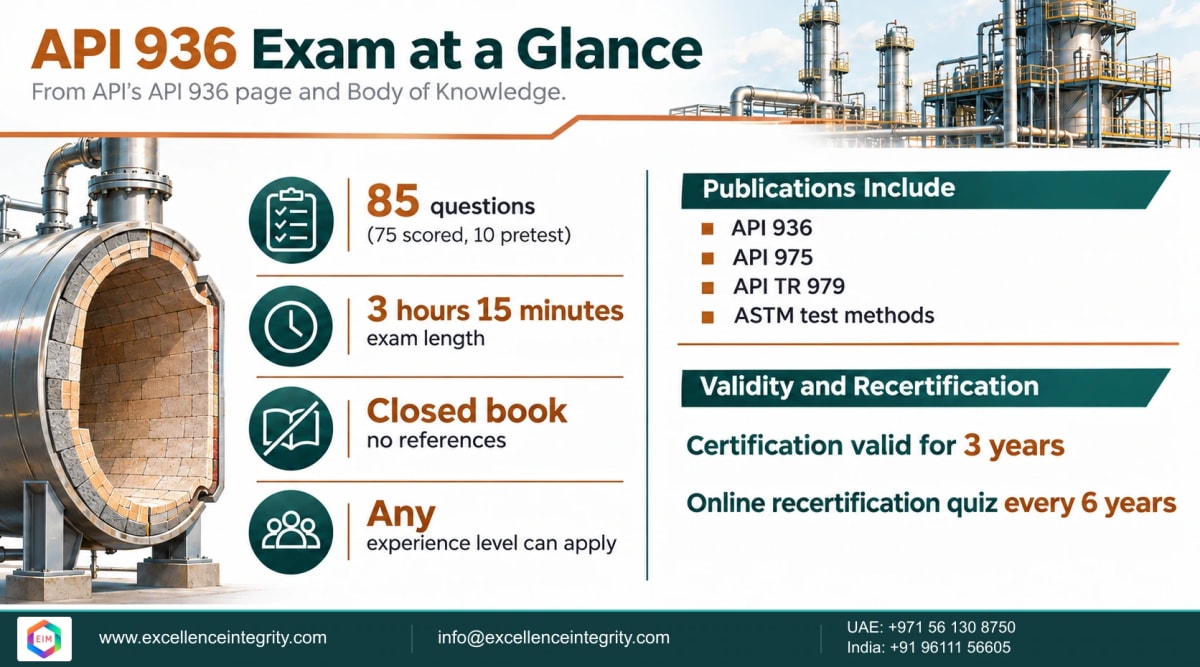
| API 936 | |
|---|---|
| Questions | 85 multiple-choice, of which 75 are scored and 10 are pretest |
| Time | 3 hours 15 minutes |
| References | Closed book: no reference information permitted |
| Who can sit | Applicants with any experience in the petroleum and petrochemical industries, and those wanting to gain it |
| Publications | API Standard 936 (5th edition from the April 2025 window), API Standard 975 (refractory brick), API TR 979 (applications of refractory lining materials), and ASTM test methods such as C113, C133, C181 and C704 |
| Validity | 3 years; recertification by an online, open-book quiz every six years |
| 2027 windows | 9 to 30 April 2027 (apply by 4 February 2027); 6 to 27 August 2027; 3 to 24 December 2027 |
Always check the current Publications Effectivity Sheet and Body of Knowledge for your window before you study.
Who API 936 suits
- Inspectors who oversee refractory work during turnarounds and new construction.
- Refractory contractor supervisors and QC staff who need to show their installation control meets an industry standard.
- Heater, FCC and SRU engineers who specify refractory and approve installations.
- Early-career engineers, because API sets no minimum experience requirement for this certification.
In the Gulf and India, with large refining, petrochemical and gas processing capacity, refractory scope is a regular part of turnarounds, and owners increasingly specify certified refractory inspection.
How to prepare
- Get the documents on the effectivity sheet, starting with API 936 5th edition.
- Learn the vocabulary. Refractory has its own terms; many questions test whether you know them precisely.
- Understand the why behind each control: why water content matters, why samples are cured a certain way, why dryout is staged.
- Know the tests, what each ASTM method measures and when it is used.
- Practise under time, remembering the exam is closed book.
With EIM
EIM is an independent training provider; API runs the certification. EIM's API 936 exam page explains the certification in full. For operators, EIM's inspection services include turnaround support. For fees across API programmes, see our guide to what an API certification really costs.
Frequently asked questions
Do I need experience to sit API 936?
No minimum is set. API opens the certification to applicants with any experience in the petroleum and petrochemical industries, and those wanting to gain it.
Is the API 936 exam open book?
No. No reference information is permitted during the exam.
How many questions are on the API 936 exam?
85, of which 75 are scored and 10 are pretest questions, in 3 hours 15 minutes.
Which edition of API 936 is examined?
API's Body of Knowledge states that the 5th edition took effect from the April 2025 window. Check the current effectivity sheet for your window.
How do I keep API 936 certification?
The certification is valid for three years, and certified personnel recertify by taking an online, open-book quiz every six years, under API's recertification rules.
Sources
- API: API 936 Refractory Personnel certification
- API: API 936 Body of Knowledge (April 2025)
- API: ICP Schedules & Fees
- All checked 7 October 2026.