API 650 for API 653 Inspectors: The Parts You Actually Use
Which parts of API 650 an API 653 tank inspector needs: design metal temperature, impact testing, reconstructed shell thickness, openings and NDE.
By Syed Hasan13 Nov 20265 min read
API 650 is a design and construction standard for new welded storage tanks. API 653 governs tanks in service. But an API 653 inspector cannot avoid API 650: whenever a tank is repaired, altered or reconstructed, API 653 sends you back to API 650 for materials, design, welding and testing. It is also one of the heaviest documents in the API 653 exam, now in its 14th edition (August 2025) for the 2027 windows.
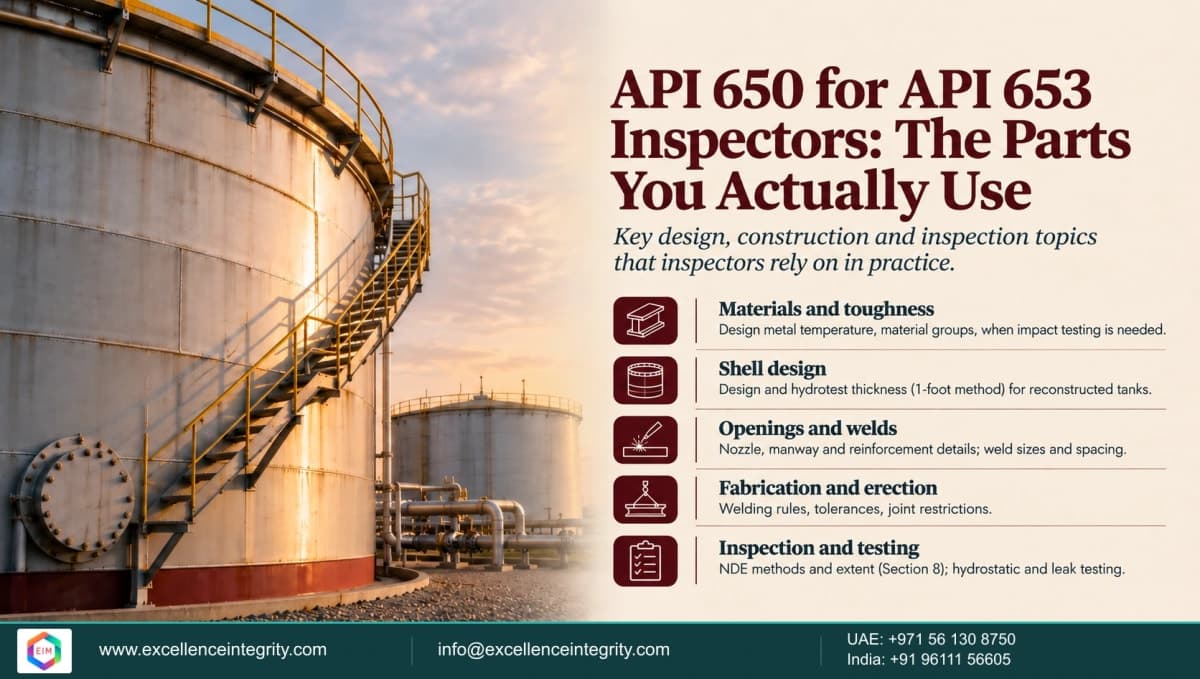
Short answer: As an API 653 inspector you mainly use API 650 for five things: material toughness (design metal temperature, material groups and impact testing), shell design thickness for reconstructed tanks (the 1-foot method), details of openings and their welds, fabrication and welding rules, and the NDE and testing requirements in Section 8. API's exam Body of Knowledge lists these topics explicitly.
Scope in one paragraph
API 650 covers vertical, cylindrical, aboveground welded tanks with uniformly supported bottoms, in non-refrigerated service with a maximum design temperature of 93 °C (200 °F), at internal pressures approximating atmospheric (with additional rules allowing somewhat higher pressures). Refrigerated and low-pressure tanks fall under other standards, such as API 620.
The parts you use
1. Materials and toughness
The design metal temperature is normally taken as the lowest one-day mean ambient temperature at the site plus 8 °C (15 °F). Each plate material falls into a material group, and API 650's impact-exemption figure shows, by group and thickness, whether a plate at that design metal temperature needs impact testing; a separate table gives acceptable impact values. The API 653 Body of Knowledge lists all four steps as exam calculations. In hot Gulf climates design metal temperatures are high, but thick plates and repair materials can still need checking.
For how toughness relates to brittle fracture in service, see our guide to brittle fracture and MDMT.
2. Shell design for reconstructed tanks
When a tank is dismantled and rebuilt, API 653 requires the shell to be checked as new construction using API 650's design rules, with allowable stresses for the design condition (Sd) and hydrotest condition (St) taken from API 650's allowable stress tables. For tanks 200 ft (61 m) in diameter and smaller, the 1-foot method gives two thicknesses per course:
td = 2.6 D (H − 1) G / Sd + CA tt = 2.6 D (H − 1) / St
The design thickness includes the product's specific gravity and the corrosion allowance; the hydrotest thickness assumes water (G = 1) and no corrosion allowance. The larger governs. Sd is typically the lesser of two-thirds of yield or two-fifths of tensile strength, and St the lesser of three-quarters of yield or three-sevenths of tensile strength: for A36, about 23,200 psi and 24,900 psi.
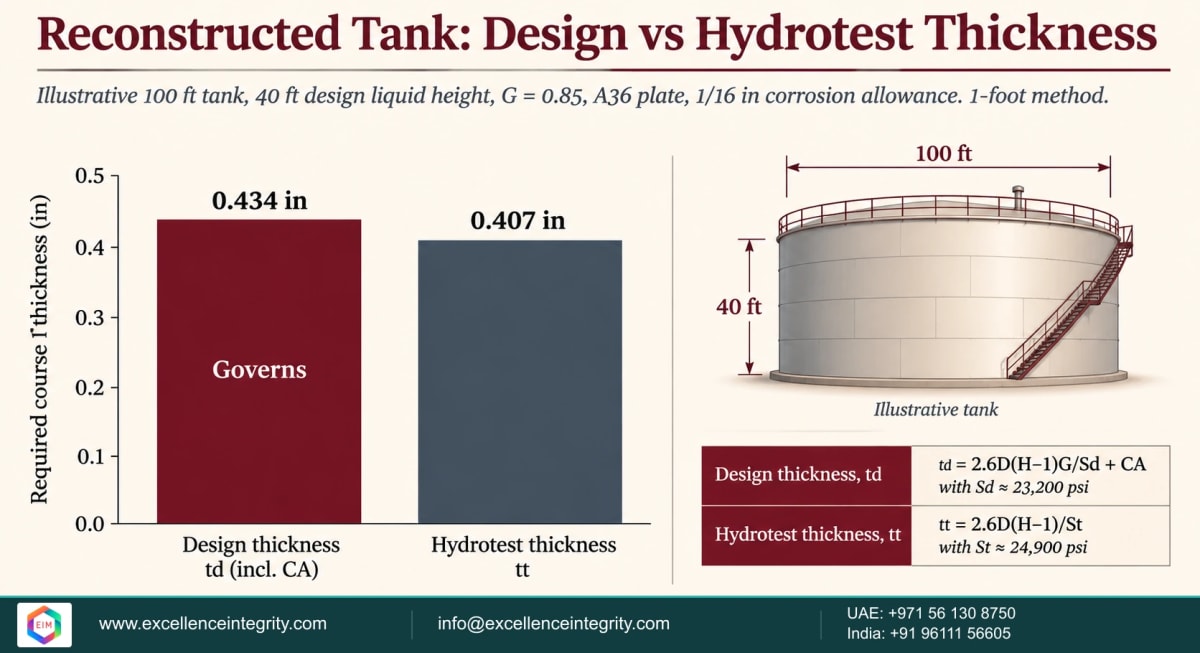
Worked example: D = 100 ft, design liquid height H = 40 ft, G = 0.85, CA = 1/16 in, A36 plate. td = 2.6 × 100 × 39 × 0.85 / 23,200 + 0.0625 = 0.434 in. tt = 2.6 × 100 × 39 / 24,900 = 0.407 in. Course 1 needs at least 0.434 in.
Note the difference from API 653's in-service check, which uses higher allowable stresses from API 653 Table 4.1 and no future corrosion allowance in the formula itself; see shell minimum thickness.
3. Openings and welds
API 650's figures and tables for shell nozzles, manholes, reinforcing plates, weld sizes and spacing are used whenever openings are added or replaced. The Body of Knowledge lists a specific set of these figures and tables for the exam, alongside API 653's own figures for repairs.
4. Fabrication, erection and welding
Rules for typical joints, weld sizes, restrictions on joints, maximum reinforcement and erection tolerances. API 653 adds its own welding rules in Section 11, and welding procedures and welders are qualified to ASME Section IX.
5. Inspection and testing
API 650 Section 8 sets out NDE methods and extent, including radiography of shell butt welds, and the testing of the completed tank. API 653 Section 12 adds its own requirements for repaired and altered tanks.
What you can skip for the exam
API's Body of Knowledge excludes many API 650 annexes and calculations from the API 653 exam, including wind, seismic and small internal pressure calculations, venting, external nozzle loads, flanges, and most of the specialised annexes. Check the current Body of Knowledge before you spend time on them.
Preparing for API 653
EIM is an independent training provider; API certifies tank inspectors. EIM's self-paced API 653 preparation covers API 650 topics in its question bank, practice mode, timed mock tests, study notes and flashcards, with one year of access. See the API 653 page. For which editions apply in 2027, read what changed in the API 653 codebooks.
Frequently asked questions
Which edition of API 650 applies to the 2027 API 653 exam?
The 14th edition (August 2025), per API's 2027 effectivity sheet. Always check the sheet for your window.
How is design metal temperature determined in API 650?
Normally as the lowest one-day mean ambient temperature at the site plus 8 °C (15 °F).
What is the 1-foot method?
API 650's method for calculating shell course thickness for tanks up to 200 ft (61 m) in diameter: td = 2.6 D (H − 1) G / Sd + CA for design, and tt = 2.6 D (H − 1) / St for hydrotest.
When does an API 653 inspector use API 650 shell design rules?
Mainly for reconstructed tanks, and for repairs and alterations where API 653 requires new construction rules to be met.
Are wind and seismic calculations on the API 653 exam?
No. API's Body of Knowledge excludes them, along with venting, flange and several other calculations.
Sources
- API: API 653 Body of Knowledge, March 2027 (API 650 topics and exclusions)
- Standards listing: API Standard 650, 14th edition, scope
- API Standard 650, Welded Tanks for Oil Storage. Formulas cited; tables and figures not reproduced.
- Worked example prepared by EIM. Checked 7 October 2026.