API 653 Hydrotest After Repairs: When It's Required, and When It Can Be Exempted
When API 653 requires a hydrostatic test after tank repairs, what counts as a major repair or alteration, and how hydrotest exemptions work under 12.3.2.
By Syed Hasan13 Nov 20265 min read
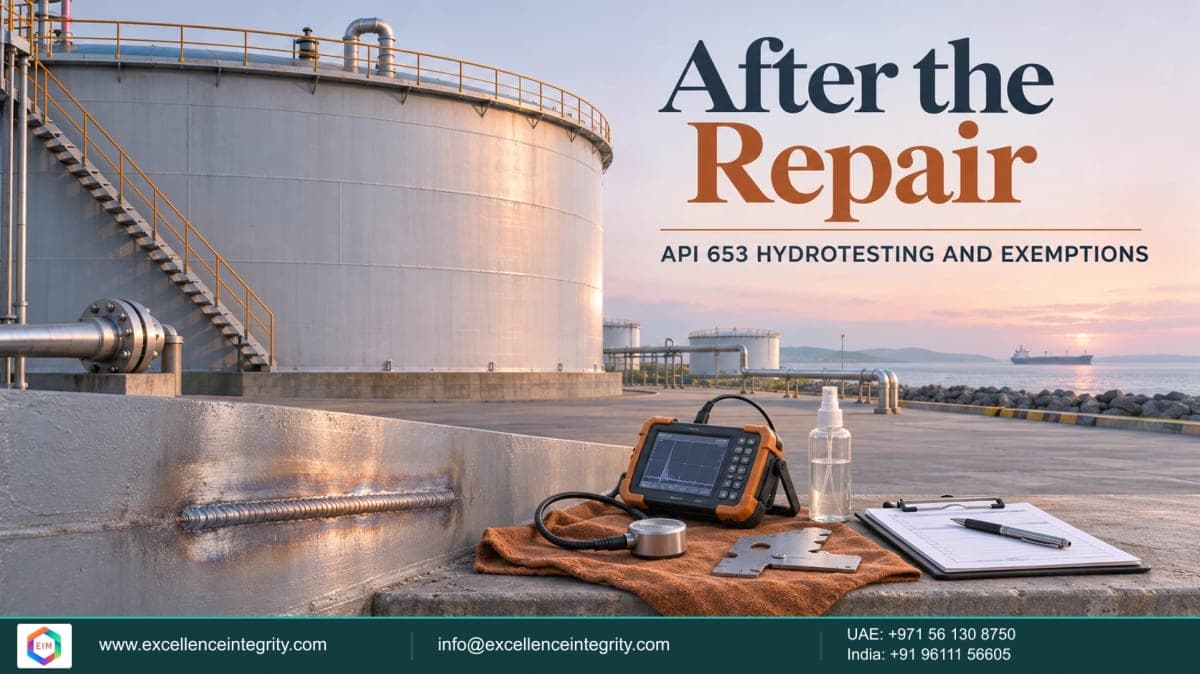
Filling a large storage tank with water, holding it, and draining it can take days or weeks and involve millions of litres of water. That makes the question "does this repair need a hydrotest?" one of the most important, and most argued about, in tank work. API 653 answers it in Section 12.3: some work always needs a full hydrostatic test, and some can be exempted, but only through a documented process.
Short answer: API 653 requires a full hydrostatic test, held for 24 hours, for reconstructed tanks and for tanks that have had a major repair or major alteration, unless an exemption under 12.3.2 applies. Major work is work on the annular plate ring, the shell-to-bottom weld or a sizable part of the shell. An exemption requires the general conditions of 12.3.2.2 plus either the specific technical requirements or a fitness-for-service evaluation.
When a hydrotest is required
In our summary of API 653 12.3.1.1, a full hydrostatic test, held for 24 hours, is required for:
- A reconstructed tank (dismantled and re-erected).
- A tank that has undergone a major repair or major alteration, unless exempted under 12.3.2.
- A tank where an engineering evaluation shows a need, for example because the service has become more severe.
What counts as a major repair or alteration
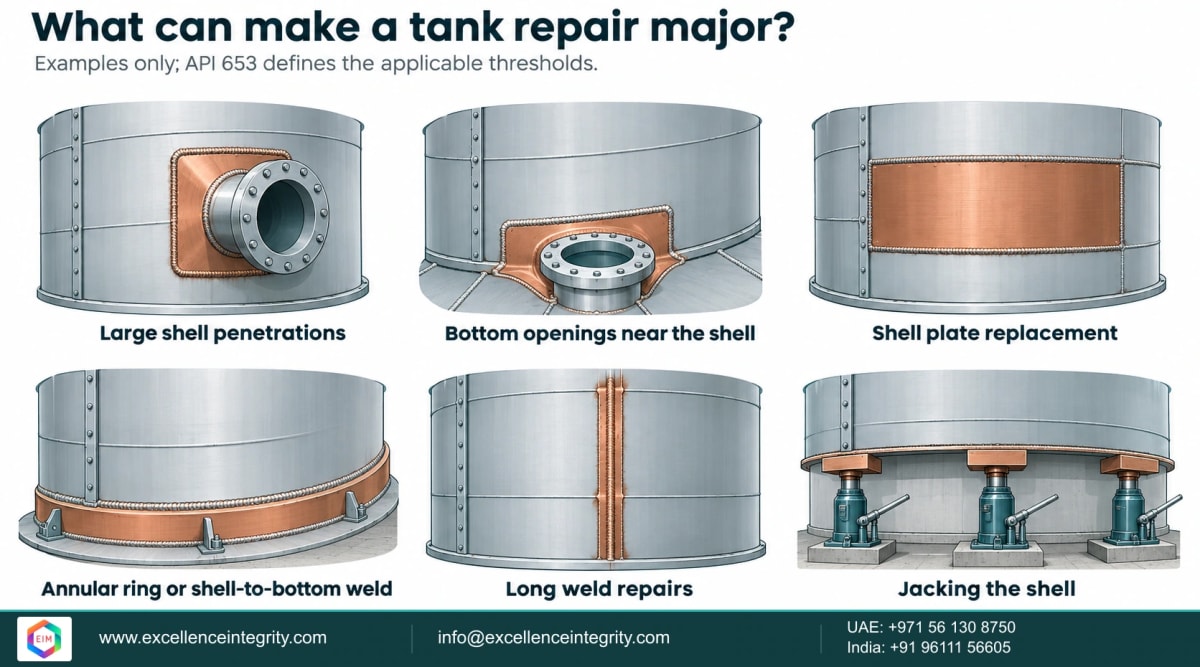
API 653 12.3.1.2 describes major repairs and major alterations as work that involves cutting, adding, removing or replacing the annular plate ring, the shell-to-bottom weld, or a sizable portion of the shell. It then lists specific operations. Typical examples include installing larger shell penetrations below the design liquid level, bottom penetrations close to the shell, replacing shell material beyond a size threshold, replacing the annular ring or lengths of the shell-to-bottom weld, longer repairs to vertical or radial welds, and jacking the shell. Check the exact list and thresholds in your edition; they decide the answer.
How exemptions work
API 653 12.3.2.1 says a full hydrostatic test is not required for major repairs and major alterations if the general conditions of 12.3.2.2 are met, plus either:
- The appropriate specific requirements of 12.3.2.3 to 12.3.2.6, which cover matters such as material toughness, welding and NDE of the new work, depending on the type of repair; or
- A fitness-for-service evaluation under 12.3.2.7, showing by engineering analysis that the tank is fit for service without the test.
In practice, an exemption package is prepared by a storage tank engineer, agreed with the authorized inspector and the owner, and documented. It typically includes the engineering evaluation, material and toughness data, welding and NDE records, and the reasoning for each requirement. Exemption analyses have saved owners weeks of downtime and large volumes of test water on major repairs, but they are an engineering decision, not a shortcut.
Why the hydrotest matters
- Leak testing of new welds and repairs.
- Settlement check of a new or repaired foundation under full load; see Annex B settlement.
- Structural confirmation, including protection against brittle fracture: a successful hydrotest at an adequate temperature is one of the factors in API 653's brittle fracture assessment for tanks. See brittle fracture and MDMT.
That last point explains why exemptions focus so heavily on material toughness and the quality of new welds: they must provide the confidence the hydrotest would otherwise give.
Common pitfalls
- Assuming a repair is minor without checking it against the 12.3.1.2 list and thresholds.
- Treating an exemption as a signature, not an evaluation. Each requirement must be met and documented.
- Forgetting the foundation. If the foundation was disturbed, settlement under load still needs confirming.
- Missing NDE required as part of the exemption route.
- Poor records, which make the exemption impossible to defend at the next inspection.
Preparing for API 653
Hydrostatic and leak testing requirements are listed in API's Body of Knowledge for the API 653 exam. EIM is an independent training provider; EIM's self-paced API 653 preparation includes a question bank, practice mode with explanations, timed mock tests, study notes and flashcards, with one year of access. See the API 653 page. EIM's live AST Inspection & Maintenance course covers repairs and testing in practice; check the course page for the next batch.
Frequently asked questions
When does API 653 require a hydrostatic test?
For reconstructed tanks, for tanks after a major repair or major alteration unless exempted, and where an engineering evaluation shows a need, such as more severe service. The test is held for 24 hours.
What is a major repair under API 653?
Work that cuts, adds, removes or replaces the annular plate ring, the shell-to-bottom weld or a sizable portion of the shell. API 653 12.3.1.2 lists the specific operations and size thresholds.
Can a hydrotest be avoided after a major repair?
Yes, through an exemption under 12.3.2: the general conditions plus either the specific requirements or a fitness-for-service evaluation, documented and approved.
Who approves a hydrotest exemption?
It is prepared by a storage tank engineer and agreed with the authorized inspector and the owner, under the conditions in 12.3.2.
Is a door sheet a major repair?
Generally yes, because it removes and replaces a sizable portion of the shell. Whether it can be exempted depends on its location and how it meets the requirements in 12.3.
Sources
- API 653, Tank Inspection, Repair, Alteration, and Reconstruction: 12.3.1 and 12.3.2. Paraphrased, not quoted.
- API: API 653 Body of Knowledge, March 2027 (hydrostatic and leak testing)
- Oil & Gas Journal: Hydrotesting not required under new API 653 procedure
- Checked 7 October 2026.