Brittle Fracture and MDMT: Why Steel Can Break Like Glass
Why carbon steel can break like glass, what MDMT means on a nameplate, when brittle fracture risk peaks, and how it is assessed in service.
By Syed Hasan12 Nov 20265 min read
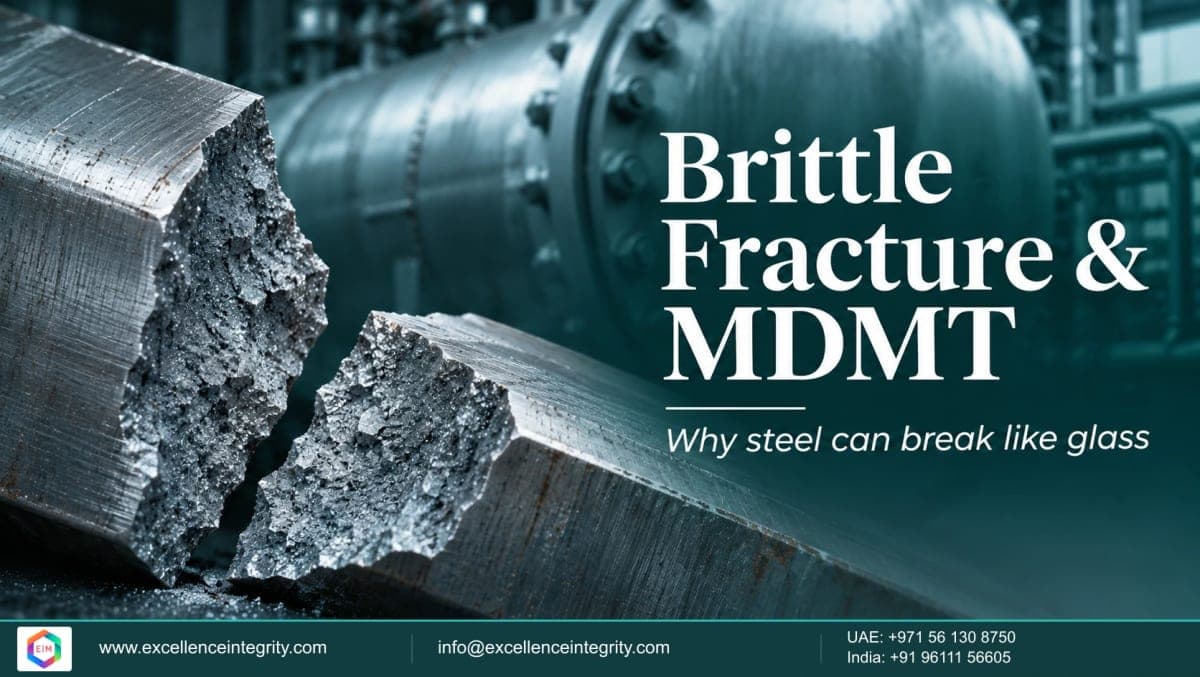
Most carbon steel equipment fails, if it fails at all, by slow, visible processes: thinning, leaking, bulging. Brittle fracture is different. Below a certain temperature, steel loses its toughness and can crack suddenly and completely, with little or no deformation, at stresses well below its design limits. It is rare, but when it happens the consequences are severe, and it most often happens at predictable moments: a cold hydrotest, a depressurisation, a cold start-up.
Short answer: Brittle fracture needs three things together: a material with low toughness at the temperature it is at, enough tensile stress, and a flaw. Every pressure vessel has a minimum design metal temperature (MDMT) on its nameplate, the lowest temperature at which it may be pressurised. Keep the metal above it, especially during hydrotests, start-ups and depressurisation.
The ductile-to-brittle transition
Carbon and low-alloy steels change behaviour with temperature. Warm, they are ductile: they stretch, absorb energy and give warning. Cold, they become brittle. The Charpy impact test measures this by striking a notched specimen and recording the energy absorbed. Plotted against temperature, it gives the familiar S-shaped curve: a low "lower shelf", a steep transition, and a high "upper shelf".
Thicker sections, coarser grain structures, high-strength steels and some older steels shift the transition to higher temperatures, which means they can be brittle at temperatures that would be safe for thinner, finer-grained material.
What MDMT means
The minimum design metal temperature (MDMT) is the lowest metal temperature at which the vessel is designed to be pressurised, usually stamped on the nameplate with its coincident pressure. Under ASME Section VIII Division 1, the designer either shows the material is exempt from impact testing at that temperature (using the impact test exemption curves in UCS-66, which depend on material group and thickness, with further allowances in UCS-66.1 when stresses are low) or specifies impact testing to prove toughness.
For an inspector, MDMT is an operating limit like any other. Pressurising the vessel when the metal is colder than its MDMT puts it outside its design basis.
When brittle fracture bites
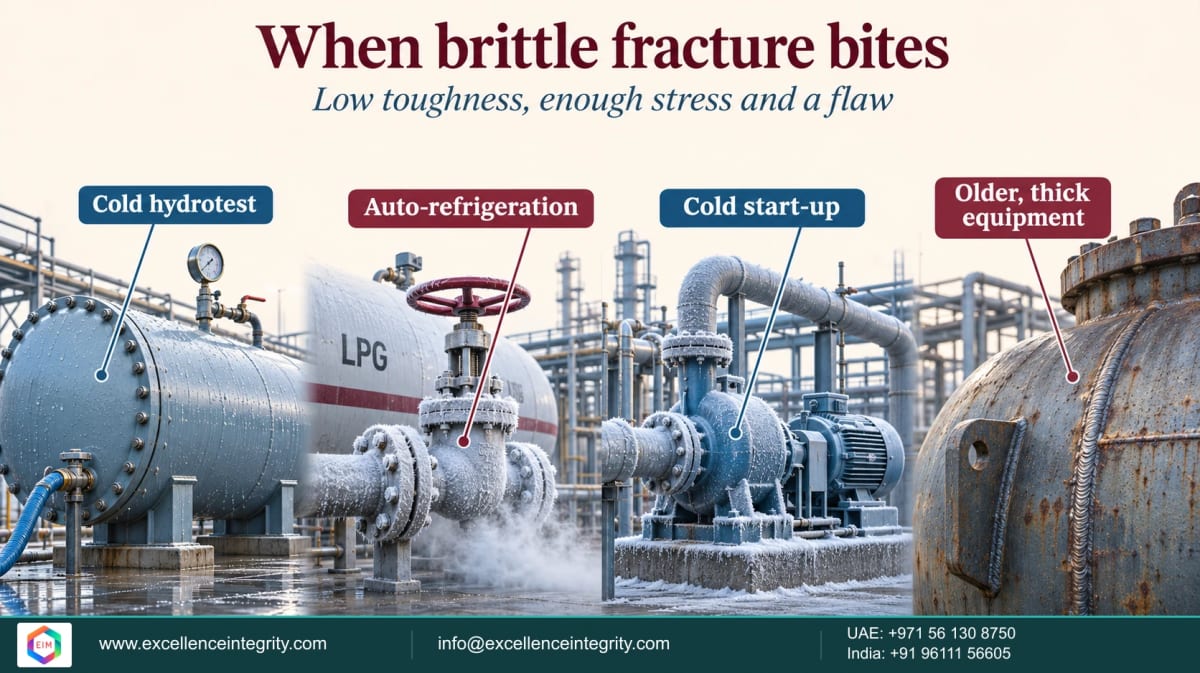
- Cold hydrotests. The test applies the highest pressure the vessel may ever see, often using water colder than you think. ASME Section VIII recommends that the metal temperature during a hydrostatic test be kept at least 17 °C (30 °F) above the MDMT to reduce the risk of brittle fracture.
- Auto-refrigeration. When light hydrocarbons such as LPG or propane depressurise, they flash and cool rapidly, chilling the metal far below normal operating temperature. If pressure is then restored before the metal warms, the vessel may be above its toughness limit.
- Cold start-ups. Pressurising equipment before it has warmed up, especially after a shutdown in cold weather.
- Older and thicker equipment. Equipment built before modern impact-test rules, or thicker than the exemption curves allow, may have a higher transition temperature than its operators assume.
Flaws matter too. Brittle fractures usually start at a crack, a weld defect, a notch or a sharp change in section. A repair weld without proper procedure or heat treatment can create exactly the hard, flawed zone a brittle fracture needs.
How brittle fracture risk is assessed
For in-service equipment, API 579-1/ASME FFS-1 Part 3 sets out a brittle fracture assessment. Level 1 uses exemption curves and simple rules (the 2021 edition added thickness limits to these curves); Level 2 can take credit for reduced pressure at low temperatures; Level 3 uses fracture mechanics. For storage tanks, API 653 includes its own brittle fracture considerations, based on shell thickness, temperature and service history.
Practical outputs of an assessment include a confirmed or revised MDMT, a minimum pressurisation temperature, operating procedures for depressurisation and start-up, and hydrotest temperature limits.
What inspectors should check
- Know the MDMT of the equipment you inspect, and whether operations can take the metal below it.
- Check hydrotest procedures for water temperature and the margin above MDMT before testing.
- Flag auto-refrigeration risks in light hydrocarbon services, and check that procedures cover re-pressurisation.
- Review repairs: welding procedures, heat treatment and impact requirements for repair welds.
- Question old data. For older equipment, confirm what toughness basis it was built to.
Learn more with EIM
EIM's self-paced API 579-1 / ASME FFS-1 Fitness-For-Service programme covers the run-repair-replace standard behind API 510, 570, 653 and 580, including Level 1 to 3 assessments and remaining life, with a question bank. It is EIM training, not exam preparation; API 579-1 has no certification exam. See the programme
Preparing for API 571? Brittle fracture is one of its mechanical and metallurgical mechanisms. EIM's live API 571 Damage Mechanisms - Exam Preparation course with Mr. Deepak Rawtal runs 16 January to 14 February 2027, Saturday and Sunday, 18:00 to 20:00 UAE time. For the related calculation, read MAWP and minimum thickness. EIM is an independent training provider.
Frequently asked questions
What is MDMT?
The minimum design metal temperature: the lowest metal temperature at which a vessel is designed to be pressurised, usually stamped on the nameplate with its coincident pressure.
Why is a hydrotest a brittle fracture risk?
It applies high pressure, often with cold water. ASME Section VIII recommends keeping the metal at least 17 °C (30 °F) above the MDMT during a hydrostatic test.
What is auto-refrigeration?
Rapid cooling of equipment when light hydrocarbons such as LPG flash during depressurisation. Re-pressurising before the metal warms can create a brittle fracture risk.
Which standard assesses brittle fracture in existing equipment?
API 579-1/ASME FFS-1 Part 3, with Level 1 to Level 3 assessments. API 653 has its own brittle fracture considerations for tanks.
Are thicker plates more at risk?
Generally yes. Thicker sections tend to have higher transition temperatures, which is why impact test exemptions depend on thickness.
Sources
- ASME Boiler and Pressure Vessel Code, Section VIII Division 1: UCS-66, UCS-66.1 and UG-99. Cited, not quoted.
- ANSI blog: Fitness-For-Service, API 579-1/ASME FFS-1-2021 (summary of changes)
- API 653, Section 5 (brittle fracture considerations). Cited, not quoted.
- All checked 7 October 2026.