Sulfidation vs Naphthenic Acid Corrosion: How to Tell Them Apart
Sulfidation and naphthenic acid corrosion both attack hot crude units. How they differ in drivers, appearance and materials, and how to inspect for each.
By Asjad Imam10 Nov 20265 min read
Hot crude and vacuum units face two high-temperature corrosion mechanisms at once. Sulfidation comes from the sulfur in the crude; naphthenic acid corrosion (NAC) from the organic acids. They overlap in temperature, they can act together, and they are one of the pairs that cost the most marks in the API 571 exam. In the plant, mistaking one for the other leads to the wrong material upgrade and the wrong inspection plan.
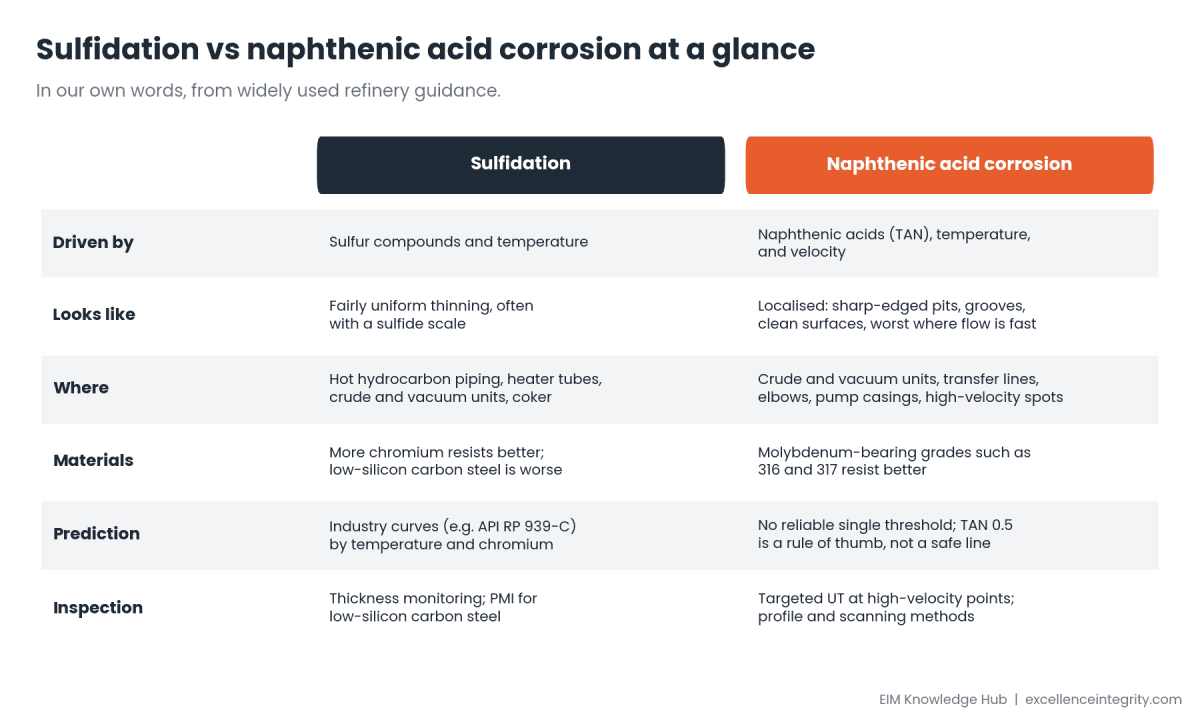
Short answer: Sulfidation is driven by sulfur and temperature, produces fairly uniform thinning with a sulfide scale, and is resisted by higher chromium. Naphthenic acid corrosion is driven by acid content (TAN), temperature and velocity, produces localised, sharp-edged pits and grooves on clean metal, and is resisted by molybdenum-bearing grades such as 316 and 317.
Where each one lives

- Sulfidation of carbon and low-alloy steels becomes significant from about 260 °C (500 °F) and keeps increasing with temperature. It affects hot hydrocarbon piping, heater tubes, crude and vacuum units, cokers and similar equipment.
- Naphthenic acid corrosion occurs mainly between about 220 and 400 °C. Above about 400 °C the acids tend to break down. It is concentrated in crude and vacuum distillation units, transfer lines and other high-velocity, high-turbulence locations.
Side by side
Sulfidation in more depth
Sulfur compounds in the hydrocarbon react with steel at high temperature to form iron sulfide scale. The result is generally even wall loss, with a sulfide scale on the surface. Corrosion rates rise with temperature and sulfur content and fall as chromium content rises, which is why alloy upgrades move from carbon steel to 5Cr, 9Cr and stainless grades in hotter service.
Two details matter in practice. First, industry prediction curves (the modified McConomy curves in API RP 939-C) estimate sulfidation rates from temperature, sulfur and chromium content; in hydrogen-rich service, different curves apply. Second, low-silicon carbon steel corrodes considerably faster in sulfidation service than steel with normal silicon content. The US Chemical Safety Board's investigation of a 2012 refinery pipe rupture and fire found severe sulfidation in a low-silicon carbon steel line, which is why PMI programmes in sulfidation service often include silicon checks (see our guide to PMI and API RP 578).
Naphthenic acid corrosion in more depth
Naphthenic acids are organic acids present in some crudes. Their concentration is measured as the total acid number (TAN), in mg of KOH per gram. They attack steel directly at high temperature, forming soluble compounds that are carried away by the flow, which is why NAC leaves clean, sharp-edged pits and grooves rather than a scale.
- TAN is a guide, not a line. A crude TAN of about 0.5 is a common rule of thumb for when NAC becomes a concern, with higher values for distillate cuts. Refiners often blend crudes to stay below it. But TAN alone does not predict corrosion reliably, because the type of acid, the temperature, the velocity and the sulfur content all matter.
- Velocity and turbulence concentrate the attack: elbows, pump casings, transfer lines, and areas of flashing or impingement.
- Sulfur interacts. Sulfide scale can partly protect against NAC, so low-sulfur, high-acid crudes can be especially aggressive.
- Materials: molybdenum is the key alloying element. 316 and 317 stainless steels resist NAC much better than 304 or carbon steel.
Telling them apart in the field
| Clue | Points to sulfidation | Points to NAC |
|---|---|---|
| Surface | Sulfide scale present | Clean metal, little or no scale |
| Pattern | Fairly uniform thinning | Localised pits, grooves, sharp-edged holes |
| Location | Across hot circuits | Worst at high-velocity or impingement points |
| Crude | Higher sulfur | Higher TAN, often lower sulfur |
| Material response | Helped by more chromium | Helped by molybdenum (316/317) |
Inspection and mitigation
- Know the crude slate. Track sulfur and TAN of the crudes and blends processed, and flag changes through management of change.
- Thickness monitoring across hot circuits for sulfidation, with extra locations at elbows and high-velocity points for NAC.
- PMI in sulfidation service, including silicon in carbon steel where relevant.
- Corrosion monitoring with high-temperature probes and coupons in critical locations.
- Mitigation: crude blending, material upgrades (chromium for sulfidation, molybdenum for NAC), and, for NAC, high-temperature corrosion inhibitors where justified.
Learn more with EIM
EIM is an independent training provider. The live API 571 Damage Mechanisms - Exam Preparation course with Mr. Deepak Rawtal covers these mechanisms within its high-temperature and chemical-environment weeks; the next batch runs from 16 January to 14 February 2027, Saturday and Sunday, 18:00 to 20:00 UAE time. EIM's self-paced API 571 preparation includes a question bank, practice mode with explanations, timed mock tests, study notes and flashcards, with one year of access. See the API 571 page
For material choices, the live Material Selection and Failure Analysis course covers material grades, refinery design references and degradation mechanisms; check the course page for the next batch.
Frequently asked questions
What is the main difference between sulfidation and NAC?
Sulfidation is driven by sulfur and temperature and gives fairly uniform thinning with a sulfide scale. NAC is driven by naphthenic acids, temperature and velocity, and gives localised, sharp-edged attack on clean metal.
At what temperature does naphthenic acid corrosion occur?
Mainly between about 220 and 400 °C. Above about 400 °C the acids tend to break down.
Is a TAN below 0.5 safe?
Not necessarily. TAN 0.5 is a rule of thumb for crude, but corrosion depends on the acids present, temperature, velocity and sulfur content.
Which materials resist naphthenic acid corrosion?
Molybdenum-bearing stainless steels such as 316 and 317 resist much better than carbon steel or 304.
Why does low-silicon carbon steel matter?
In sulfidation service, carbon steel with low silicon content corrodes considerably faster than steel with normal silicon, so PMI programmes often check silicon in these systems.
Sources
- API RP 571, Damage Mechanisms Affecting Fixed Equipment in the Refining Industry, and API RP 939-C, Guidelines for Avoiding Sulfidation Corrosion Failures in Oil Refineries. Summarised, not quoted.
- Corrosionpedia: Naphthenic acid corrosion
- Ohio University ICMT / NACE 2016 paper 7519: flow effect on naphthenic acid corrosion
- US Chemical Safety Board investigation of a 2012 refinery pipe rupture and fire (sulfidation of low-silicon carbon steel).
- All checked 7 October 2026.