Chloride Stress Corrosion Cracking: Why Stainless Steel Cracks, and How to Stop It
Why austenitic stainless steel cracks in chloride service: the conditions it needs, where it happens, how to find it, and how to prevent it.
By Asjad Imam9 Nov 20265 min read
Stainless steel is chosen because it resists corrosion. That makes chloride stress corrosion cracking (Cl-SCC) all the more dangerous: a 304 or 316 line can look perfect on the surface while fine, branching cracks run through the wall. It is one of the most common causes of stainless steel failures in refineries, gas plants and water systems, and in hot, coastal Gulf plants, the conditions for it are easy to create.
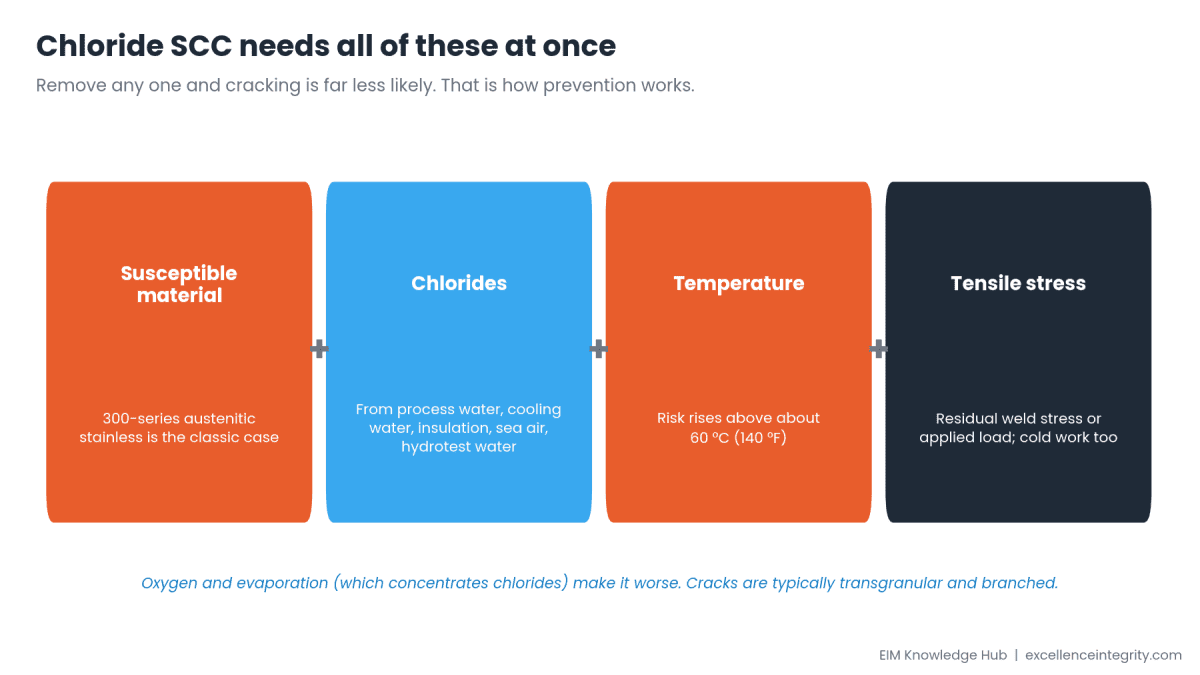
Short answer: Chloride SCC needs four things at once: a susceptible material (classically 300-series austenitic stainless steel), chlorides, temperature (risk rises above about 60 °C), and tensile stress. Remove any one and the risk falls sharply. Prevention means choosing a resistant alloy, keeping chlorides away from hot stainless surfaces, and controlling stress.
What it needs
- Susceptible material. 300-series austenitic stainless steels such as 304 and 316 are the classic case. Duplex stainless steels are considerably more resistant, and high-nickel alloys more resistant still.
- Chlorides. Even small amounts can be enough if they concentrate, for example by evaporation on a hot surface or in crevices and deposits.
- Temperature. Cracking is rarely seen at ambient temperature. Risk rises with temperature, with about 60 °C (140 °F) commonly cited as where it becomes a concern.
- Tensile stress. Residual stress from welding is often enough on its own. Cold work and applied loads add to it.
- Oxygen in the environment generally makes cracking more likely.
Why nickel matters
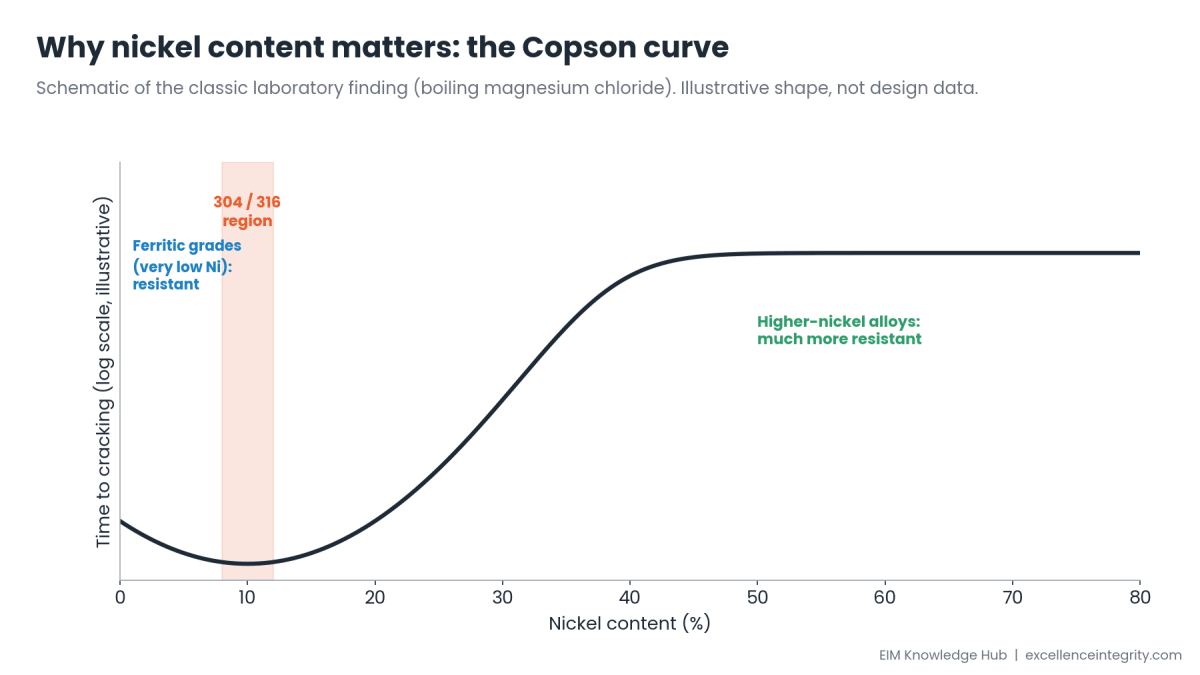
The classic laboratory work behind the Copson curve showed that susceptibility to chloride cracking is greatest at around 8 to 12% nickel, which is exactly where common austenitic grades such as 304 and 316 sit. Ferritic stainless steels with very little nickel, and alloys with much higher nickel, are far more resistant. That is why material upgrades for chloride service often move to duplex grades or nickel alloys rather than to a "better" austenitic grade.
Where it happens
- Under insulation (external chloride SCC). Rainwater or wash water leaches chlorides from insulation or carries salt from the air; hot stainless steel concentrates them. This is a major CUI-related risk; see our guide to corrosion under insulation.
- Cooling water and process water containing chlorides, especially where water evaporates or boils on hot surfaces, such as exchanger tubes.
- Hydrotest water left in equipment. Water with chlorides left to stand or evaporate inside stainless equipment can start cracking before the unit even starts up. Many specifications limit chlorides in hydrotest water for stainless steel and require prompt draining and drying.
- Deposits and crevices, where chlorides collect and concentrate.
- Coastal and marine atmospheres, where salt settles on warm surfaces.
What it looks like
Chloride SCC typically produces fine, branching cracks that are mostly transgranular (through the grains), often with little visible corrosion around them. Cracks can start on either surface and are often clustered near welds, attachments and other high-stress areas. This morphology helps tell it apart from polythionic acid SCC, which is intergranular and appears after shutdowns in sensitised stainless steel.
How to find it
- Penetrant testing (PT) on accessible surfaces, with good cleaning; tight cracks need careful technique.
- Eddy current techniques, including array probes, for surface cracks on stainless steel.
- Ultrasonic testing, including phased array, for cracks starting on the far surface.
- Under insulation: target inspection at the high-risk locations, and remove insulation where the risk ranking points to it.
- Metallography on samples, when you need to confirm the mechanism.
How to prevent it
- Choose a resistant material where hot chloride service is unavoidable: duplex or super duplex stainless steels, high-nickel alloys, or in some cases ferritic grades.
- Keep chlorides off hot stainless surfaces: low-chloride insulation, coatings on stainless under insulation, good jacketing, and design that avoids evaporation and deposits.
- Control hydrotest water: low-chloride water, and drain and dry promptly.
- Reduce stress where practical, through design and, where suitable for the material, stress relief.
- Control temperature where operation allows, keeping metal temperatures below the range of concern.
Chloride SCC in exams
Chloride SCC is one of the damage mechanisms in API RP 571, the whole of which is examined in API 571, so inspectors are expected to know its critical factors, affected materials and inspection methods. Check the effectivity sheet for API 510, 570 or 653 to see which RP 571 mechanisms your exam includes. It is also one of the confusable pairs in our API 571 study plan: chloride SCC (transgranular, hot chloride service) versus polythionic acid SCC (intergranular, sensitised metal, after shutdowns).
Learn more with EIM
EIM's live Material Selection and Failure Analysis course with Mr. Deepak Rawtal covers material selection principles, corrosion resistance, failure analysis methodology and degradation mechanisms; check the course page for the next batch. Preparing for API 571? EIM's live API 571 Damage Mechanisms - Exam Preparation course runs from 16 January to 14 February 2027, Saturday and Sunday, 18:00 to 20:00 UAE time, and the self-paced API 571 preparation includes a question bank, timed mock tests, study notes and flashcards, with one year of access. EIM is an independent training provider.
Frequently asked questions
Which stainless steels are most susceptible to chloride SCC?
300-series austenitic stainless steels such as 304 and 316 are the most commonly affected. Duplex stainless steels are more resistant, and high-nickel alloys more resistant still.
At what temperature does chloride SCC occur?
It is rarely seen at ambient temperature. Risk rises with temperature, and about 60 °C (140 °F) is commonly cited as where it becomes a concern.
Does 316 resist chloride SCC better than 304?
Only slightly. 316's molybdenum improves pitting resistance, but both sit in the most susceptible nickel range for chloride SCC. Duplex grades or nickel alloys are the usual upgrades.
Can hydrotest water cause chloride SCC?
Yes, if water containing chlorides is left in stainless equipment, particularly where it evaporates or is later heated. Use low-chloride water and drain and dry promptly.
How is chloride SCC different from polythionic acid SCC?
Chloride SCC is usually transgranular and branched, in hot chloride service. Polythionic acid SCC is intergranular, needs sensitised stainless steel, and typically appears after shutdowns.
Sources
- API RP 571, Damage Mechanisms Affecting Fixed Equipment in the Refining Industry, 3rd edition: chloride stress corrosion cracking. Summarised, not quoted.
- Copson, H.R., classic work on the effect of nickel content on chloride stress corrosion cracking (boiling magnesium chloride tests). Shape summarised.
- Checked 7 October 2026.