Amine SCC vs Caustic SCC: Two Look-Alike Cracks, Two Different Causes
Amine and caustic SCC look almost identical. How they differ in environment and drivers, where caustic concentrates, and how PWHT prevents both.
By Siddique13 Nov 20265 min read
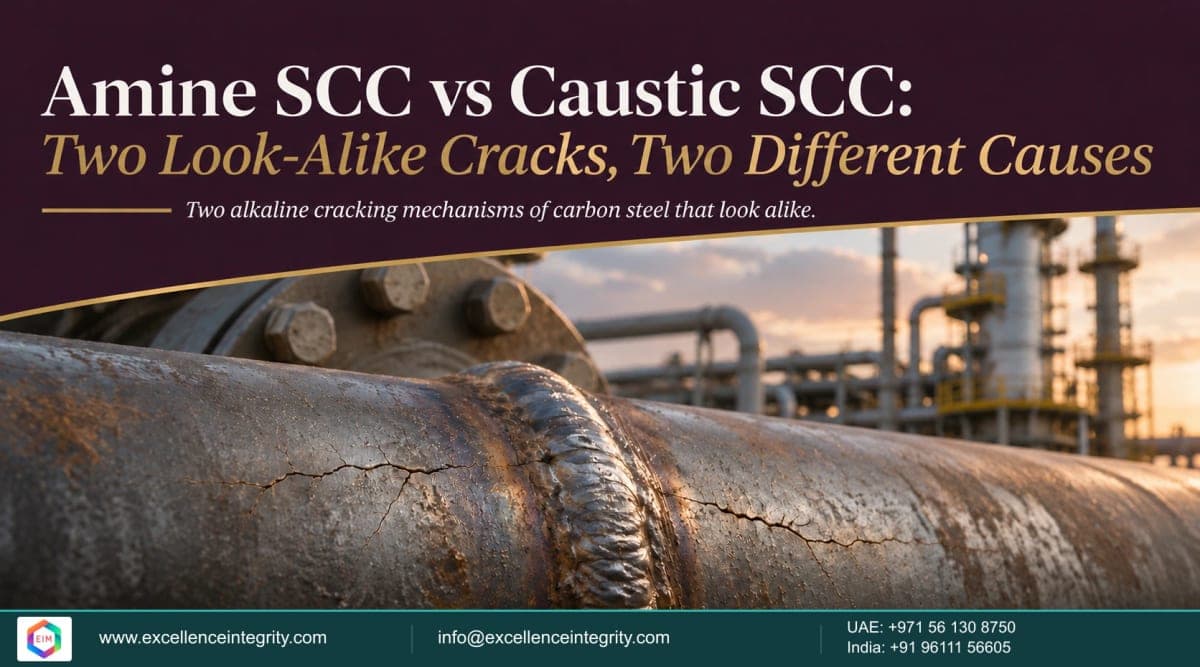
Put a metallographic section of amine stress corrosion cracking next to one of caustic stress corrosion cracking and even experienced engineers can struggle to tell them apart. Both are alkaline cracking of carbon steel, both are usually intergranular and oxide-filled, and both cluster near welds that were never stress-relieved. The difference is the environment, and that determines how you prevent them.
Short answer: Amine SCC happens in lean amine service (most often MEA and DEA) in carbon steel welds that were not stress-relieved; API RP 945 gives the PWHT guidance. Caustic SCC happens where sodium hydroxide is hot or concentrated enough; NACE SP0403's caustic service chart sets when PWHT is needed. Both are prevented mainly by post-weld heat treatment and by avoiding conditions that concentrate the chemical.
Side by side
Amine stress corrosion cracking
Amine units use alkanolamines such as MEA, DEA, MDEA and DIPA to remove H2S and CO2. Amine cracking is a form of alkaline SCC in carbon and low-alloy steel, most commonly associated with lean amine (amine after the acid gases have been stripped out). It is more prevalent in MEA and DEA service, though it can occur in others.
- Where: near welds and cold-worked areas in equipment and piping that was not stress-relieved, or was stress-relieved inadequately.
- Drivers: residual tensile stress, temperature (susceptibility generally rises with temperature) and the amine solution's composition.
- Looks like: branched, intergranular cracks, often oxide-filled, usually starting on the process side next to welds.
- Resistant materials: austenitic stainless steels and Alloy 400 are resistant to amine cracking.
API RP 945, Avoiding Environmental Cracking in Amine Units, now in its 4th edition (September 2022), is the main guidance. It covers carbon steel equipment in amine units, including when PWHT is required, fabrication, inspection and repair. Rotating equipment is outside its scope, though API 610 recommends PWHT of welds in amine service for pumps.
Caustic stress corrosion cracking
Caustic (sodium hydroxide) is used throughout refineries: treating, neutralising, and in utility systems. Caustic SCC, sometimes called caustic embrittlement, has been known since the days of riveted steam boilers. Whether carbon steel is at risk depends on the caustic concentration and the metal temperature.
- Where: welds and cold-worked areas that were not stress-relieved, exposed to caustic that is hot enough or concentrated enough.
- Drivers: caustic concentration, metal temperature and residual stress.
- Looks like: fine, branched, intergranular cracks, often oxide-filled, near welds.
- Stainless steel can also crack in caustic at higher temperatures.
NACE SP0403-2023, Avoiding Caustic Stress Corrosion Cracking of Refinery Equipment and Piping, presents the long-standing Caustic Service Chart, which shows, by concentration and temperature, where carbon steel can be used without stress relief, where PWHT is needed, and where an alloy upgrade is required. Recent editions also include a chart for 300-series stainless steels. Use the chart from the edition your specification calls for.
Where caustic quietly concentrates
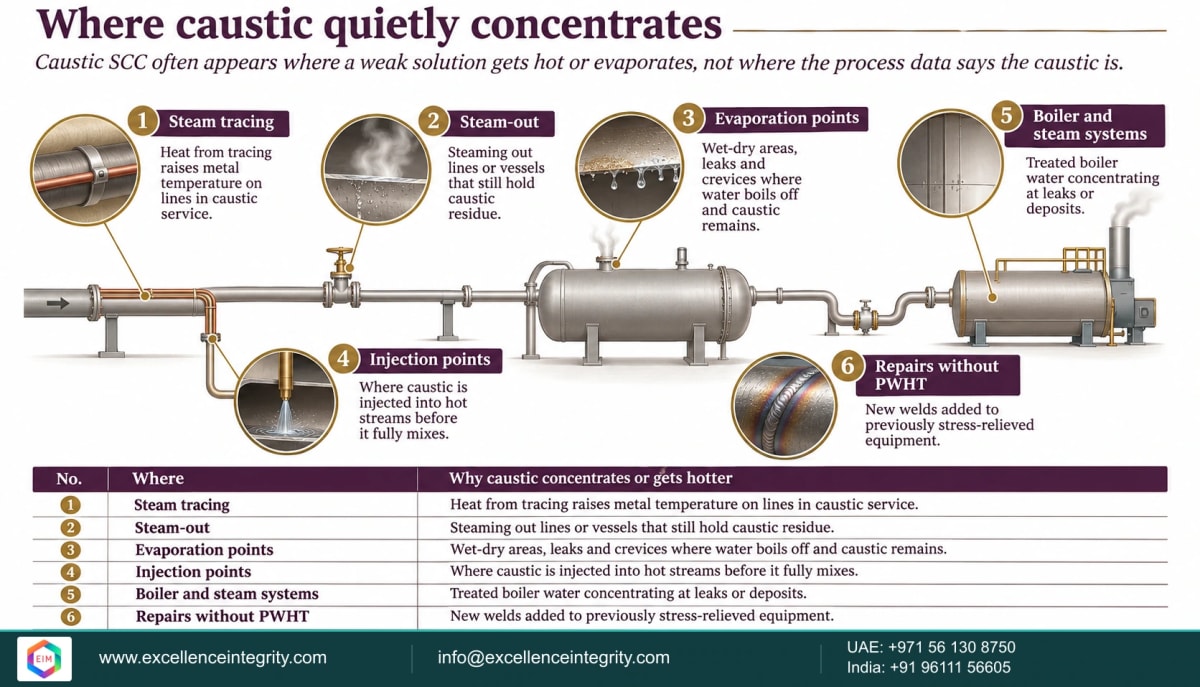
Many caustic SCC failures happen in equipment designed for safe conditions, because the metal saw something different from the process design: a steam-traced line that runs hotter than the fluid, a line steamed out with caustic still inside, a leak or crevice where water evaporates and caustic concentrates, or an injection point where caustic meets a hot stream before mixing. A repair weld added without PWHT to equipment that was stress-relieved can also reintroduce the risk.
Telling them apart
Because the cracks look the same, the environment is the best clue. Ask: is this equipment in amine service, caustic service, or exposed to either through upsets, carry-over, cleaning or steam-out? Check the PWHT records of the welds involved, and the actual metal temperatures, including tracing and start-up conditions. In exams, the question usually gives you the environment; in the plant, you have to go and find it.
Prevention and inspection
- PWHT where the guidance requires it: API RP 945 for amine service, NACE SP0403 for caustic service, including repair welds.
- Control the environment: avoid steam tracing hot spots on caustic lines, wash out caustic before steam-out, and design injection points for good mixing.
- Choose resistant materials where conditions are too severe for stress-relieved carbon steel.
- Inspect for cracking at welds: wet fluorescent magnetic particle testing on prepared surfaces, and shear-wave or phased array UT for cracks that may not reach the surface you can access.
- Check repairs: confirm PWHT was done on any weld in these services.
Learn more with EIM
Both mechanisms are in API RP 571 and are one of the classic confusable pairs on the API 571 exam; see our API 571 study plan. EIM's live API 571 Damage Mechanisms - Exam Preparation course with Mr. Deepak Rawtal covers chemical-environment damage, including amine cracking, in week 2; the current batch runs 16 January to 14 February 2027. EIM's self-paced API 571 preparation includes a question bank, practice mode with explanations, timed mock tests, study notes and flashcards, with one year of access. EIM is an independent training provider.
Frequently asked questions
What is the difference between amine SCC and caustic SCC?
Both are alkaline stress corrosion cracking of carbon steel near non-stress-relieved welds and look very similar. Amine SCC occurs in amine (especially lean amine) service; caustic SCC occurs where sodium hydroxide is hot or concentrated enough.
Does PWHT prevent amine cracking?
Post-weld heat treatment is an effective way to mitigate amine cracking. API RP 945 gives guidance on when PWHT is required.
Which amines are most associated with cracking?
Amine cracking is more prevalent in MEA and DEA service, although it can occur in MDEA and DIPA service too.
Which standard covers caustic SCC?
NACE SP0403, Avoiding Caustic Stress Corrosion Cracking of Refinery Equipment and Piping, with its Caustic Service Chart. The current edition is 2023.
Can stainless steel suffer caustic SCC?
Yes, at higher temperatures. Recent editions of NACE SP0403 include a caustic service chart for 300-series stainless steels.