From QA/QC Inspector to Asset Integrity Engineer: How to Make the Move
How QA/QC inspectors move into asset integrity: the skills you already have, the gap to close, which certifications help, and a 24-month plan.
By Syed Hasan13 Nov 20265 min read
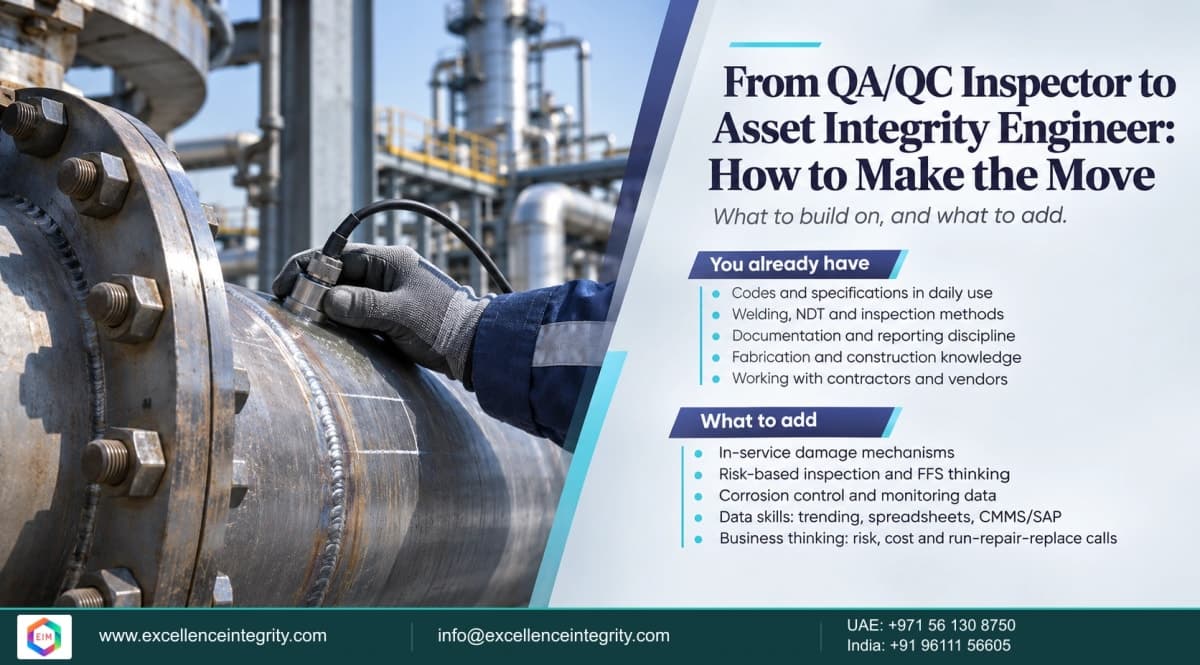
Many inspection professionals in the Gulf and India start in QA/QC on construction and fabrication projects: checking welds, witnessing tests, reviewing documents. A common next goal is asset integrity: deciding how operating plant is inspected, what damage it faces, and whether it can keep running. The move is very achievable, but it is not just a change of job title. It is a change in the questions you answer.
Short answer: QA/QC asks "was it built to the specification?" Asset integrity asks "what is happening to it in service, and what should we do about it?" You already have the codes, inspection methods and documentation discipline. Add in-service damage mechanisms, RBI and fitness-for-service thinking, corrosion and monitoring data, and the confidence to make and defend risk-based decisions.
What changes when you move
| QA/QC (construction) | Asset integrity (operations) | |
|---|---|---|
| Main question | Was it built to the specification? | What is happening to it in service, and what do we do? |
| Time frame | The project, until handover | The life of the asset |
| Typical codes | Fabrication codes, welding and NDT standards | API 510, 570, 653, API 571, 580/581, 579-1, plus the construction codes |
| Decisions | Accept or reject against the code | Run, repair, replace, rerate or monitor, based on risk |
| Data | Inspection reports and test records | Thickness trends, corrosion rates, monitoring data, process conditions |
The skills you already have, and the gap
Your QA/QC experience is a real advantage: you know how equipment is built, where welds go wrong, and how to read a code. What integrity roles add is thinking over time. Damage mechanisms, corrosion rates, risk and remaining life are the language of the job, and the biggest step is moving from "pass or fail" to "how long, how likely, and what should we do".
Which certifications help
- API 510, 570 or 653. The core in-service inspector certifications for vessels, piping and tanks. Each has an education-and-experience table; check where your experience counts. Choose the one that matches the equipment in the roles you want.
- API 571 and API 580. Holding API 510, 570 or 653 qualifies you automatically. API 571 covers damage mechanisms; API 580 covers risk-based inspection. Together they are the clearest signal that you think like an integrity engineer.
- Fitness-for-service training. API has no certification exam for API 579-1, so structured training is how you show the skill.
- AMPP certifications if your path is corrosion-focused: cathodic protection, internal corrosion or general corrosion ladders.
A 24-month plan
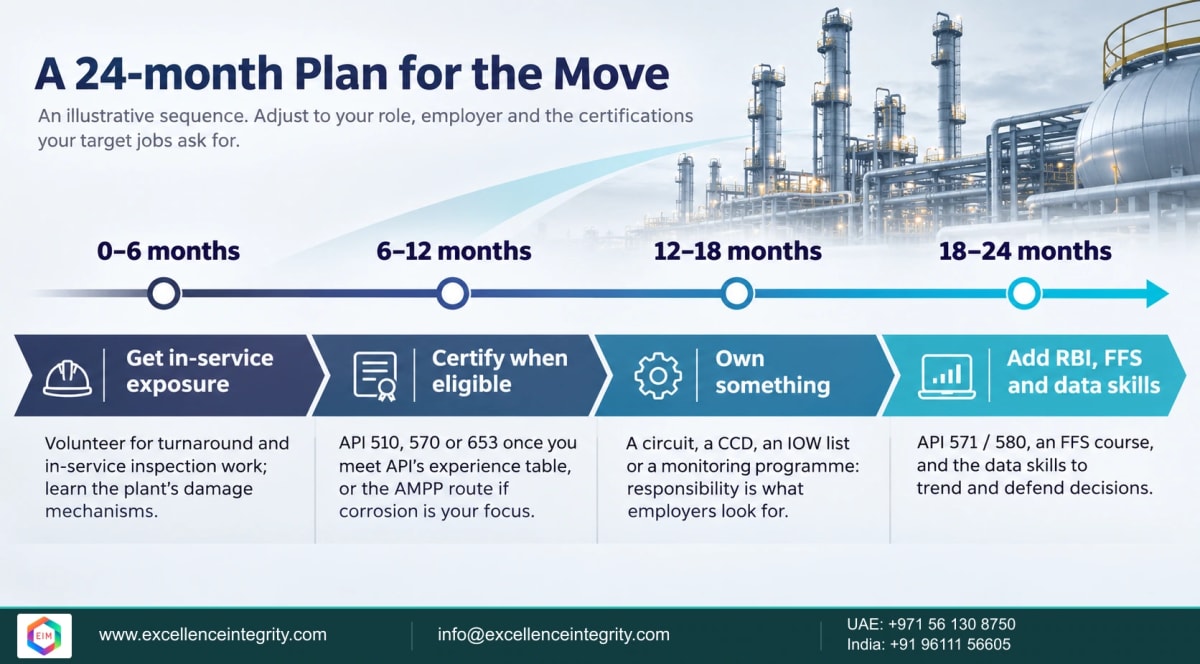
- Get in-service exposure (months 0 to 6). Volunteer for turnaround inspection, in-service inspections or shutdown support. Learn the damage mechanisms in your plant and read the corrosion control documents.
- Certify when eligible (months 6 to 12). API 510, 570 or 653 once you meet API's experience table, or the AMPP route if corrosion is your focus.
- Own something (months 12 to 18). Ask to own a circuit, a corrosion control document, an IOW list, or a monitoring programme. Responsibility is what employers look for in integrity candidates.
- Add RBI, FFS and data (months 18 to 24). API 571 and 580, fitness-for-service training, and the data skills to trend thickness, calculate remaining life and defend a recommendation.
Skills that make the difference in interviews
- Explain a decision. "We extended the interval because the rates in that circuit were uniform and low, and we added scanning at the injection point" beats "I did thickness surveys".
- Show you can use data. Trending corrosion rates, spotting outliers, and calculating remaining life. A simple spreadsheet you built tells an interviewer a lot.
- Speak risk and cost. Integrity decisions balance safety, production and money. Show you understand all three.
- Write clearly. Integrity recommendations are only useful if operations and management understand them.
Rewrite your CV for the role you want
A QA/QC CV lists inspections and documents. An integrity CV shows decisions and outcomes in operating plant. Lead with your in-service experience, damage mechanisms you have dealt with, and any ownership of circuits or programmes. See The Inspector's CV for how to turn duties into outcomes.
Where EIM can help
EIM's One-to-One Career Acceleration Mentoring is built for experienced inspection, corrosion, integrity and reliability professionals who want to move beyond technical execution. Its eight weekly sessions cover a career reality check, skill repositioning, technical confidence, risk and business thinking, digital capability, professional credibility and leadership readiness, with an optional 12-week track, by arrangement. See the mentoring programme
EIM's Career Navigator rebuilds CVs and LinkedIn profiles for inspection professionals, and the Leadership Career Strategy Program supports senior professionals with ten years or more aiming for leadership moves. For technical depth, EIM's self-paced preparation for API 571 and API 580 is built, and the live Asset Integrity Management course covers AIM from asset register to RBI, FFS and IOWs; check the course page for the next batch. EIM is an independent training provider.
Frequently asked questions
Can a QA/QC inspector become an asset integrity engineer?
Yes. Many do. The key steps are gaining in-service experience, learning damage mechanisms and risk-based thinking, and taking ownership of integrity decisions.
Which certification should I get first?
Usually the API in-service certification that matches the equipment in your target roles: API 510, 570 or 653. Holding one qualifies you for API 571 and 580.
Do I need an engineering degree?
A degree helps with some roles and shortens experience requirements for several certifications, but many integrity professionals have built the role on inspection experience. Check what your target employers ask for.
How long does the move take?
It depends on your starting point and opportunities. A deliberate plan over one to two years, with in-service exposure and ownership of a programme, is a realistic frame.
What do integrity interviewers ask about?
Damage mechanisms, how you would set an inspection interval, how you use corrosion data, and how you would handle a finding that challenges continued operation.
Sources
- EIM career services and course descriptions.
- API Individual Certification Programs: API 510, 570, 653, 571 and 580 eligibility (see EIM's earlier guides).
- Career guidance is EIM's view. Checked 7 October 2026.