API 653 Inspection Intervals: Routine, External, UT and Internal
API 653 inspection intervals: routine, external, shell UT and internal, the RCA/4N and RCA/2N rules, safeguard credits and the 20/30-year limits.
By Syed Hasan15 Nov 20264 min read
API 653 does not set one inspection interval for a storage tank. It sets four clocks running at once: frequent routine checks by site personnel, external inspections by an authorized inspector, ultrasonic thickness surveys of the shell, and internal inspections of the floor and inside of the tank. Two of them can be shortened by the tank's own corrosion data, and the internal one can be lengthened by safeguards. Knowing how they interact is basic to the job, and to the exam.
Short answer: External inspection: every 5 years or RCA/4N, whichever is less. Shell UT: RCA/2N or 15 years, whichever is less (5 years if the corrosion rate is unknown). Internal: the first within 10 years of service, extended by credits for safeguards; later intervals from corrosion rates and minimum remaining thickness, or RBI; never more than 20 years, or 30 with a release prevention barrier. RCA is the remaining corrosion allowance in mils; N is the corrosion rate in mils per year.
The four clocks
1. Routine in-service inspection
Frequent visual checks of the tank's exterior by owner or operator personnel who know the operation: leaks, shell distortion, settlement signs, corrosion, the condition of the foundation, coatings and appurtenances. API 653 sets a maximum interval for these; check 6.3.1 in your edition.
2. External inspection
A formal visual external inspection by an authorized inspector, at least every 5 years or RCA/4N years, whichever is less. A tank that is corroding quickly gets inspected more often.
3. Shell ultrasonic thickness
In-service UT thickness measurements of the shell, at RCA/2N years or 15 years, whichever is less. Where the corrosion rate is not known, the maximum interval is 5 years. These surveys feed the shell calculations in our guide to shell minimum thickness.
4. Internal inspection
The out-of-service inspection that looks at the floor, the inside of the shell and internal components.
- First internal inspection: within 10 years of entering service, extended by credits in API 653's table of safeguards, for example linings, soil-side cathodic protection, a release prevention barrier, or a thicker or corrosion-resistant bottom. See linings and cathodic protection.
- Later internal inspections: set so the floor stays above its minimum remaining thickness at the next inspection, using measured product-side and soil-side corrosion rates, or by a risk-based inspection assessment.
- Absolute limits: never more than 20 years between internal inspections without a release prevention barrier, or 30 years with one, whether the interval comes from corrosion rates or RBI.
Our tank floor inspection guide covers the floor side: MFL scanning and the minimum remaining thickness limits.
Worked example
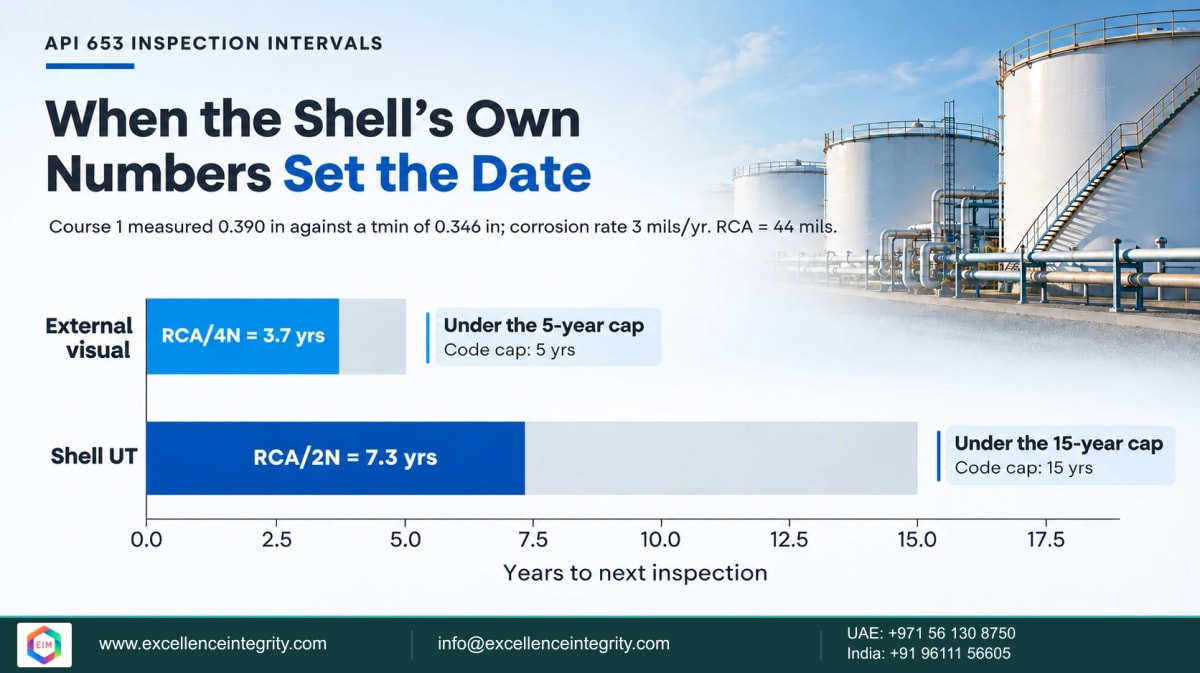
Course 1 of a tank measures 0.390 in against a minimum required thickness of 0.346 in, so RCA = 0.044 in = 44 mils. The shell corrosion rate is 3 mils per year.
| Inspection | Calculation | Code cap | Next due |
|---|---|---|---|
| External visual | RCA/4N = 44 / (4 × 3) = 3.7 yrs | 5 years | 3.7 years |
| Shell UT | RCA/2N = 44 / (2 × 3) = 7.3 yrs | 15 years | 7.3 years |
Because the remaining corrosion allowance is small, both inspections are due well before the code caps. If the shell were 0.450 in, RCA would be 104 mils, RCA/4N 8.7 years, and the 5-year cap would govern the external inspection instead.
Common mistakes
- Using inches instead of mils for RCA and N, or mixing the two.
- Forgetting "whichever is less". The calculated value and the cap are compared every time.
- Using the wrong course. RCA should come from the governing course: the one with the least remaining allowance relative to its corrosion rate.
- Treating credits as permanent. Safeguard credits apply to the initial internal interval; later intervals depend on measured rates.
- Exceeding the 20 or 30-year ceiling with an RBI interval.
Preparing for API 653
Interval calculations appear in every API 653 exam. EIM is an independent training provider; EIM's self-paced API 653 preparation includes interval questions in its question bank, practice mode with explanations, timed mock tests, study notes and flashcards, with one year of access. See the API 653 page. Sitting in March 2027? Applications close on 7 January.
Frequently asked questions
How often is an external inspection required under API 653?
At least every 5 years or RCA/4N years, whichever is less, by an authorized inspector.
What is the shell UT thickness interval?
RCA/2N years or 15 years, whichever is less. If the corrosion rate is not known, the maximum is 5 years.
When is the first internal inspection due?
Within 10 years of entering service, plus any credits for safeguards such as linings, cathodic protection or a release prevention barrier.
What is the maximum internal inspection interval?
20 years without a release prevention barrier, or 30 years with one, even when intervals are set by corrosion rate or RBI.
What do RCA and N mean?
RCA is the remaining corrosion allowance: the measured thickness minus the minimum required thickness, in mils. N is the corrosion rate in mils per year.
Sources
- Inspenet: What does API 653 require owners and operators to do?
- Reliability Magazine: API 510, 570 and 653 inspection intervals
- API 653, Section 6 and Table 6.1. Rules paraphrased; table not reproduced.
- Worked example prepared by EIM. Checked 7 October 2026.
Exam preparation
Preparing for API 653?
Practise with exam-style questions, timed mocks and study notes. 1,317 questions in the bank.