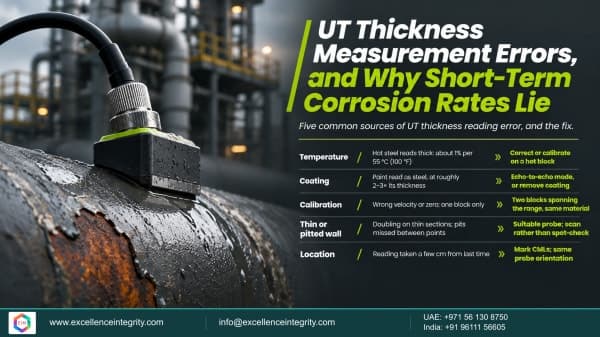
Erosion and Erosion-Corrosion in Piping: Where It Strikes and How to Find It
How erosion and erosion-corrosion damage piping at elbows, tees, valves and mix points, the erosional velocity idea, and how to inspect and mitigate.
By Siddique14 Nov 20264 min read
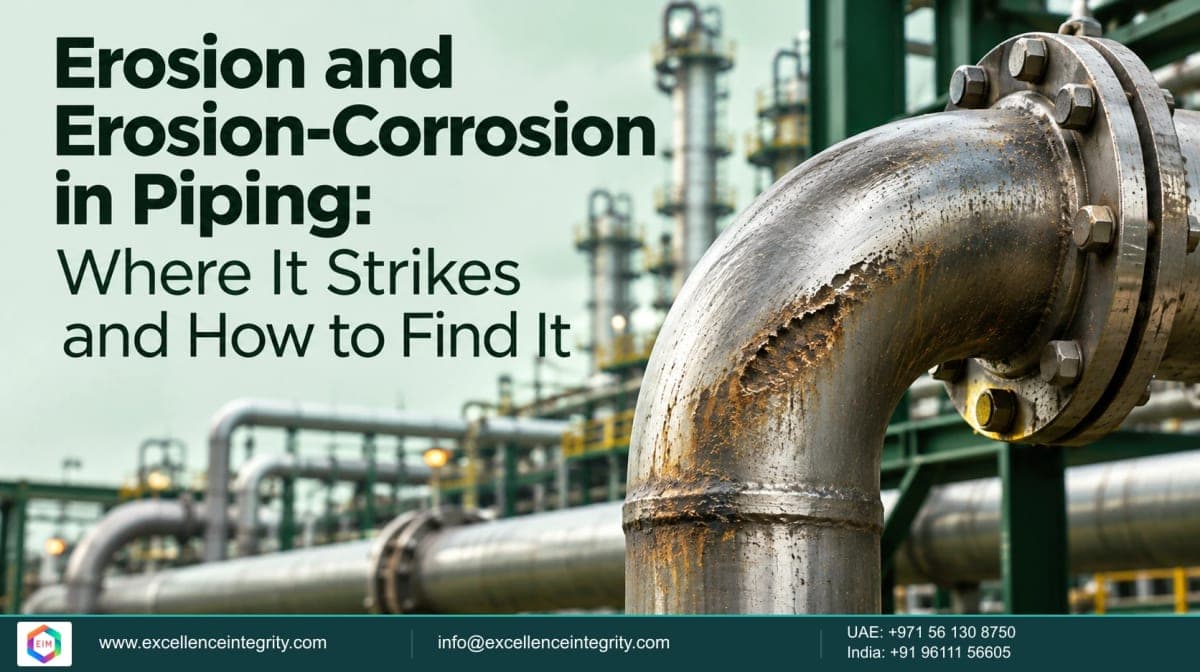
Most corrosion is a slow chemical process. Erosion adds mechanics: fast-moving fluid, droplets or solid particles strip away the protective film, or the metal itself, wherever flow changes direction or speed. The result can be wall loss many times faster than in the straight pipe a metre away, concentrated in small areas that general thickness surveys easily miss.
Short answer: Erosion is mechanical wear by the flowing fluid or particles; erosion-corrosion is the combination of wear and corrosion, where flow keeps removing the protective film so corrosion keeps going. It concentrates at elbows (outer radius), tees, reducers, downstream of control valves, pump casings, and injection and mix points. Find it by targeted scanning at those spots, and control it with velocity limits, design and materials.
Erosion vs erosion-corrosion
- Erosion is mechanical removal of metal by the impact of solid particles, liquid droplets or cavitation. It can damage even corrosion-resistant materials. Sand in production lines is the classic case.
- Erosion-corrosion is the combined effect: the flow removes the protective oxide or scale, and corrosion attacks the fresh metal underneath. Each process speeds up the other. Damage often has a smooth, grooved or horseshoe-shaped appearance aligned with the flow.
- Flow-accelerated corrosion (FAC) is a related form in water and steam systems, where carbon steel's protective oxide dissolves faster in fast-flowing water, especially downstream of flow disturbances.
Where it strikes
- Downstream of control valves and orifices, where velocity and turbulence peak and flashing can occur.
- Elbows, especially the outer radius (extrados), where particles and droplets impinge.
- Tees and branch connections, particularly where flow impinges on the opposite wall.
- Reducers and expanders, where velocity changes.
- Injection and mix points, where a corrosive or cold stream meets the main flow. These also bring thermal fatigue and concentrated corrosion, which is why API 570 treats injection points as their own inspection circuits.
- Pumps and impingement plates, including casings and impellers.
The erosional velocity idea
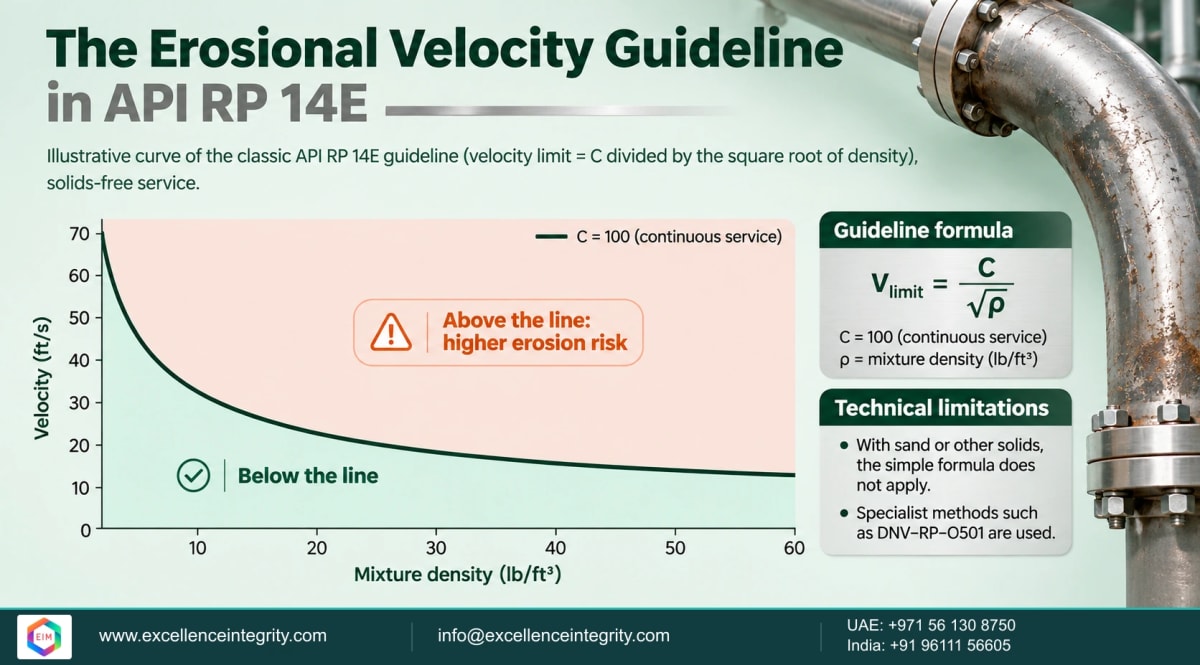
A widely quoted rule for multiphase piping is the erosional velocity guideline in API RP 14E: the velocity limit equals a constant, C, divided by the square root of the mixture density (in ft/s and lb/ft³). A C value of about 100 is commonly used for continuous, solids-free service. Keep its limits in mind: it was developed for solids-free conditions, it can be conservative in clean service, and it does not address sand. Where solids are present, specialist methods such as DNV-RP-O501 are used to predict erosion rates.
How to find it
- Target the hot spots. Put scanning, grids or extra CMLs at the locations above, rather than relying on evenly spaced spot readings. See our guide to CML optimisation.
- Scan, don't spot. Erosion damage is often localised and patterned; UT scanning or profile radiography finds what a single reading misses.
- Monitor where solids are present: sand detectors and erosion probes in production systems give early warning.
- Watch the process: rate increases, sand production, changes in water cut or flashing conditions all change the erosion picture.
- Trend properly. Calculate rates at each hot spot separately; they can differ greatly from the circuit average. The EIM Calculator includes corrosion rate and remaining life tools.
How to control it
- Velocity: size lines and set operating limits to keep velocity within the design basis.
- Geometry: long-radius bends, avoiding closely spaced fittings, and designing injection points for good mixing.
- Materials and liners: harder or more resistant materials, weld overlay or wear-resistant linings at the worst spots.
- Solids control: sand management upstream, such as screens and separation, in production systems.
- Water chemistry: for FAC in water and steam systems, chemistry control and chromium-bearing materials reduce attack.
Learn more with EIM
Erosion and erosion-corrosion appear in API RP 571 and in the piping inspector's day-to-day work; our API 570 exam page explains the piping inspector certification. For pipelines, EIM's self-paced Pipeline Integrity Management programme covers threat assessment, inline inspection and defect assessment. EIM is an independent training provider.
Frequently asked questions
What is the difference between erosion and erosion-corrosion?
Erosion is purely mechanical wear by particles, droplets or cavitation. Erosion-corrosion combines wear with corrosion: the flow strips protective films so corrosion continues at a higher rate.
Where does erosion usually occur in piping?
At elbows (especially the outer radius), tees, reducers, downstream of control valves and orifices, pump casings, and injection and mix points.
What is the API RP 14E erosional velocity?
A guideline that sets a velocity limit equal to a constant C divided by the square root of the mixture density, commonly with C around 100 for continuous solids-free service. It does not address sand.
How do you inspect for erosion?
With targeted scanning, grids or profile radiography at high-wear locations, rather than evenly spaced spot readings, and with erosion monitoring where solids are present.
What is flow-accelerated corrosion?
A form of attack in water and steam systems where carbon steel's protective oxide dissolves faster in fast-flowing water, often downstream of flow disturbances.
Sources
- API RP 571, Damage Mechanisms Affecting Fixed Equipment in the Refining Industry: erosion and erosion-corrosion. Summarised, not quoted.
- API RP 14E, Design and Installation of Offshore Production Platform Piping Systems (erosional velocity guideline). Cited, not quoted.
- DNV-RP-O501, Managing sand production and erosion. Cited by name.
- Checked 7 October 2026.
Exam preparation
Preparing for API 570?
Practise with exam-style questions, timed mocks and study notes. 1,841 questions in the bank.
Also relevant: API 571 Corrosion and Materials