Turnaround Inspection Planning: From Scope to Close-Out
How inspection teams plan a turnaround: scope from RBI and CCDs, work packs, scope freeze, NDT resources, discovery work and close-out.
By Harish Haseeb14 Nov 20265 min read

A turnaround is the one time in years that much of a unit is open for internal inspection. It is also expensive by the day, so every hour the plant stays down matters. Inspection sits right at the centre: inspection scope drives a large share of the work, and inspection findings drive most of the surprises. Turnarounds are won or lost months before the plant shuts down, in how well that scope is planned.
Short answer: Build the inspection scope from RBI, corrosion control documents and history, not from last time's list. Turn it into work packs with clear methods and acceptance criteria. Lock in specialist NDT and materials early, freeze the scope on time, and agree in advance how discovery work will be assessed and decided. After the event, get the data back into the system so the next plan is better.
The inspection side of a turnaround, step by step
1. Build the scope from evidence
The strongest inspection scopes start from the risk picture, not from a copy of the last turnaround's list:
- RBI results: which equipment needs inspection now, by what method and coverage, to stay below its risk target.
- Corrosion control documents and damage mechanism reviews: what damage to expect, where.
- Inspection history: remaining life, open recommendations and deferred items from the last event.
- IOW exceedances and process changes: anything that may have changed the damage since the last inspection.
- Statutory and code requirements: items whose intervals are fixed regardless of risk.
For each item the scope should say what is inspected, how, how much (coverage), and why. If nobody can say why an item is on the list, it is a candidate to remove; if a high-risk item is missing, it is a gap.
2. Turn scope into work packs
A good inspection work pack lets an inspector who has never seen the equipment do the job right. It typically includes the equipment data and history, drawings with inspection locations, the expected damage mechanisms, the methods and coverage required, acceptance criteria or the assessment route, safety and access requirements, and the records to complete.
3. Secure long-lead resources early
Specialist NDT (advanced UT, tube inspection, refractory inspection), qualified inspectors, replacement materials and spare bundles can take many months to arrange. So can contracts with inspection and NDT vendors. These belong early in the plan, well before scope freeze. The heat exchanger tube inspection and PSV testing programmes are typical long-lead items.
4. Freeze the scope, then protect it
A scope freeze date gives planners and contractors a stable base. Changes after the freeze still happen, but they should go through a defined change process with a reason, a cost and a schedule impact. Late additions without that discipline are a major source of overruns.
5. Inspect what you can before shutdown
On-stream inspection in the months before the turnaround (external UT, radiography, guided wave, thermography) can confirm or remove scope items, size damage in advance so repairs can be prepared, and focus the internal inspection where it matters most.
6. Plan for discovery work
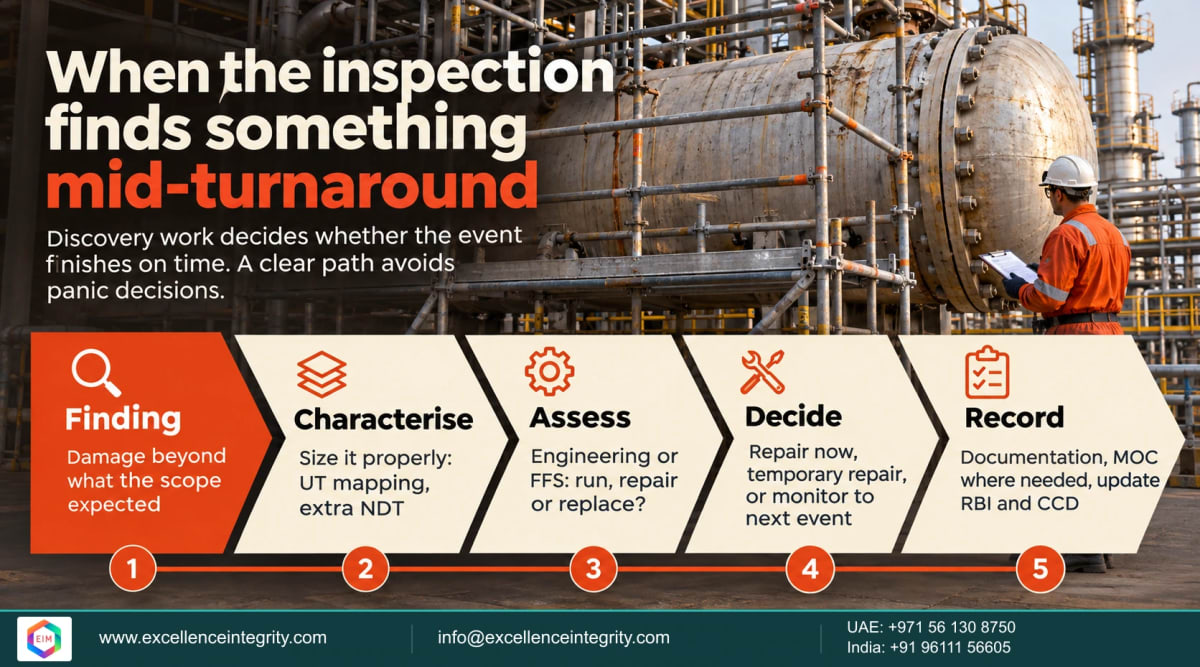
Every turnaround finds something unexpected. What decides the schedule is how fast a finding becomes a decision. Agree in advance: who characterises the damage and how, who can carry out a fitness-for-service or engineering assessment at short notice, what repair options and materials are on standby, and who can approve a decision to repair now, apply a temporary repair or monitor to the next event. Our API 579-1 worked example shows the kind of assessment involved.
7. Close out: the step most often rushed
The turnaround is not finished when the unit restarts. Inspection results, repairs and deferred items must be recorded, thickness data loaded into the inspection system, RBI and corrosion control documents updated, and lessons captured. That close-out is what makes the next turnaround's scope better, and it is the step most often left until it is forgotten.
Common turnaround inspection pitfalls
- Copying last time's scope instead of building it from current risk.
- Late scope freeze, or no change control after it.
- Booking specialist NDT too late.
- No agreed route for discovery work, so every finding waits for a meeting.
- Skipping close-out, so the next event starts from poor data.
Where EIM can help
EIM's inspection services include turnaround support alongside in-service inspection, NDT surveillance and vendor inspection, acting for the owner. When a finding needs a fast second opinion, EIM Daily offers shutdown and emergency support consultations with a written summary. For the planning foundations, EIM's live Risk-Based Inspection (RBI) Techniques course covers inspection planning for piping circuits; check the course page for the next batch. EIM is an independent training provider.
Frequently asked questions
How early should turnaround inspection planning start?
For major events, planning often starts well over a year ahead, so that scope, long-lead NDT, materials and contracts are secured before scope freeze. Smaller events need less lead time.
What is a scope freeze?
The date after which the planned scope is fixed and changes go through a formal change process with justification, cost and schedule impact.
What is discovery work?
Work that arises from unexpected findings during the turnaround, such as damage beyond what the scope anticipated.
Should every item from the last turnaround be inspected again?
Not automatically. Scope should be built from current risk, damage mechanisms and history. Some items may be removed and others added.
What happens after the turnaround?
Close-out: recording results and repairs, loading data into the inspection system, updating RBI and corrosion control documents, and capturing lessons for the next event.
Sources
- Turnaround inspection practice summarised by EIM; no single standard governs turnaround planning.
- Checked 7 October 2026.
Exam preparation
Preparing for SMRP CMRP?
Practise with exam-style questions, timed mocks and study notes. 1,448 questions in the bank.