What Is Asset Integrity Management? A Plain Answer With an Example
What is asset integrity management? A two-sentence answer, the stages from design to retirement, who owns each, and one vessel followed through the cycle.
By Syed Hasan26 Nov 20268 min read
Ask ten people in a plant "what is asset integrity management?" and you will get ten answers. The inspector says it is inspection. The maintenance planner says it is maintenance. The manager says it is a system with a policy and some audits. They are all describing a part of it, which is why the term confuses people new to the field.
This post gives the short answer first, then the stages every piece of equipment goes through, who does what at each stage, and one pressure vessel followed through the whole cycle with simple numbers. If you want the long version afterwards, with programmes, software and organisation in depth, read the complete guide to asset integrity management.
What is asset integrity management?
Asset integrity management is the way a company makes sure its equipment keeps doing its job safely, without leaking or failing, for as long as it is in service. It covers the whole life of the equipment, from design to retirement, and it ties together design, operation, inspection, maintenance and the decisions made from what those activities find.
In process plants the word integrity mostly means containment: keeping hydrocarbons, chemicals and steam inside pipes, vessels, tanks and exchangers. A leak is the failure that asset integrity management exists to prevent.
What asset integrity management is not
It is not a synonym for inspection. Inspection finds and measures damage, but an inspection programme with nobody acting on the findings is just a filing cabinet. It is also not the same as maintenance, which keeps equipment working day to day and often focuses on machines and availability rather than wall thickness and cracks.
And it is not a piece of software. Integrity software holds the data and schedules the work, but the decisions still come from people who understand the damage mechanisms, the codes and the process. A good test is simple: when an inspection finds something, does a named person decide what happens next, and is that decision recorded? If yes, there is integrity management. If not, there is only activity.
The integrity cycle, stage by stage
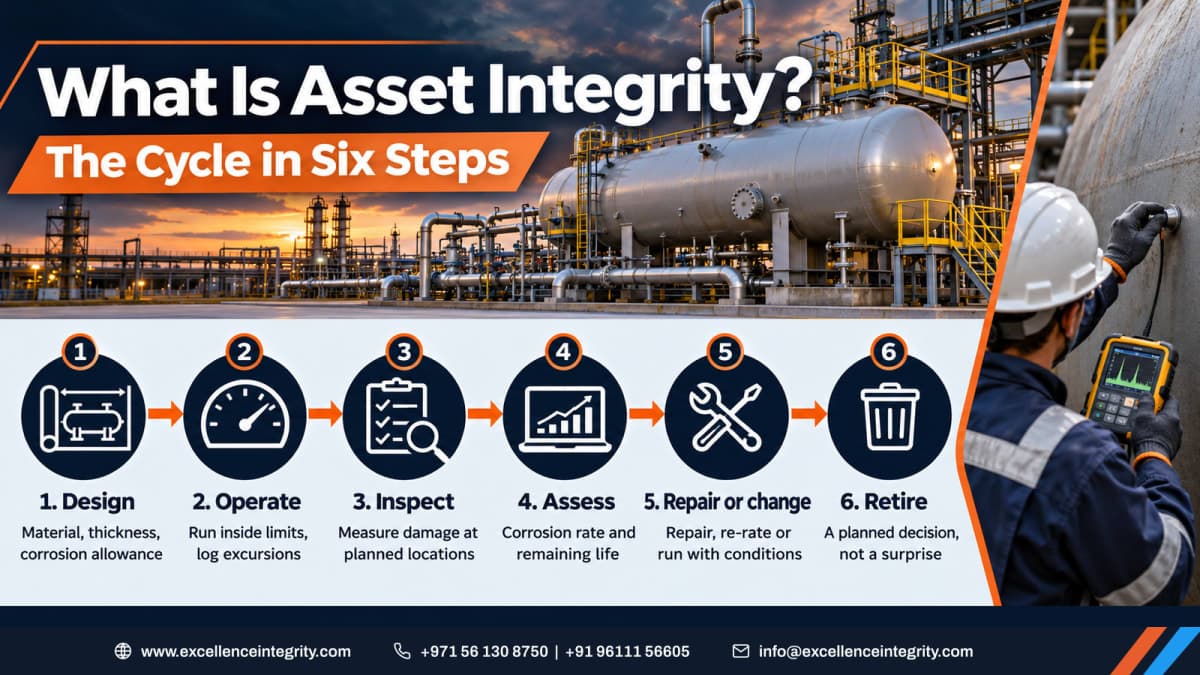
Every item of equipment passes through the same broad stages of the integrity lifecycle. The names vary between companies, but the logic does not.
| Stage | What happens | Who usually owns it |
|---|---|---|
| Design | Material, wall thickness, corrosion allowance and code are chosen for the expected service | Design and materials engineers |
| Operate | The process is run inside agreed limits, and excursions are recorded | Operations |
| Inspect | Damage is looked for and measured at planned locations and intervals | Inspection, often with an inspector network |
| Assess | Findings are turned into a corrosion rate, a remaining life and a decision | Integrity or inspection engineer |
| Repair or change | The item is repaired, re-rated, modified or left in service with conditions | Maintenance, engineering, with integrity sign-off |
| Retire | The item is taken out of service when it can no longer be kept safe or economic | Management, on integrity advice |
The stages loop. After an assessment and a repair, the item goes back to operation with a new inspection date, and the cycle runs again. What changes each time is the information: every loop adds thickness readings, process history and repair records, and the decisions get better as that history grows.
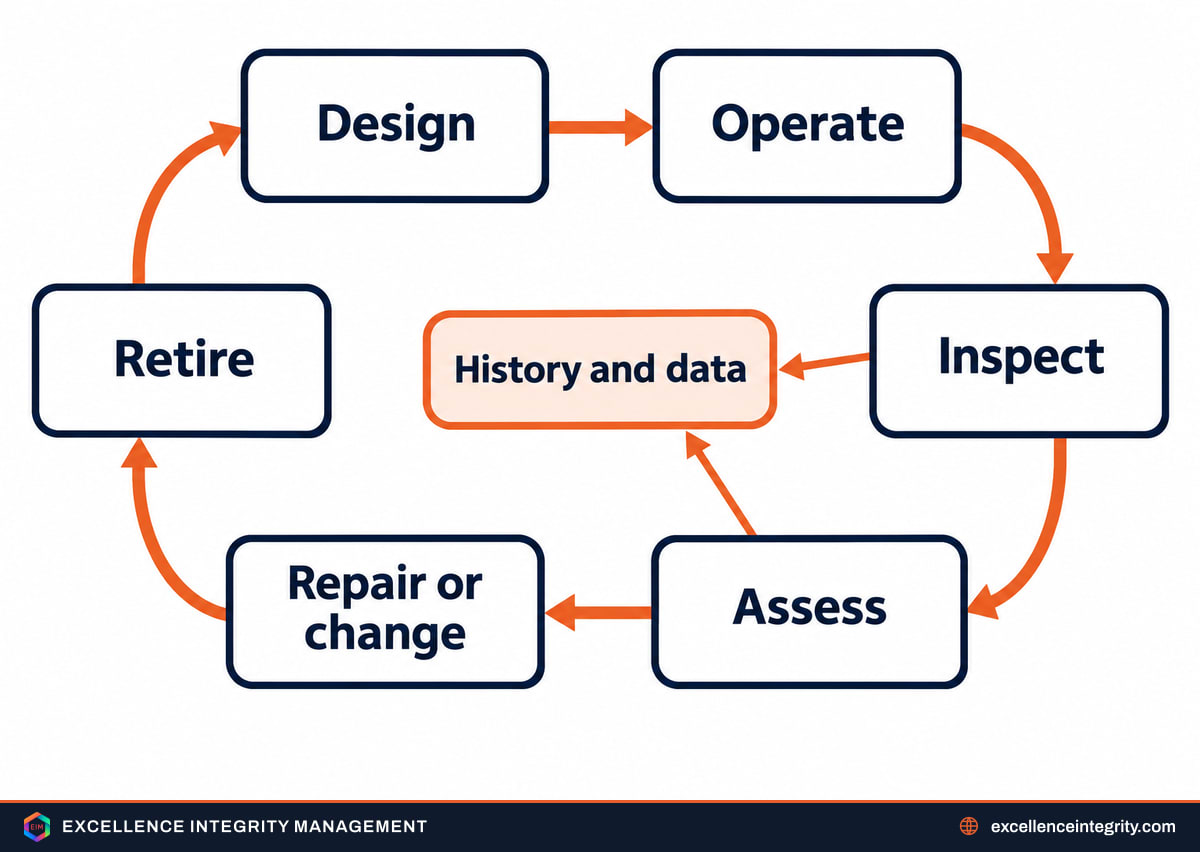
A worked example: one separator through the cycle
The numbers below are illustrative, chosen to show the method. They are not design values for any real vessel.
Design
A carbon steel separator is designed to a pressure vessel code. The design calculation gives a minimum required shell thickness of 9.0 mm. The designer adds a corrosion allowance and the vessel is built with a 12.0 mm shell. That allowance is the metal the vessel is expected to lose over its planned life.
Operate
The separator handles wet gas with some carbon dioxide and produced water. Operations agrees limits on temperature, water content and inhibitor injection, because those drive the corrosion rate. When inhibitor injection stops for a week during a pump failure, the excursion is logged. That single log entry will matter later. Limits like these are called integrity operating windows.
Inspect
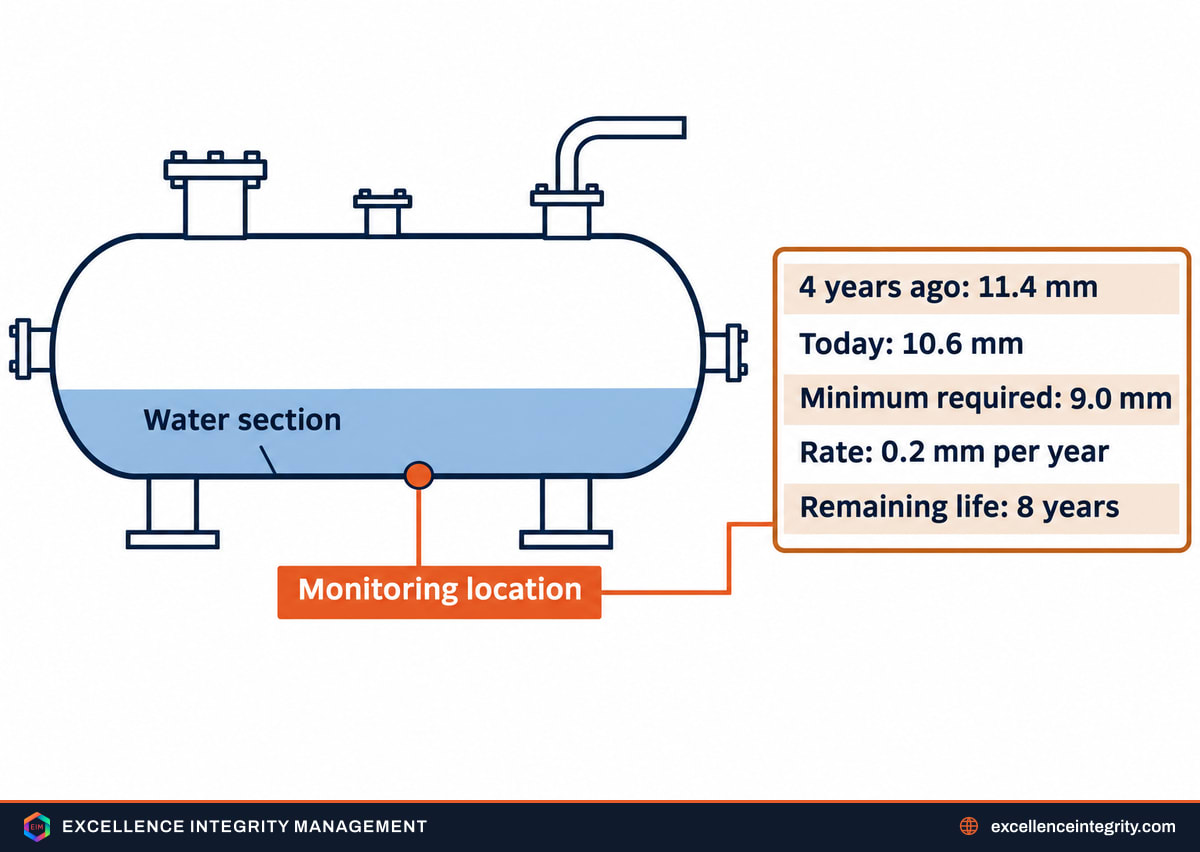
Thickness readings are taken at fixed monitoring locations on the shell and bottom head. At one location in the water section, the reading was 11.4 mm four years ago and is 10.6 mm today.
Assess
The corrosion rate is the metal lost divided by the time: (11.4 minus 10.6) divided by 4 gives 0.2 mm per year. The remaining life is the metal left above the minimum divided by the rate: (10.6 minus 9.0) divided by 0.2 gives 8 years. The full method, including short-term and long-term rates, is in how to calculate corrosion rate and remaining life.
The engineer now makes decisions. Under API 510, the familiar rule is that the interval to the next internal or on-stream inspection should not exceed half the remaining life, subject to a maximum the code also sets, so the next inspection is due within 4 years at most. The engineer also checks the operating log, sees the week without inhibitor, and asks whether the rate is steady or whether most of the loss happened in that week. Either answer changes the plan: a steady rate means watch and trend, a step change means fix the injection reliability.
Repair or change
Suppose the next inspection finds a local area of deeper loss below 9.0 mm. That does not automatically mean the vessel must come out of service. A fitness-for-service assessment can show whether it is safe to run until the next turnaround, perhaps at a reduced pressure, while a repair is planned. The decision, its conditions and its expiry date go into the record.
Retire
Years later, if repairs become frequent and remaining life keeps shrinking, the integrity engineer recommends replacement. Retirement is a planned decision based on the history, not a surprise forced by a leak.
Where the cycle usually breaks
Look back at the example and count the handovers. The designer hands a corrosion allowance to operations. Operations hands an excursion log to the integrity engineer. The inspector hands readings to the engineer, the engineer hands a decision to maintenance, and maintenance hands a repair record back. Each handover is a place where information can drop on the floor.
The common failures are ordinary ones. Design data is missing, so nobody knows the minimum required thickness and every reading is judged against the nominal wall. Process excursions are recorded in an operations system the integrity team never sees. Inspection findings sit in a report that was filed rather than reviewed. A temporary repair, such as a clamp or a sleeve, is fitted with a review date and then forgotten until it leaks.
None of these needs advanced engineering to fix. They need each handover to have an owner, a format and a check that it happened. That is most of what an integrity management system does on paper, and it is why companies write one down rather than relying on good people remembering.
Where risk-based inspection fits
In the example, the inspection interval came from remaining life alone. Many plants instead set intervals and methods using risk-based inspection, which weighs the probability of failure against its consequence. A small water line and a large hydrocarbon vessel with the same corrosion rate need not be inspected the same way. The basics are in risk-based inspection explained, and the professional credential for it is the API 580 risk-based inspection certification preparation.
Three questions to test your own plant
You do not need a full audit to see how well integrity is managed. Pick one vessel and ask:
- Can you find its minimum required thickness, its latest readings and its calculated remaining life in under ten minutes?
- Is there an operating limit for whatever drives its main damage mechanism, and is anyone told when that limit is exceeded?
- Was the last inspection finding closed with a recorded decision, by a named person?
If any answer is no, that is where to start. Most integrity failures are not a lack of inspection. They are a gap between finding something and deciding what to do about it.
Frequently asked questions
What are the stages of asset integrity management?
Equipment passes through design, operation, inspection, assessment, repair or change, and finally retirement. The stages loop: after an assessment and a repair the item goes back into service with a new inspection date, and each loop adds thickness readings, process history and repair records, so the decisions improve as that history grows.
What is the difference between asset integrity management and maintenance?
Maintenance keeps equipment working day to day and often focuses on machines and availability. Integrity management is about containment over the whole life of the equipment: wall thickness, cracks, operating limits, remaining life and the recorded decisions made from inspection findings. Maintenance is one of the activities it ties together, along with design, operation and inspection.
How does risk-based inspection fit into asset integrity management?
Risk-based inspection is one way of setting the inspect stage. Instead of basing intervals on remaining life alone, it weighs the probability of failure against its consequence, so a small water line and a large hydrocarbon vessel with the same corrosion rate need not be inspected the same way or at the same interval.
What to do next
If you are new to integrity work and still asking what is asset integrity management in practice, the most useful habit is to follow one item of equipment through the cycle, as above, using your own plant's records. You will learn more about how your site really works from one vessel than from any organisation chart. For pressure vessel integrity and inspection specifically, the API 510 pressure vessel inspector certification preparation covers the code requirements in detail.
Exam preparation
Preparing for API 580?
Practise with exam-style questions, timed mocks and study notes. 912 questions in the bank.
Preparing for a different exam? Try a free mock test:
Also relevant: API 510 Pressure Vessel Inspector