LNG Heat Exchangers: Plate-Fin, Coil Wound and PCHE in Gas Service
LNG heat exchangers explained: how plate-fin, coil wound and PCHE units are built, what threatens them and how to inspect the ones you cannot open.
By Syed Hasan26 Nov 20269 min read
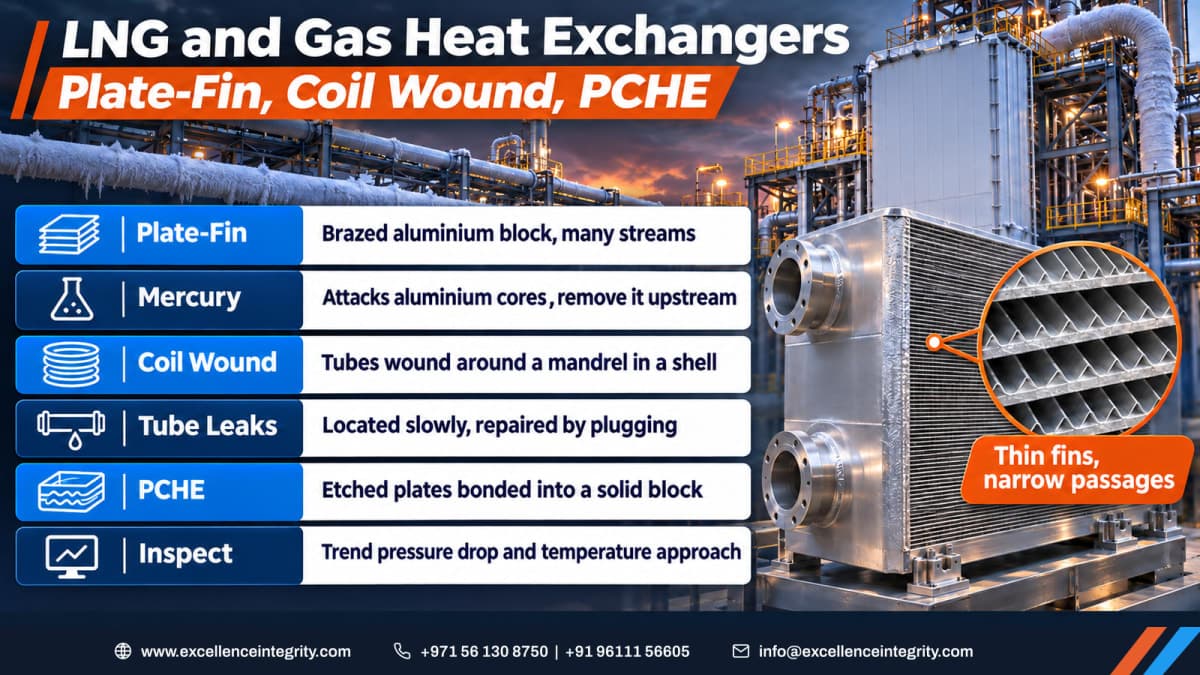
Most heat exchanger advice is written for refinery shell-and-tube bundles: pull the bundle, clean it, test the tubes, plug the bad ones, put it back. Then you move to a gas processing plant or an LNG train and find exchangers that cannot be opened at all. The core is a brazed block, a wound coil inside a welded shell, or a solid diffusion-bonded slab threaded with fine etched channels.
This post covers the three natural gas and LNG heat exchangers you meet most: plate-fin, coil wound (also called spiral wound) and printed circuit. For each you get how it is built, why gas plants choose it and what threatens it, then how to inspect equipment you cannot see inside, which is the real difference from refinery work.
What makes LNG heat exchangers different
Three things set gas and cryogenic service apart. First, the duties are large and the plot space is not, especially offshore and on floating units, so compact exchangers with a lot of surface per cubic metre win. Second, liquefaction and gas separation run at very low temperatures, where ordinary carbon steel loses its toughness and can fail in a brittle way. That pushes the design towards aluminium, austenitic stainless steel and nickel steels. Third, the temperature differences between streams are small and tightly controlled, because the whole process depends on squeezing heat out of the gas efficiently.
Those three pressures lead to exchangers with many streams in one unit, very thin metal sections and small passages. Good for performance, hard on integrity. Thin metal and narrow channels tolerate far less fouling, thermal stress and corrosion than a thick-walled tube bundle does, and most of these designs cannot be repaired the way a tube bundle can.
If a shell-and-tube natural gas heat exchanger is what you look after, start with the general picture in heat exchangers in oil and gas. The rest of this post stays with the compact types.
Plate-fin heat exchangers
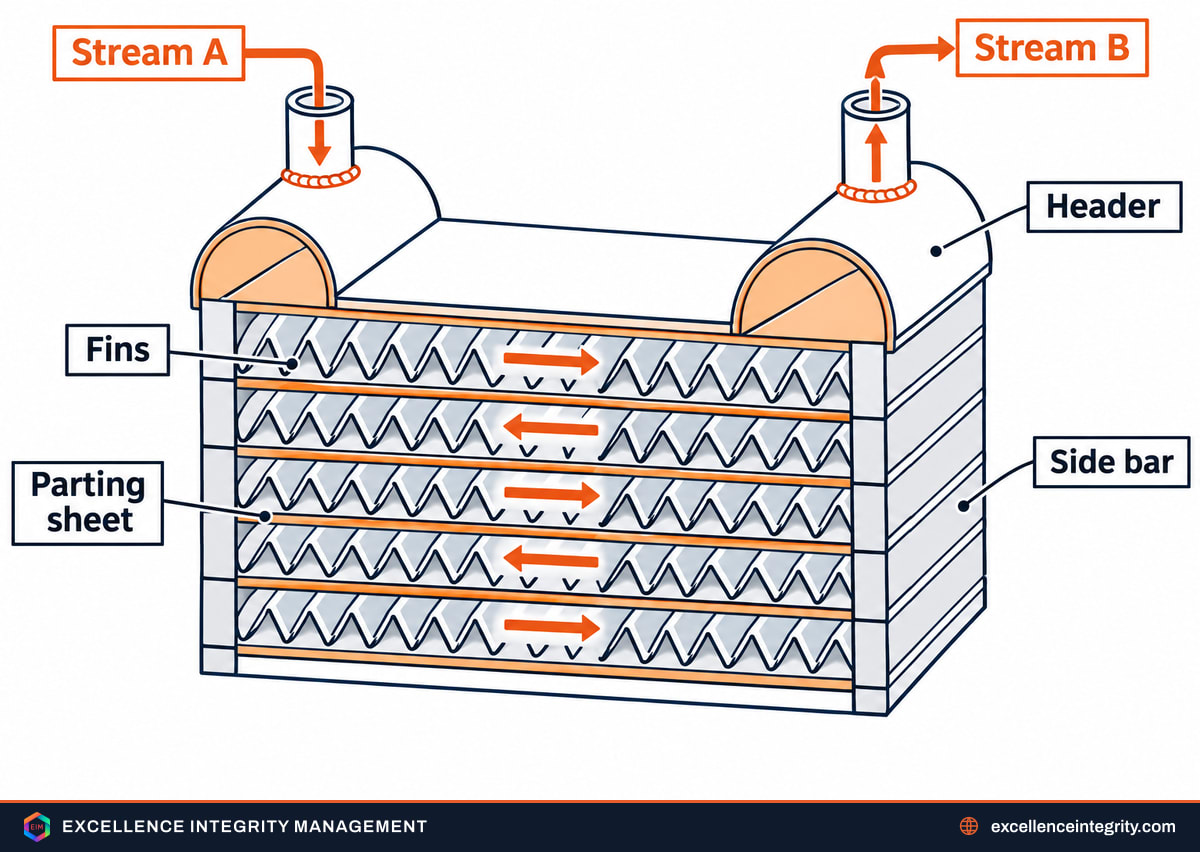
A plate-fin exchanger, often called a brazed aluminium heat exchanger, is a stack of corrugated fin layers separated by flat parting sheets, closed at the edges by side bars and brazed into one block in a vacuum furnace. Headers and nozzles are welded on afterwards. Each layer can carry a different stream, so one core can exchange heat between several streams at once.
Gas plants use them in cryogenic duties such as natural gas liquids recovery, nitrogen rejection and parts of some liquefaction processes. The cores usually sit inside a cold box, a steel enclosure packed with insulation.
What threatens a plate-fin core
The best known risk is mercury. Even small amounts in the feed gas can attack aluminium through liquid metal embrittlement, and the damage can lead to leaks and cracking of the core. That is why gas plants with brazed aluminium exchangers put mercury removal upstream and treat its performance as an integrity issue, not only a product quality one.
The second is thermal stress. Brazed joints and thin fins do not like large or rapid temperature differences between adjacent layers, and repeated upsets, trips and fast cooldowns can crack the core. Manufacturers give limits for temperature difference and rate of change, and the operating procedure should carry them. The third is blockage: solids, hydrates and components that freeze out at low temperature, such as water, carbon dioxide or heavy hydrocarbons, can plug passages. Upstream filtration and dehydration protect the core.
ALPEMA, the manufacturers' association, publishes guidance on the design, operation and care of brazed aluminium plate-fin exchangers. Take any limit you apply from the current edition or the manufacturer.
Coil wound (spiral wound) heat exchangers
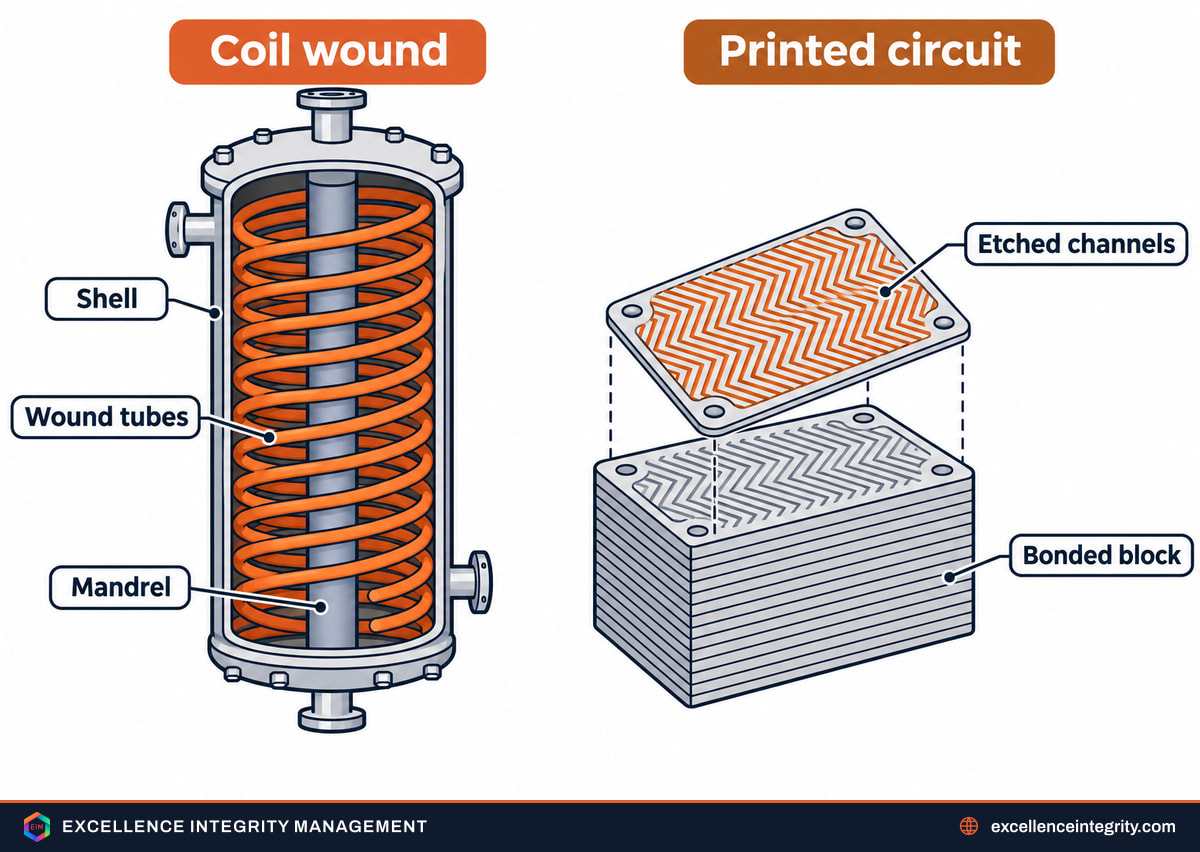
A coil wound heat exchanger has many tubes wound helically in layers around a central mandrel, all inside a tall pressure shell. Several tube-side streams can run through separate tube bundles in the same shell, while a refrigerant usually flows on the shell side. In many large liquefaction trains the main cryogenic heat exchanger is a coil wound unit.
The design is chosen for very large surface area in one vessel and for coping better with thermal transients than a brazed core. Tubes and shell may be aluminium or stainless steel, depending on the licensor's design.
What threatens a coil wound unit
Tube leaks are the main concern. A leak between streams can contaminate a product or upset the refrigerant cycle, and finding it inside thousands of wound tubes is slow. Repair is usually limited to plugging the leaking tube, so every plug costs surface area for the rest of the unit's life. Shell-side maldistribution is the second: the refrigerant has to spread evenly over the bundle, and poor distribution shows up as lost performance and uneven cold spots. Thermal stress during cooldown and warm-up also matters, as with any large cryogenic vessel.
Printed circuit heat exchangers (PCHE)
A printed circuit heat exchanger is built from flat metal plates with fine flow channels chemically etched into one face. The plates are stacked and diffusion bonded, which joins them into what is effectively a solid block of metal with the channels running through it. They are usually stainless steel or nickel alloy.
The result is very compact and suited to high pressure, which is why PCHEs are common offshore and on floating LNG, in gas compression cooling and in other high-pressure gas duties where weight and space count.
What threatens a PCHE
The channels are small, so blockage is the first risk. Fine solids, corrosion products from upstream piping, hydrates or wax can plug channels, and a blocked PCHE generally cannot be cleaned mechanically. Strainers or filters upstream are part of the design for that reason, and chemical cleaning is the usual remedy. Internal leaks are the second: a leak between passages inside a bonded block normally cannot be repaired in the field. Quality of the diffusion bond and correct pressure testing at manufacture are the main defences.
The three types side by side
| Type | How it is built | Typical gas or LNG use | Main integrity concerns |
|---|---|---|---|
| Plate-fin (brazed aluminium) | Fin layers and parting sheets brazed into a block | NGL recovery, nitrogen rejection, cold box duties | Mercury attack, thermal stress, blockage by freezing or solids |
| Coil wound (spiral wound) | Tubes wound around a mandrel inside a pressure shell | Main cryogenic exchanger in many liquefaction trains | Tube leaks, shell-side maldistribution, cooldown stress |
| Printed circuit (PCHE) | Etched plates diffusion bonded into a solid block | Offshore and floating LNG, high-pressure gas cooling | Channel blockage, internal leaks that cannot be repaired |
All three share one awkward fact: you cannot walk inside them, and a defect found late may mean replacing a large, long-lead item rather than fixing a part of it.
How you inspect what you cannot open
With a shell-and-tube bundle, inspection means looking and measuring. With LNG heat exchangers, most integrity evidence comes from the process side, and the inspector's job is to make sure it is collected and acted on.
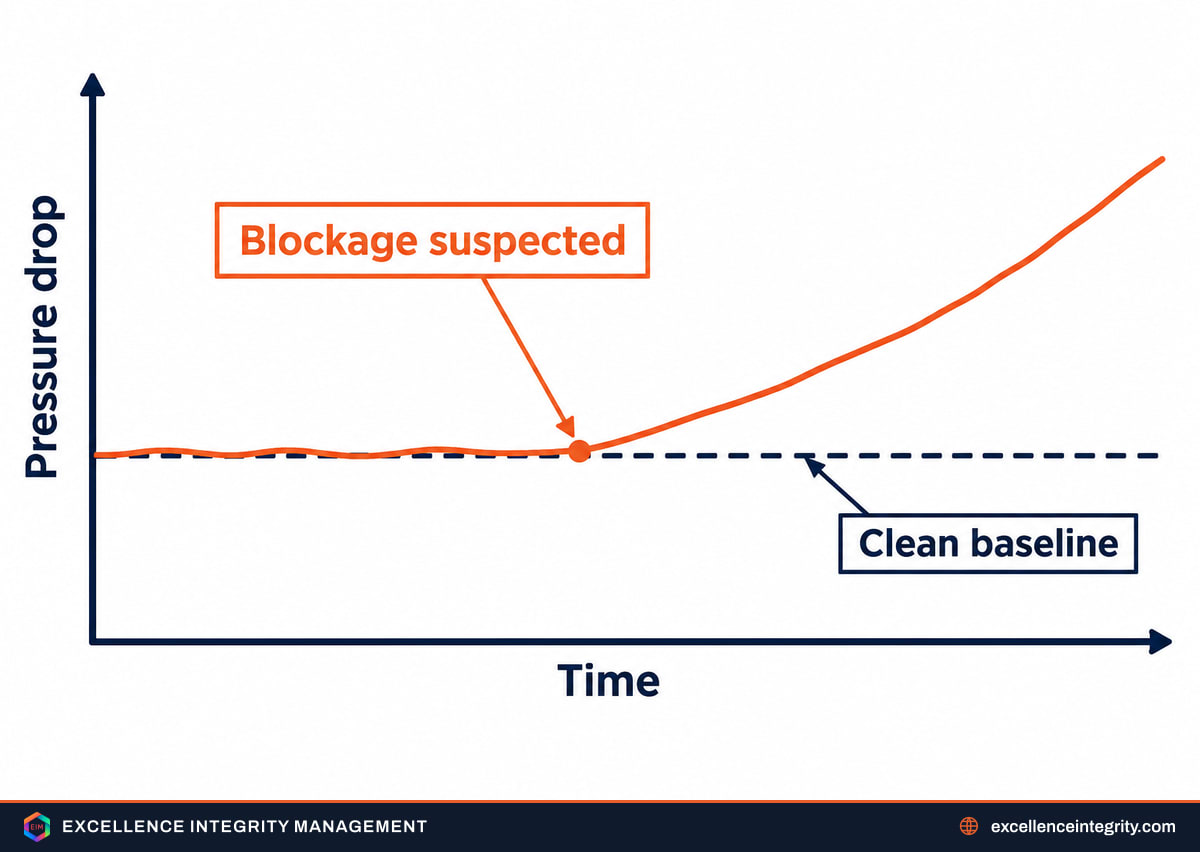
Performance trending. Track the temperature approach between streams and the pressure drop across each pass. A rising pressure drop in one pass points to blockage; a widening temperature approach points to fouling or maldistribution. What matters is the trend against a clean baseline from commissioning.
Leak detection. Analysers on product streams can show cross-contamination between passes. In a cold box, gas detection or analysis of the purge gas can show an external leak from a core or its piping. These leaks are then located by pressure or tracer gas testing at shutdown.
Operating limits. Temperature difference between streams, cooldown and warm-up rates and the number of thermal cycles are integrity data for these exchangers. Write them into the operating procedure, record excursions, and review them the same way you would review a corrosion rate. This is the idea behind integrity operating windows, covered in the integrity operating windows and corrosion control documents programme.
Feed quality. Mercury removal, dehydration and filtration performance belong in the exchanger's integrity file. When one of them slips, the exchanger is the equipment that pays.
External condition. Nozzles, headers, cold box casings and connecting piping still corrode and still crack. Inspect them as usual, watching for insulation damage and ice on cold surfaces.
Common mistakes on these exchangers
The first mistake is treating the exchanger as maintenance-free because it has no bundle to pull. These units fail quietly, through blocked passages and slowly growing leaks, and the evidence sits in process data that nobody reviews. The second is fast cooldown after a trip to get back on line. That is exactly when thermal stress damage happens, and it rarely shows on the day. The third is ignoring upstream equipment: a filter bypassed for weeks or a mercury guard bed past its life does its damage downstream.
Fouling deserves attention even in clean gas service; the mechanisms and how to trend them are in heat exchanger fouling.
Frequently asked questions
What type of heat exchanger is used in LNG plants?
Three compact types dominate. Coil wound units are the main cryogenic exchanger in many large liquefaction trains, brazed aluminium plate-fin cores handle cold box duties such as NGL recovery and nitrogen rejection, and printed circuit exchangers suit high-pressure gas duties offshore and on floating LNG, where weight and space count.
Why are LNG heat exchangers made of aluminium or stainless steel?
Liquefaction runs at very low temperatures, where ordinary carbon steel loses its toughness and can fail in a brittle way. Designers therefore use aluminium, austenitic stainless steel and nickel steels. Aluminium cores bring their own risk: even small amounts of mercury in the feed gas can attack them, so mercury removal goes upstream.
How do you inspect a heat exchanger you cannot open?
Most of the evidence comes from process data. Trend pressure drop and temperature approach per pass against a clean commissioning baseline, watch analysers and cold box purge gas for leaks, record excursions beyond operating limits, and inspect the nozzles, headers and connecting piping externally as you would any other equipment.
What to do next
If you look after LNG heat exchangers, start by listing each unit's operating limits and checking that someone actually reviews excursions against them. Then make sure pressure drop and temperature approach are trended per pass against a clean baseline.
For the hands-on side of inspecting and maintaining exchangers, the heat exchanger inspection and maintenance course covers the methods in detail. For fleet-wide integrity decisions, including remaining life, see the heat exchanger integrity and tube bundle assessment programme.
Exam preparation
Preparing for API 571?
Practise with exam-style questions, timed mocks and study notes. 3,357 questions in the bank.