10 Types of Power Transmission Systems and How to Choose One
Ten power transmission systems compared: belt, chain, gear, shaft, rope, friction, coupling, clutch, hydraulic and pneumatic drives, and how to choose one.
By Harish Haseeb26 Nov 20268 min read
Every motor, engine or turbine has the same problem: the power it produces has to reach a pump, fan, conveyor or wheel that is somewhere else, turns at a different speed or needs a different kind of motion. The system that bridges that gap is the power transmission, and choosing the wrong one costs energy, reliability and maintenance hours for the life of the machine.
This post walks through ten common types of power transmission systems, from belts and chains to clutches and fluid power. For each one you get how it works, where it fits and what to check on it in service. It finishes with the questions that decide which one to use. It is an overview: gears, couplings, bearings and alignment each deserve their own detailed treatment, so they are kept short here.
Mechanical drives and fluid power
Strictly speaking, mechanical power transmission means transmitting motion and torque through solid parts: belts, chains, gears, shafts, ropes, friction wheels, couplings and clutches. Hydraulic and pneumatic drives transmit power through a pressurised fluid instead, so they are fluid power systems rather than mechanical drives. They are included here because plant engineers choose between them and mechanical drives for the same jobs, but the distinction matters when you read standards and specifications.
1. Belt drive
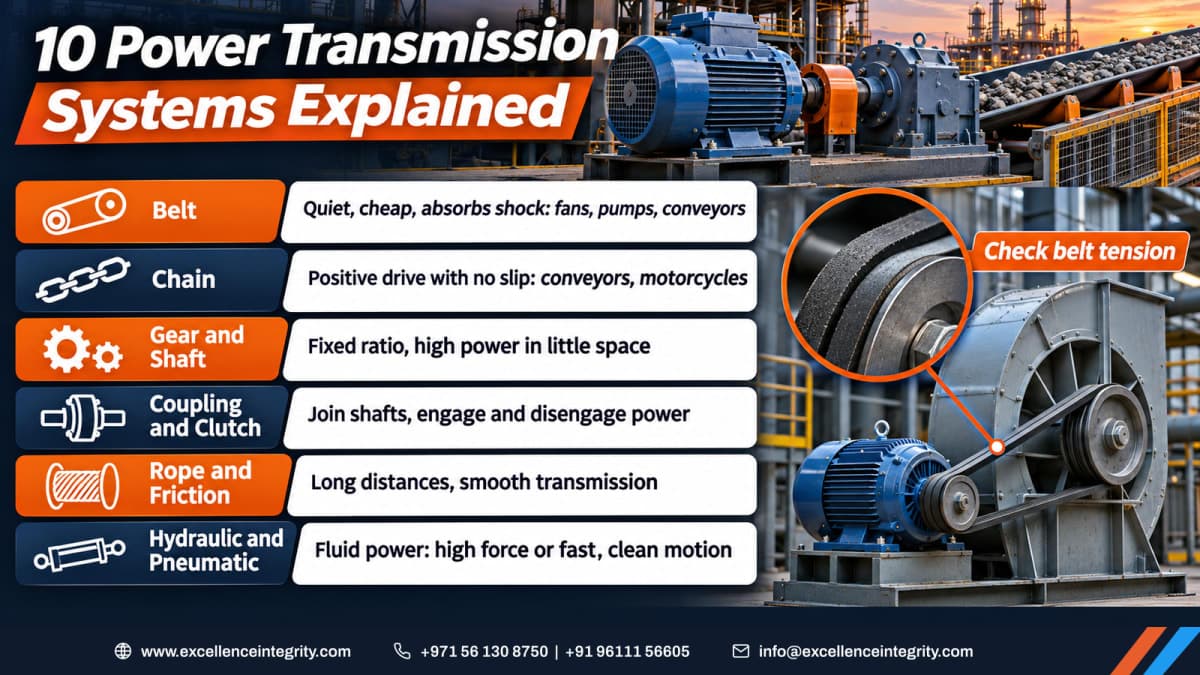
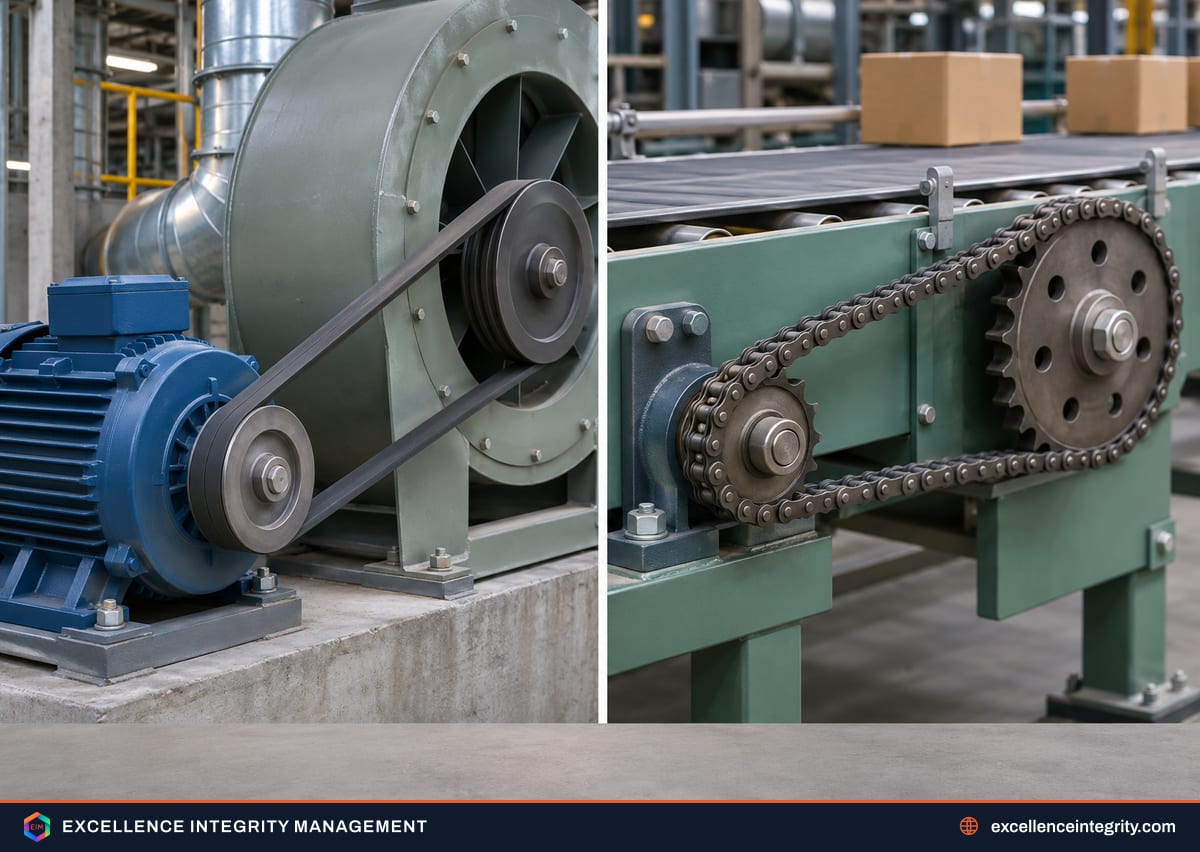
A belt running over pulleys transmits power between rotating shafts, often some distance apart. Belt drives are quiet, cheap, need no lubrication and absorb some shock. They are everywhere on fans, pumps and conveyors. Ordinary belts can slip under overload, which can protect the machine but means the speed ratio is not exact; toothed (timing) belts avoid slip. In service, check belt tension, wear, cracking and glazing, and pulley alignment, which is the most common cause of short belt life.
2. Chain drive
A chain running on sprockets gives a positive drive with minimal slipping, so the speed ratio stays fixed. Chain drives carry high loads at moderate speeds and are used on motorcycles and industrial conveyors, among many other machines. They need lubrication and they stretch as the pins and bushes wear. Check chain stretch, lubrication, sprocket tooth wear and alignment; a worn chain on new sprockets, or the reverse, wears out fast.
3. Gear drive
Meshing gears transmit power with a fixed speed ratio and change torque accordingly. Gear drives are compact and carry high power, which is why gearboxes sit inside so much industrial machinery. The type of gear depends on how the shafts are arranged, from spur and helical gears on parallel shafts to bevel, worm and planetary sets. In service, the essentials are correct lubrication, alignment, backlash and regular checks of tooth wear patterns.
4. Shaft drive
A rotating shaft carries torque directly from one point to another. It is the simplest transmission element and is part of almost every other drive, from line shafts in older industrial plants to drive shafts in vehicles. Shaft condition comes down to straightness, bearing support, keyway and fit integrity, and balance at speed.
5. Rope drive
Ropes running in grooved pulleys transmit power, typically over relatively long distances. Rope drives are used in certain heavy-duty and lifting applications. The ropes need inspection for wear, broken strands, corrosion and lubrication, and the pulley grooves must suit the rope.
6. Friction drive
Power is transmitted by friction between surfaces pressed together, such as two wheels in contact. Friction drives give smooth transmission and can allow variable speed in some designs, which suits selected machinery. Contact pressure and surface condition decide how well they work, and wear of the contact surfaces is the main maintenance item.
7. Coupling drive
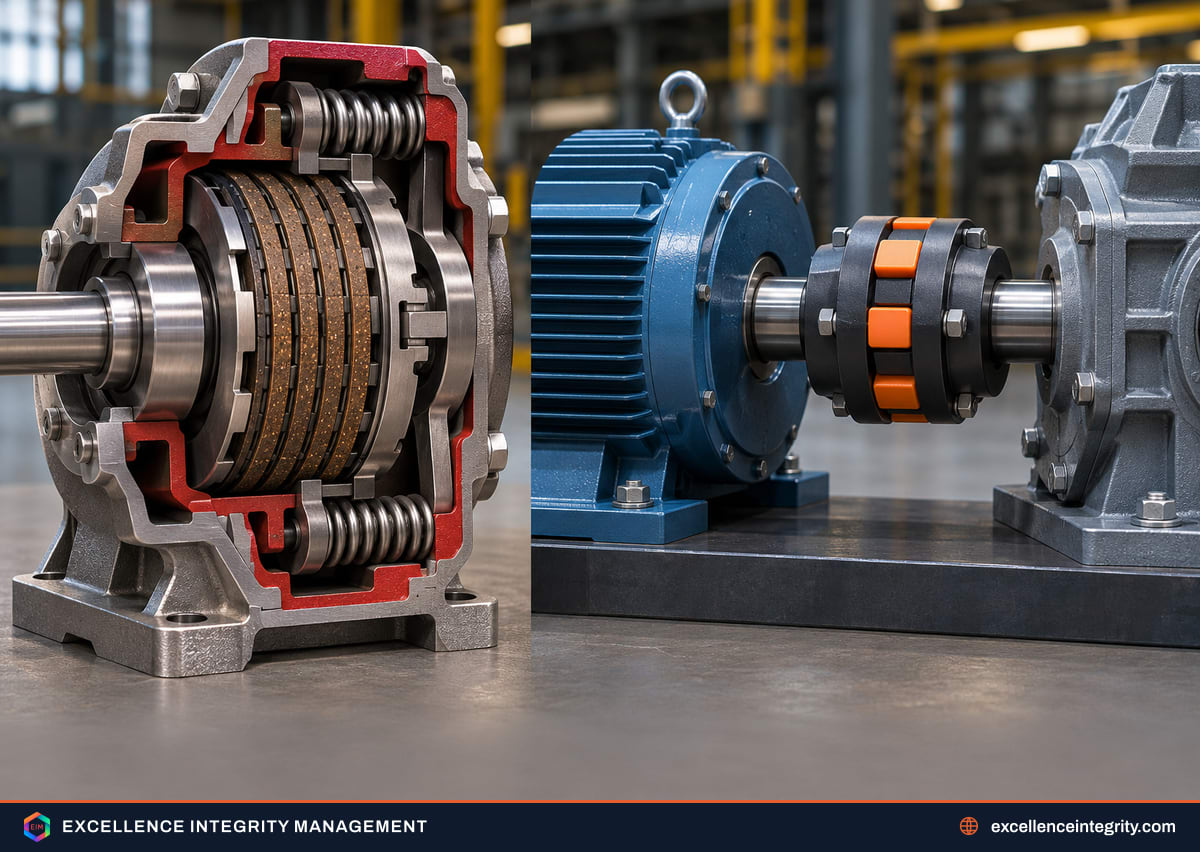
A coupling connects two shafts end to end so one drives the other, as between a motor and a pump. Depending on its type, it can also accommodate some misalignment and reduce the effects of vibration and shock. Couplings range from rigid sleeves to gear, disc, jaw and fluid couplings. Their reliability depends heavily on how well the two shafts are aligned.
8. Clutch drive
A clutch engages or disengages power between a driving and a driven part, so a machine can be started, stopped or changed over without stopping the prime mover. Clutches are used in vehicles and machine tools, and in industrial drives that need controlled engagement. Friction surfaces wear and need adjustment or replacement; overheating and slipping are the usual warnings.
9. Hydraulic drive
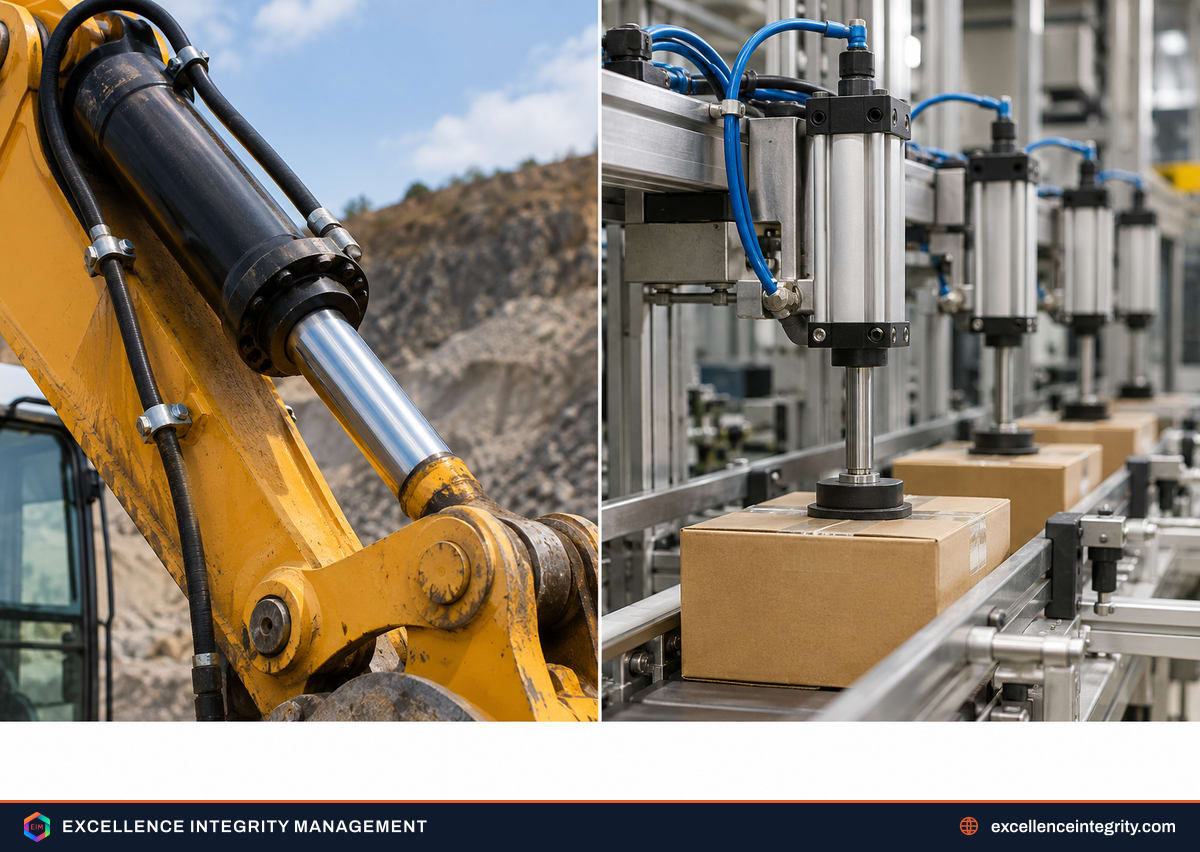
A pump pressurises a fluid, and the fluid drives cylinders or motors to produce force or motion. Hydraulic systems deliver very high force in a compact package and allow smooth, controllable movement, which is why presses, excavators and heavy machinery use them. Their enemies are leaks and contamination: dirty or degraded oil wears pumps and valves and makes the system behave unpredictably. Check for leaks, filter condition, oil condition and temperature, and hose damage.
10. Pneumatic drive
Compressed air drives cylinders, motors and actuators. Pneumatics are clean, simple and fast, and safe in many hazardous areas, so they suit automation, packaging machines and actuators. They are less suited to high, precise forces because air compresses. Check air quality (moisture, oil and dirt), leaks, and the condition of cylinders and valves. Air leaks are a hidden running cost as well as a performance problem.
How to choose between power transmission systems
The choice comes from a handful of questions about the job:
- How far apart are the shafts? Short distances suit gears and couplings; longer distances suit belts, chains or ropes.
- Does the speed ratio need to be exact? Gears, chains and timing belts give a fixed ratio; ordinary belts and friction drives can slip.
- How much torque, and is there shock? High torque points to gears, chains or hydraulics; shock loads favour belts, flexible couplings or fluid couplings that absorb it.
- Is lubrication possible and practical? Belts need none; chains and gears do.
- Noise, space and cost? Belts are quiet and cheap; gears are compact; hydraulics pack great force into small actuators.
- Do you need to engage and disengage? Then a clutch, or a fluid coupling for soft starts.
- Is the motion rotary or straight-line? Straight-line force often points to hydraulic or pneumatic cylinders.
| System | Strength | Main maintenance check |
|---|---|---|
| Belt | Quiet, cheap, absorbs shock | Tension, wear, pulley alignment |
| Chain | Positive drive, high load | Stretch, lubrication, sprocket wear |
| Gear | Compact, fixed ratio, high power | Lubrication, wear pattern, backlash |
| Shaft | Simplest torque path | Straightness, fits, balance |
| Rope | Long distances, heavy duty | Strand wear, lubrication |
| Friction | Smooth transmission | Contact surface wear |
| Coupling | Joins shafts, eases misalignment | Alignment, element wear |
| Clutch | Engage and disengage | Friction wear, slipping, heat |
| Hydraulic | Very high force, smooth control | Leaks, oil contamination |
| Pneumatic | Clean, fast, simple | Air quality, leaks |
Why the choice matters for reliability
The transmission is often where a machine's problems show up first: a squealing belt, a stretched chain, a hot gearbox or a leaking hydraulic hose. Picking the system that suits the load, speed and environment, and then looking after it with the right checks, has a direct effect on efficiency, reliability, safety and how the whole machine performs.
Frequently asked questions
What are the main types of power transmission systems?
Mechanical drives transmit motion and torque through solid parts: belts, chains, gears, shafts, ropes, friction wheels, couplings and clutches. Hydraulic and pneumatic drives transmit power through a pressurised fluid, so they are fluid power systems rather than mechanical drives. Plant engineers still choose between the two groups for the same jobs.
What is the difference between a belt drive and a chain drive?
A belt drive is quiet, cheap, needs no lubrication and absorbs some shock, but an ordinary belt can slip, so the speed ratio is not exact. A chain drive gives a positive drive with minimal slipping and carries high loads at moderate speeds, but it needs lubrication and stretches as the pins and bushes wear.
What is the difference between hydraulic and pneumatic drives?
Hydraulic drives use pressurised oil to deliver very high force in a compact package with smooth, controllable movement, which suits presses and excavators. Pneumatic drives use compressed air and are clean, simple and fast, but they are less suited to high, precise forces because air compresses. Leaks and contamination are the main enemies of both.
Which drive should you use when the shafts are far apart?
Short distances between shafts suit gears and couplings. When the shafts are further apart, a belt, chain or rope drive is usually the better fit, with ropes used for relatively long distances in certain heavy-duty and lifting work. Then check whether the job needs an exact speed ratio, which rules out ordinary belts.
Where to go from here
Each drive element has its own failure modes and inspection routine. Types of shaft keys covers how pulleys, sprockets and gears are fixed to shafts, and rotating equipment maintenance in oil and gas sets out the wider maintenance strategy. The rotating equipment maintenance and troubleshooting course covers drive trains hands-on, and the SMRP CMRP exam preparation and reliability and asset integrity programme suit engineers moving into reliability roles.
Exam preparation
Preparing for SMRP CMRP?
Practise with exam-style questions, timed mocks and study notes. 1,448 questions in the bank.