Variable vs Constant Spring Hangers: How They Work and How to Choose
Variable vs constant spring hangers: how each carries pipe load, hot and cold settings, how engineers choose between them and what to check in service.
By Syed Hasan25 Nov 20269 min read
Hot piping moves. A line running from a pump to a heater can rise or drop noticeably between cold shutdown and normal operation, and whatever holds it up has to follow that movement without letting go of the weight. A rigid support cannot do that, which is why pipe spring supports exist. The trouble is that "spring support" covers two quite different devices, and they are often confused on drawings, in specifications and even in supplier literature.
This post compares variable vs constant spring hangers: how each one carries load, why the load changes in one and not the other, how engineers choose between them, and what an inspector should look for on site. For the wider family of supports, guides and anchors, see types of pipe supports and what each one controls.
Why hot pipework needs spring supports
When a pipe heats up it expands in every direction. Horizontal growth is usually handled with guides, loops and the routing itself. Vertical growth is the harder part, because every support along that run carries weight. If the pipe lifts off a rigid support, that support stops carrying anything and its share of the weight goes somewhere else, often onto a pump, compressor or vessel nozzle. If the pipe pushes down against a rigid support, the support takes far more load than it was designed for.
A spring support solves this by letting the pipe move vertically while still pushing up on it. How much it pushes, and whether that push changes as the pipe moves, is the difference between the two types.
How a variable spring hanger works
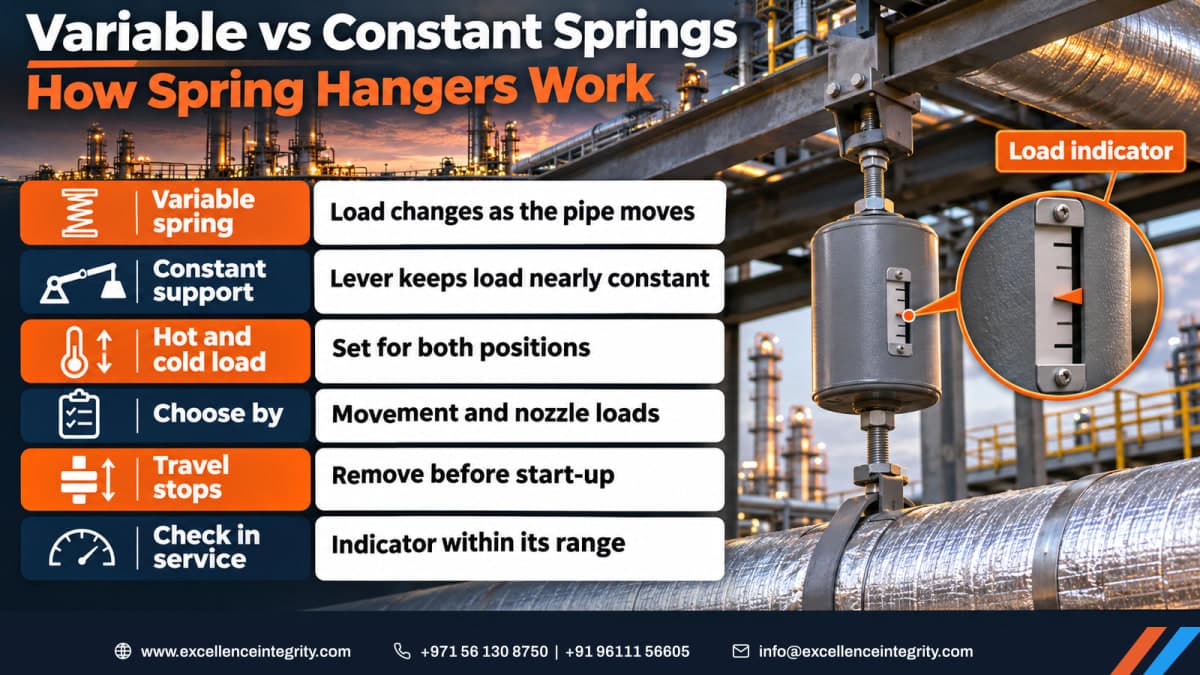
A variable spring hanger is a coil spring inside a housing, usually called a can. The pipe hangs from a rod connected to the spring, and the spring compresses or extends as the pipe moves.
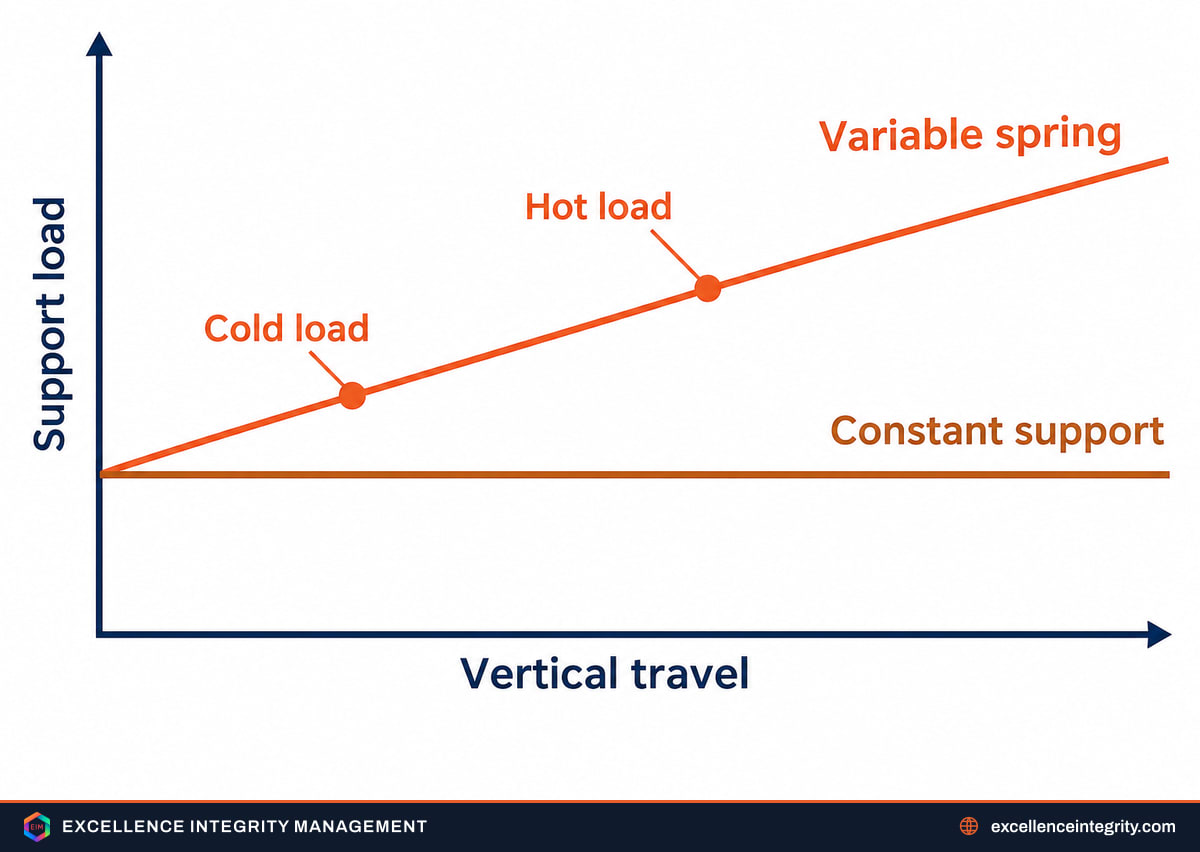
The key point is that a coil spring's force depends on how far it is compressed. So as the pipe travels, the force the hanger exerts changes. That is why it is called variable. The designer works out the pipe's weight at the support and its vertical movement from the stress analysis, then picks a spring so that the hanger carries the right load in one condition, usually the hot operating condition, and a different but acceptable load in the other.
Those two numbers are the hot load and the cold load (also called the installed load). The difference between them is the spring rate multiplied by the travel. The larger the movement, or the stiffer the spring, the bigger the difference, and the more of the pipe's weight gets pushed onto the next support or the nearest nozzle when the line is not at its design condition.
How a constant spring support works
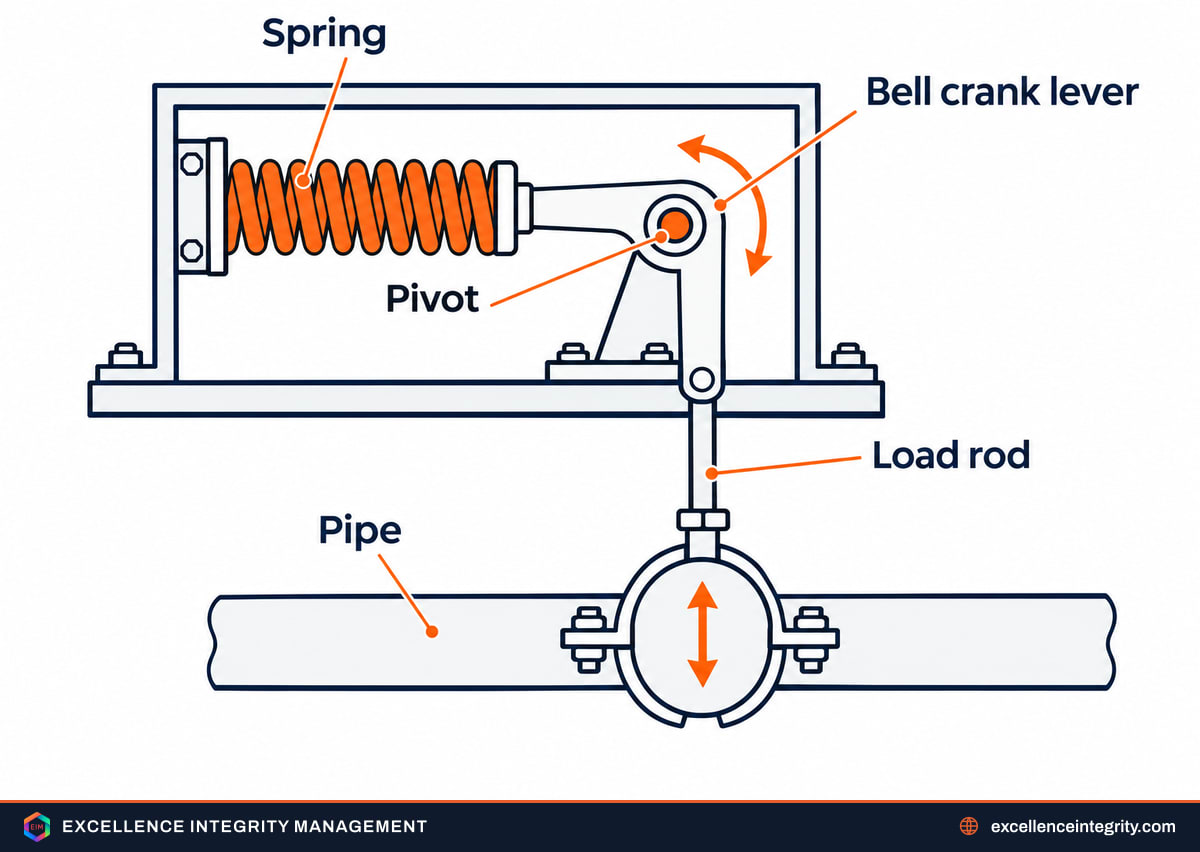
A constant spring support, also called a constant effort or constant load support, is designed so that the force stays nearly the same through its whole travel range. It still uses a spring, but the spring acts through a lever or bell crank mechanism. As the pipe moves, the geometry of the lever changes in a way that offsets the change in spring force, so the pipe sees an almost steady upward push.
The result is that the support carries the pipe's weight in the cold position, the hot position and everywhere in between, and almost none of that weight shifts to other supports or to equipment as the line moves. The price is size, weight and cost: a constant support is a larger, more complex piece of hardware than a variable spring can.
One labelling trap: some supplier sheets and training material describe a "spring support" that maintains a nearly constant load and then list a "variable spring support" separately, as if the first were the general case. It is not. An ordinary coil spring support is a variable support. Only the lever or cam mechanism makes the load constant.
Variable vs constant spring hangers: how to choose
| Question | Variable spring hanger | Constant spring support |
|---|---|---|
| Load through travel | Changes with movement | Nearly constant |
| Vertical movement | Small to moderate | Large |
| Effect on nearby nozzles | Some load shifts as the line moves | Very little load shifts |
| Size and cost | Compact, cheaper | Larger, heavier, dearer |
| Typical use | General hot process lines | Critical lines near sensitive equipment |
The choice between variable vs constant spring hangers is made by the piping stress engineer, not on site. The usual logic is this. If there is no meaningful vertical movement, a rigid support is fine. If there is movement and a variable spring keeps the change in load within the limit set by the project specification, a variable spring is chosen because it is simpler and cheaper. If the movement is large, or the line connects to equipment whose nozzle loads are tight, such as a turbine or a compressor, a constant support is used so that the weight does not move around as the system heats up.
The governing documents are the piping code and the project specification. ASME B31.3 covers supports as part of process piping design, and MSS SP-58 covers the materials, design and manufacture of pipe hangers and supports. The allowable load variation and the selection of a particular model come from those documents and the supplier's data, not from rules of thumb.
Hot and cold settings, travel stops and the load scale
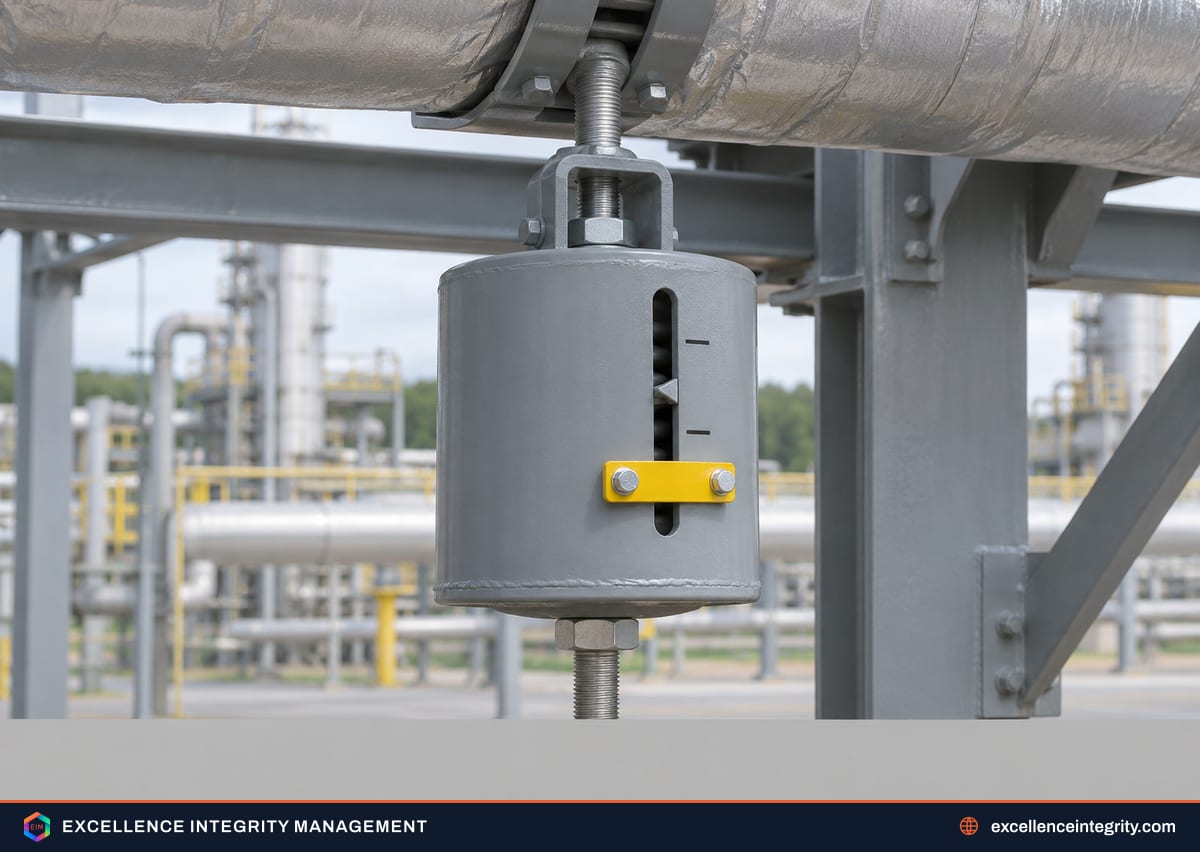
Both types of spring support arrive from the factory preset to their cold load and locked with travel stops, pins or plates that hold the spring at that position. The stops let the pipe be erected at the right elevation and, where the hanger is designed for it, carry the extra weight of water during a hydrotest.
Each support also has a load or travel indicator on the housing, with marks for the cold and hot positions. When everything is right, the pointer sits at the cold mark after the stops are removed with the line cold, and moves to near the hot mark when the line reaches operating temperature.
That makes commissioning the moment that matters most. The travel stops must be removed before the line is heated. A spring left locked behaves as a rigid support, which is exactly the condition the spring was there to avoid. Every spring support should be recorded as unlocked, with its cold indicator reading, before start-up.
What to check on spring supports in service
Spring supports rarely fail dramatically. They drift out of adjustment quietly, so the useful checks are visual and quick, and they should be done both cold and hot where possible:
- Travel stops still fitted after start-up, or refitted after a shutdown and never removed.
- Indicator outside its range. A pointer at or beyond either end means the spring is bottomed out or topped out and is no longer supporting as designed.
- Indicator far from the expected mark for the current condition, which points to a wrong setting, a weight change such as added insulation, or a problem elsewhere in the system.
- Corrosion of the spring, housing, rods and clamps, especially where insulation is wet or the support is in a splash zone.
- Seized hardware: rods, turnbuckles, clevises or the lever pivots of a constant support that cannot move freely.
- Rods out of plumb by more than the movement explains, or rubbing on steelwork.
Record readings and compare them with the hot and cold values on the support datasheet. Do not adjust a spring support or change its rod length on site without the piping engineer's approval: on a variable spring, changing the rod length changes the load it carries. Supports are part of the piping system's condition, and they belong in the inspection records alongside thickness and external condition.
Mistakes that turn a spring support into a problem
Most spring support trouble on site comes from a handful of repeat errors. A variable spring swapped for a rigid support during a quick repair, because the spring was corroded and a rigid one was on the shelf. A replacement hanger ordered by size alone, without the hot and cold loads, so it arrives with the wrong spring. Insulation added or upgraded years after design, so the line is heavier than the setting assumed. And the travel stops removed on one unit but forgotten on the next, because nobody owned the commissioning list.
Each of these looks harmless on the day. Each one moves weight to somewhere it was never meant to go, and the first sign is often a leaking flange or a vibrating pump rather than anything at the support itself.
Frequently asked questions
What is the difference between a variable and a constant spring hanger?
A variable spring hanger is a coil spring in a can, so the force it exerts changes as the pipe moves and some weight shifts to other supports. A constant spring support uses a lever or bell crank mechanism that offsets the change in spring force, so the load stays nearly the same through its whole travel.
When should you use a constant spring hanger?
When the vertical movement is large, or when the line connects to equipment with tight nozzle loads, such as a turbine or a compressor, so the weight does not move around as the system heats up. The piping stress engineer makes the call from the code, the project specification and the supplier's data, not from a rule of thumb.
Why must the spring hanger travel stop be removed before start-up?
The stops lock the spring at its cold setting for erection and, where designed for it, hydrotest. A spring left locked behaves as a rigid support, which is exactly what it was installed to avoid. Remove the stops before the line is heated, and record each support as released, with its cold indicator reading.
What are the hot load and cold load on a spring hanger?
The hot load is what the hanger carries at operating temperature; the cold load, also called the installed load, is what it carries with the line cold. On a variable spring the difference is the spring rate multiplied by the travel. Both values are on the support datasheet, and the indicator shows a mark for each.
Next steps
Checking supports, hangers and restraints is a routine part of in-service piping inspection. The API 570 piping inspector preparation covers inspection of piping systems including their supports, and carbon steel piping components explains the parts these supports hold up. For equipment-side integrity, the pressure vessel fabrication and inspection course covers the nozzles that badly set supports load.
Related reading: Small-Bore Piping and Vibration Fatigue: An Inspector's Guide, Dead Legs in Piping: Why They Corrode and How to Manage Them.
Exam preparation
Preparing for API 570?
Practise with exam-style questions, timed mocks and study notes. 1,841 questions in the bank.