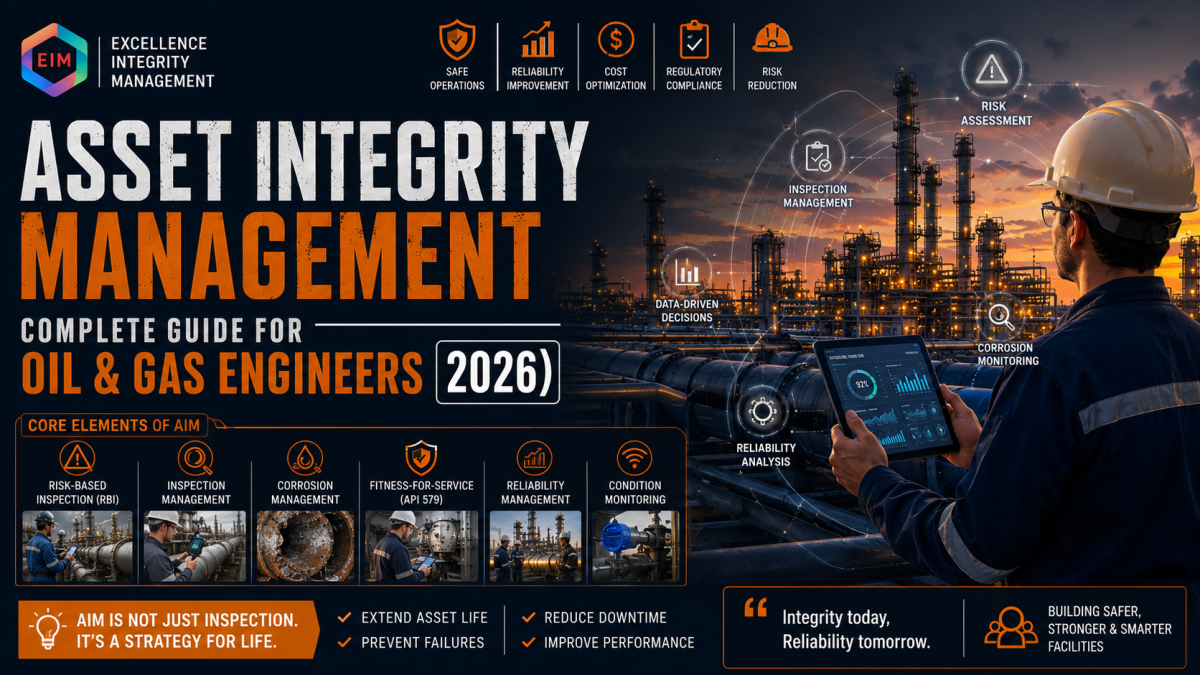
Asset Integrity Management (AIM) has become one of the most important engineering disciplines in the oil and gas industry. As facilities become more complex and production targets continue to increase, maintaining the safety, reliability, and performance of critical assets is no longer optional—it is essential.
Whether operating an offshore platform, refinery, petrochemical plant, gas processing facility, or pipeline network, organizations must ensure that every pressure vessel, pipeline, storage tank, heat exchanger, valve, compressor, and structural component performs safely throughout its intended service life.
Introduction
Every industrial facility depends on thousands of interconnected assets working together safely and efficiently. These assets operate under demanding conditions, including high pressure, elevated temperatures, corrosive chemicals, vibration, cyclic loading, and continuous production schedules.
Over time, these operating conditions cause deterioration. Corrosion, erosion, fatigue, creep, cracking, vibration damage, and material degradation gradually reduce equipment reliability. Without proper monitoring and maintenance, these mechanisms can eventually lead to equipment failure.
Unexpected failures are expensive. They may result in unplanned shutdowns, environmental incidents, production losses, costly repairs, regulatory penalties, and, most importantly, risks to personnel safety.
Asset Integrity Management provides a structured framework to identify, monitor, assess, and manage these risks before failures occur. Instead of reacting after equipment breaks down, AIM focuses on understanding asset condition, predicting degradation, and making informed engineering decisions that improve safety and reliability.
Modern Asset Integrity Management combines engineering knowledge, inspection planning, maintenance strategies, corrosion management, risk assessment, digital technologies, and international standards into one integrated system. This approach allows organizations to maximize equipment performance while minimizing operational risk.
What is Asset Integrity Management?
Asset Integrity Management (AIM) is the systematic process of ensuring that physical assets perform their intended function safely, efficiently, reliably, and in compliance with applicable regulations throughout their entire lifecycle.
Rather than focusing only on inspection or maintenance, Asset Integrity Management integrates multiple engineering disciplines into a comprehensive management system that supports safe operations and informed decision-making.
An effective AIM program continuously evaluates equipment condition, identifies potential failure mechanisms, prioritizes risks, schedules inspections, implements corrective actions, and verifies that assets remain fit for service.
The primary goal is not simply to prevent equipment failure but to manage risk in a cost-effective manner while protecting people, the environment, and business operations.
Why Asset Integrity Matters
Oil and gas facilities operate under some of the harshest industrial conditions in the world. Equipment is exposed to corrosive fluids, extreme temperatures, high pressures, cyclic loading, aggressive chemicals, seawater, hydrogen, carbon dioxide, hydrogen sulfide, and abrasive particles.
Without a structured integrity management program, these conditions gradually degrade equipment until failure becomes inevitable.
Asset Integrity Management enables organizations to detect degradation at an early stage, allowing maintenance teams to intervene before failures affect production or safety.
Major industrial accidents throughout history have demonstrated that poor asset integrity can have catastrophic consequences. Equipment failures may result in fires, explosions, toxic releases, environmental pollution, production losses, and significant financial damage.
For this reason, leading oil and gas companies invest heavily in inspection, corrosion management, reliability engineering, predictive maintenance, and risk-based inspection programs as part of their Asset Integrity Management strategy.
Objectives of Asset Integrity Management
- Protect personnel and surrounding communities.
- Prevent equipment failures.
- Reduce operational risk.
- Improve equipment reliability.
- Increase plant availability.
- Optimize inspection intervals.
- Reduce maintenance costs.
- Extend equipment service life.
- Maintain compliance with industry standards.
- Improve operational efficiency.
- Support sustainable production.
- Reduce environmental impact.
By achieving these objectives, organizations can improve both safety performance and financial performance while maintaining regulatory compliance.
Assets Covered Under Asset Integrity Management
Asset Integrity Management applies to virtually every critical component within an industrial facility. Depending on the type of plant, an AIM program may include thousands of assets requiring different inspection strategies and maintenance approaches.
| Static Equipment | Rotating Equipment | Infrastructure |
|---|---|---|
| Pressure Vessels | Pumps | Pipelines |
| Storage Tanks | Compressors | Offshore Platforms |
| Heat Exchangers | Steam Turbines | Marine Structures |
| Columns | Fans | Loading Facilities |
| Boilers | Generators | Process Units |
| Reactors | Blowers | Pipe Racks |
Each asset type experiences unique degradation mechanisms, requiring specific inspection techniques, maintenance plans, and engineering evaluations.
Benefits of Asset Integrity Management
Organizations implementing a mature Asset Integrity Management program realize significant operational and financial benefits.
- Improved process safety.
- Higher equipment reliability.
- Reduced unplanned shutdowns.
- Lower maintenance costs.
- Extended asset life.
- Better inspection planning.
- Enhanced regulatory compliance.
- Improved production efficiency.
- Reduced environmental incidents.
- Greater confidence in operational decision-making.
Beyond technical improvements, Asset Integrity Management also supports business objectives by reducing operational risk, improving return on investment, protecting company reputation, and ensuring sustainable long-term operations.