Temper Embrittlement: Damage Mechanism of the Week
Temper embrittlement of Cr-Mo steels: the temperature range, the impurities behind it, J and X-bar factors, and minimum pressurisation temperature.
By Syed Hasan18 Nov 20264 min read
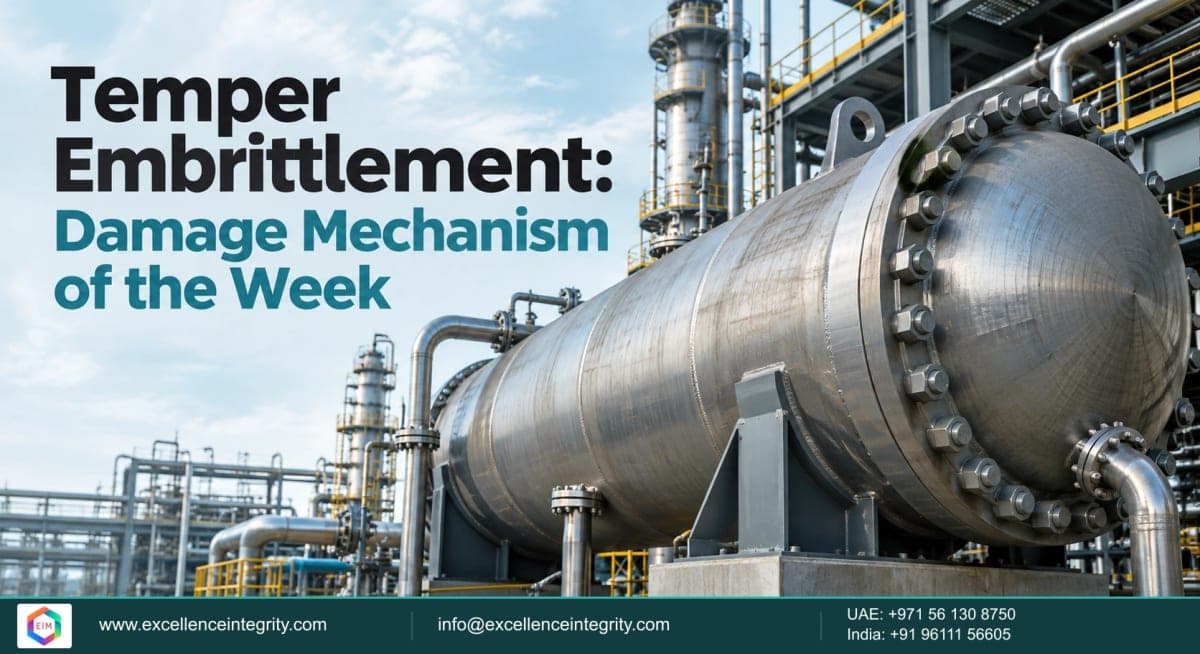
Week 3 of our Damage Mechanism of the Week series turns to low-alloy steels. Temper embrittlement quietly raises the temperature at which heavy-wall Cr-Mo equipment, such as hydroprocessing reactors, turns brittle. In service it does no harm. During start-up and shutdown, it decides how carefully pressure must be managed.
Short answer: Long service at roughly 650 to 1070 °F (343 to 577 °C) lets impurities such as phosphorus, tin, antimony and arsenic gather at grain boundaries in low-alloy steels like 2.25Cr-1Mo. The ductile-to-brittle transition moves up, sometimes well above ambient temperature. Equipment is managed with a minimum pressurisation temperature (MPT) so that it is not fully stressed until it is warm enough, and newer steels are made with low impurity levels.
At a glance
What happens in the metal
During long exposure in the critical range, trace impurity elements migrate to the prior austenite grain boundaries. The steel's room-temperature tensile properties barely change, but its fracture toughness at lower temperatures drops: the transition curve shifts to the right. The effect is cumulative over years and is worst in older steels made before low-impurity practice became standard, and in weld metal.
The transition shift
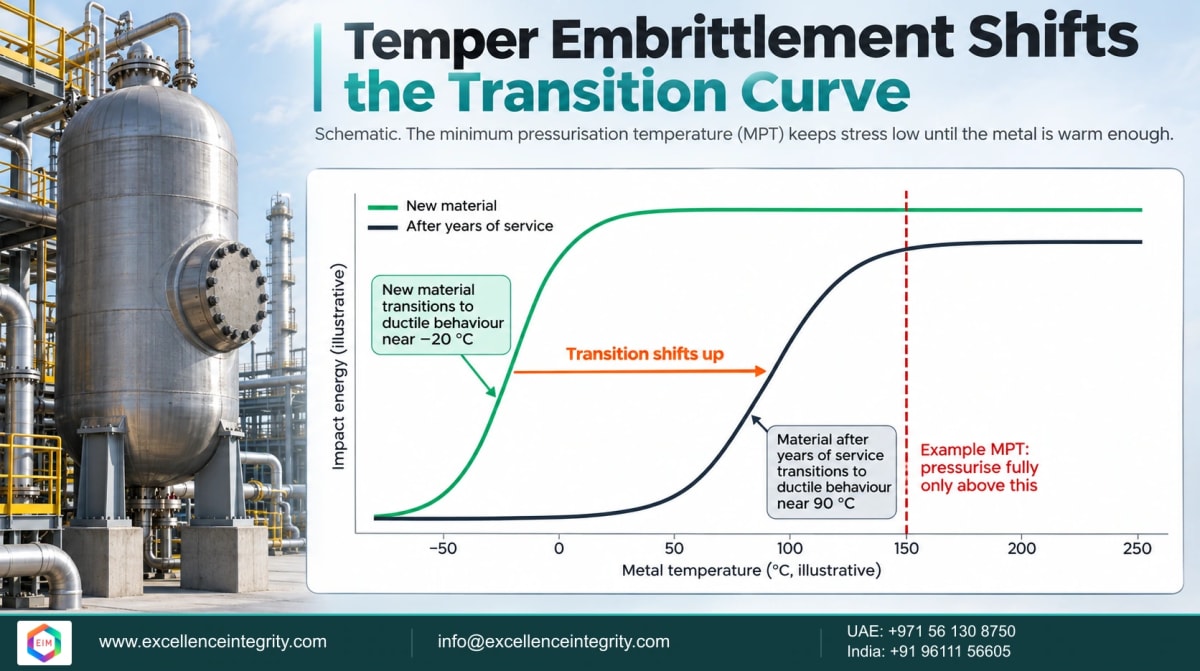
Because the transition can move above ambient temperature, a reactor that is perfectly safe at operating temperature can be brittle when cold. Pressurising it fully while cold, or a rapid depressurisation that chills it, risks brittle fracture. See our guide to brittle fracture and MDMT for the underlying mechanics.
Chemistry factors: J and X-bar
Steelmakers and purchasers control susceptibility through chemistry limits, usually expressed as two factors:
- J-factor for base metal, based on silicon, manganese, phosphorus and tin: J = (Si + Mn) × (P + Sn) × 10⁴, with elements in weight percent.
- X-bar factor for weld metal, based on phosphorus, antimony, tin and arsenic: X̄ = (10P + 5Sb + 4Sn + As) / 100, with elements in parts per million.
Purchase specifications set maximum values for both. Step-cooling tests, which simulate long service with an accelerated heat treatment, check how much the transition will shift.
Managing it in service
- Minimum pressurisation temperature (MPT): keep pressure low until the metal temperature is above a set value, typically defined by the owner or licensor from material data.
- Controlled start-up and shutdown: heat up before full pressure; avoid rapid depressurisation that chills the metal.
- Know your material: records of chemistry, step-cooling results and fabrication history for each heavy-wall item.
- Sample and test where needed, for example with surveillance specimens or samples from removed components.
Temper embrittlement and other damage
The same reactors can also face high-temperature hydrogen attack and hydrogen embrittlement during shutdown. A temper-embrittled steel with dissolved hydrogen at low temperature is a combination owners plan carefully for. See HTHA and API 941.
Learn more with EIM
Temper embrittlement is one of the mechanisms in API RP 571 (3rd edition), the body of knowledge for the API 571 certification. EIM is an independent training provider; EIM's self-paced API 571 preparation includes a question bank, practice mode with explanations, timed mock tests, study notes and flashcards, with one year of access. See the API 571 page. Next week: ammonium bisulfide corrosion.
Frequently asked questions
Which steels suffer temper embrittlement?
Low-alloy steels, especially 2.25Cr-1Mo and 3Cr-1Mo, with older steels and weld metal most susceptible.
What temperature range causes it?
Long service at roughly 650 to 1070 °F (343 to 577 °C).
What is the minimum pressurisation temperature?
A metal temperature below which equipment is kept at reduced pressure, so it is not highly stressed while brittle.
What are the J and X-bar factors?
Chemistry factors used to limit susceptibility: J = (Si + Mn)(P + Sn) × 10⁴ for base metal (wt%), and X-bar = (10P + 5Sb + 4Sn + As)/100 for weld metal (ppm).
Can temper embrittlement be seen with NDE?
No. It is a change in toughness without thinning or cracking. It is assessed through chemistry, step-cooling and impact testing.
Sources
- API RP 571, Damage Mechanisms Affecting Fixed Equipment in the Refining Industry, 3rd edition: temper embrittlement. Summarised, not quoted.
- J-factor and X-bar factor as widely used in Cr-Mo steel purchase specifications.
- Checked 7 October 2026.
Exam preparation
Preparing for API 571?
Practise with exam-style questions, timed mocks and study notes. 3,357 questions in the bank.