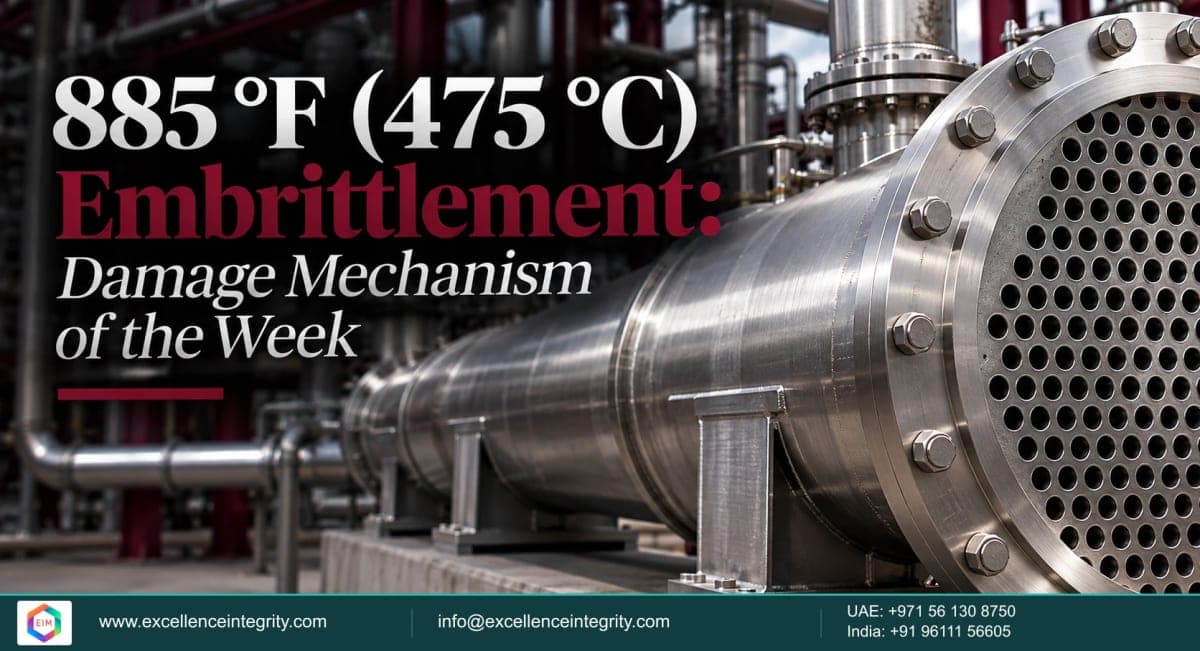
885 °F (475 °C) Embrittlement: Damage Mechanism of the Week
885 °F (475 °C) embrittlement: which stainless steels it affects, the temperature range, why it bites at shutdown, and how to detect and manage it.
By Syed Hasan17 Nov 20264 min read
This is the first post in our Damage Mechanism of the Week series, working through the mechanisms in API RP 571 one at a time. We start with one that hides perfectly in service and shows itself only when the plant cools down: 885 °F embrittlement, also called 475 °C embrittlement.
Short answer: Stainless steels that contain ferrite, mainly the ferritic (400 series) and duplex grades, slowly lose toughness when held at roughly 600 to 1000 °F (316 to 540 °C), fastest near 885 °F. In service they still behave normally; at ambient temperature they can be brittle. The damage is invisible to normal NDE, so it is managed through material selection, careful shutdown and start-up practice, and testing.
At a glance
What happens in the metal
In the ferrite phase of these steels, long exposure in the critical range causes a fine-scale change in the chromium distribution that hardens the ferrite. The steel becomes stronger and harder but loses ductility and toughness. Because the change is in the microstructure, there is no thinning, no crack and nothing for a thickness gauge or a dye penetrant to find, until a cold load arrives.
Where to expect it
- Ferritic stainless steels (for example 405, 409, 430, 446) used for trays, internals, liners and heater parts.
- Duplex stainless steels, whose ferrite phase makes them susceptible, which limits their upper service temperature.
- Equipment that runs in the critical range for long periods, such as fractionator internals and heater components.
- Ferrite in weld metal of otherwise austenitic stainless steels, to a lesser extent.
Three embrittlement windows
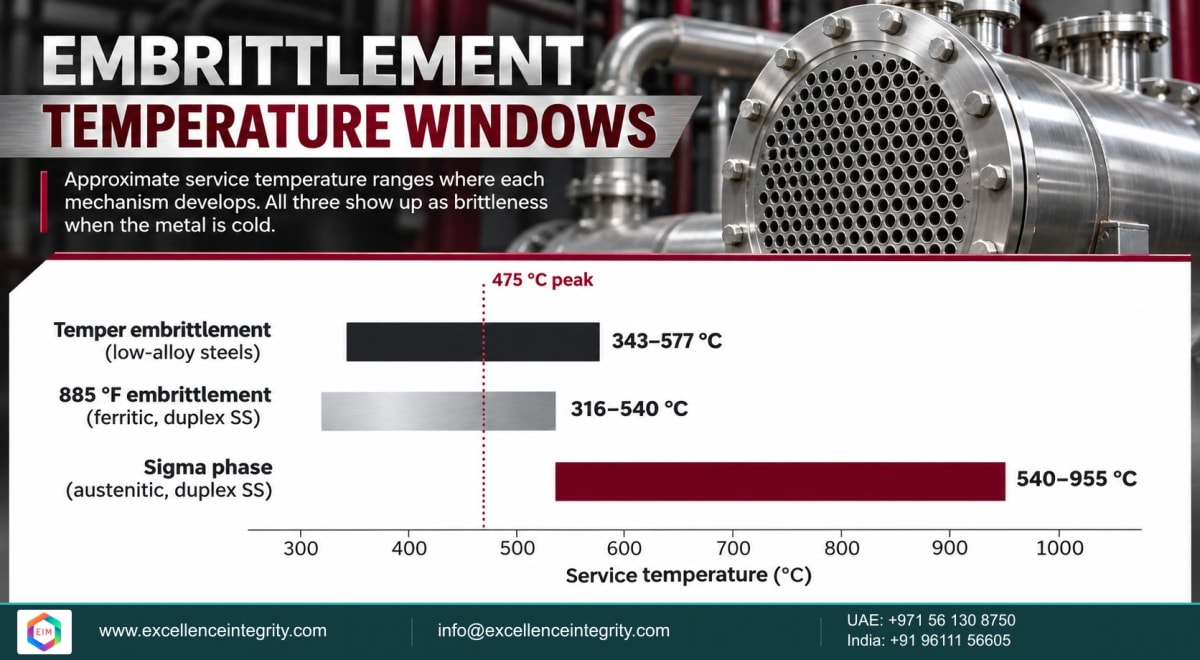
885 °F embrittlement is one of three embrittlement mechanisms that develop during hot service and show up as brittleness when cold. Temper embrittlement affects low-alloy steels in a similar temperature range; sigma phase affects stainless steels at higher temperatures. The next two weeks of the series cover them.
Why it bites at shutdown
At operating temperature, an embrittled part still has reasonable toughness. The danger comes when it is cold: during shutdowns, start-ups, hydrotests, or maintenance when someone hammers, bends or drops a part. Cracks or fractures appear then, often in parts that looked perfect.
Detecting it
- Hardness testing: an increase compared with the original material can indicate embrittlement.
- Impact or bend tests on samples taken from equipment during a turnaround.
- Metallography in a laboratory.
- Records: knowing which equipment has spent long periods in the critical range is the first and best screening tool.
Managing it
- Choose materials for the temperature: avoid susceptible grades for long service in the critical range, or accept the limitation knowingly.
- Treat cold equipment as brittle: avoid impact and high stress during shutdowns, start-ups and maintenance.
- Heat treatment can reverse it: heating above the embrittlement range can restore toughness, though the embrittlement returns with further exposure.
- Plan sampling and testing for critical equipment with long service in the range.
Learn more with EIM
885 °F embrittlement is one of the mechanisms in API RP 571 (3rd edition), the body of knowledge for the API 571 certification. EIM is an independent training provider; API certifies inspectors. EIM's self-paced API 571 preparation includes a question bank, practice mode with explanations, timed mock tests, study notes and flashcards, with one year of access, and EIM's live API 571 Damage Mechanisms - Exam Preparation course with Mr. Deepak Rawtal runs weekend batches; see the API 571 page for dates. Related reading: brittle fracture and MDMT.
Frequently asked questions
Which materials suffer 885 °F embrittlement?
Steels with a ferrite phase: mainly ferritic (400 series) and duplex stainless steels, and to a lesser extent ferrite in austenitic stainless weld metal.
At what temperature does it occur?
Roughly 600 to 1000 °F (316 to 540 °C), most rapidly near 885 °F (475 °C).
Can NDE detect it?
Not directly. It changes the microstructure without thinning or cracking. Hardness, impact or bend tests and metallography are used.
Is it reversible?
Heat treatment above the embrittlement range can restore toughness, but further exposure in the range will embrittle the material again.
Why does it matter for duplex stainless steel?
Duplex steels contain ferrite, so 885 °F embrittlement limits their maximum service temperature.
Sources
- API RP 571, Damage Mechanisms Affecting Fixed Equipment in the Refining Industry, 3rd edition: 885 °F (475 °C) embrittlement. Summarised, not quoted.
- Checked 7 October 2026.
Exam preparation
Preparing for API 571?
Practise with exam-style questions, timed mocks and study notes. 3,357 questions in the bank.