Tank Shell Tolerances: Plumbness, Roundness, Peaking and Banding
API 653 reconstruction tolerances: plumbness, roundness, peaking and banding, how each is measured, and how they differ from API 650, with an example.
By Syed Hasan17 Nov 20264 min read

A reconstructed tank must be built to shape, not just to thickness. Shells that lean, go out of round, or peak and band at their welds carry extra bending stresses, can bind floating roofs, and open gaps under seals. API 653 Section 10.5 sets four dimensional tolerances for reconstructed tanks, and they are a staple of the API 653 exam.
Short answer: For reconstructed tanks, API 653 limits plumbness to 1/100 of the total tank height, with a maximum of 5 in (fixed-roof columns too); sets radius tolerances by diameter, measured 1 ft above the bottom corner weld; limits peaking at vertical welds to 1/2 in using a 36 in horizontal sweep board; and limits banding at horizontal welds using a 36 in vertical sweep board. New tanks built to API 650 have tighter limits for plumbness and banding.
The four tolerances
Plumbness
The out-of-plumbness of the top of the shell relative to the bottom must not exceed 1/100 of the total tank height, with a maximum of 5 in. The same limit applies to fixed-roof columns.
Worked example: a 48 ft high tank: 1/100 of 48 ft = 0.48 ft = 5.76 in, so the 5 in maximum governs. A 30 ft tank: 0.30 ft = 3.6 in, under the cap, so 3.6 in governs.
Roundness
Radii are measured 1 ft above the bottom corner weld, and must fall within the tolerance for the tank's diameter given in API 653 Table 10.2. Larger tanks are allowed larger deviations.
Peaking
Peaking is the inward or outward "tenting" of the shell at vertical welds. It is measured with a horizontal sweep board 36 in long, cut to the true radius of the tank and centred on the weld, and must not exceed 1/2 in.
Banding
Banding is the similar distortion at horizontal welds, measured with a 36 in vertical sweep board or straight edge. Published quotations of API 653 10.5.5 give a 1 in limit for reconstructed tanks, while some study material quotes 1/2 in; check the edition you are working to.
API 650 vs API 653
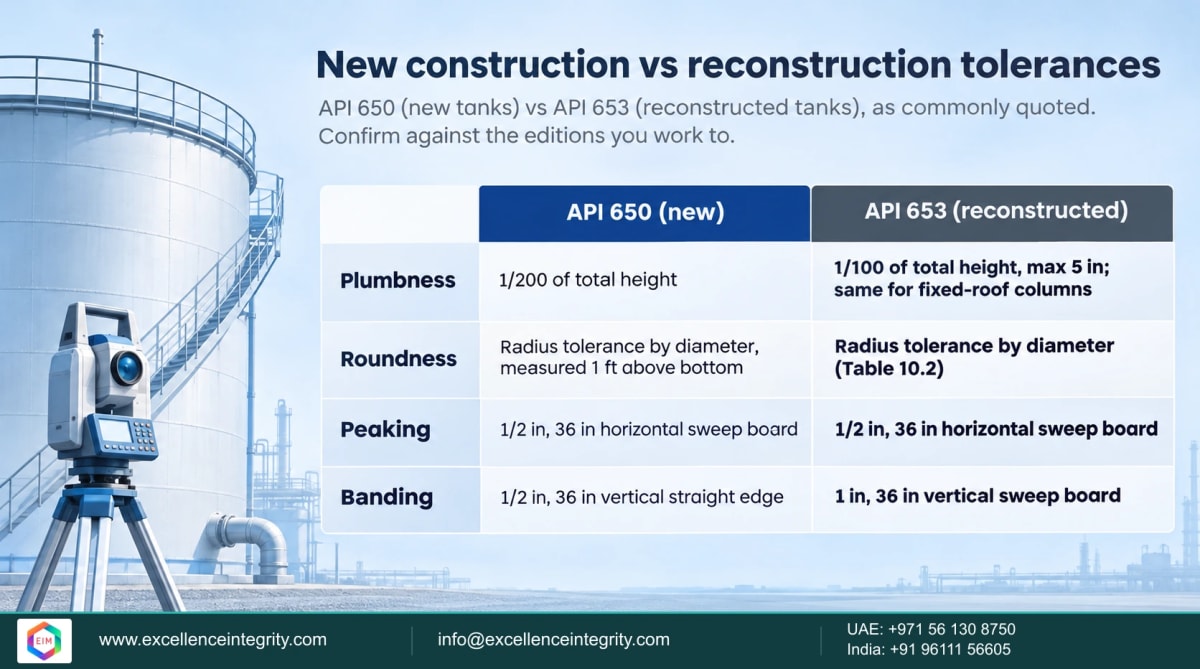
New tanks built to API 650 have tighter limits: plumbness of 1/200 of the total height, and 1/2 in for both peaking and banding. API 653 relaxes some limits for reconstruction, where reused plates and existing foundations make the new-construction values harder to achieve. In the exam, read carefully whether the question concerns a new tank or a reconstructed one.
Why tolerances matter in service
- Bending stresses: peaking and banding add local bending at welds, which can matter for fatigue and brittle fracture.
- Floating roofs: out-of-roundness and lean change the gap the seals must cover and can make the roof bind; see tank roof inspection.
- Settlement: tilt from settlement adds to plumbness; settlement surveys and plumbness surveys should be read together. See Annex B settlement.
Common mistakes
- Using API 650 limits for a reconstructed tank, or the reverse.
- Forgetting the 5 in cap on plumbness for tall tanks.
- Using a flat board for peaking: the horizontal sweep board must be cut to the tank's radius.
- Measuring roundness at the wrong height: it is 1 ft above the bottom corner weld.
- Ignoring settlement tilt when interpreting a plumbness survey.
Preparing for API 653
Peaking, banding, plumbness and roundness are listed in API's Body of Knowledge for the API 653 exam. EIM is an independent training provider; EIM's self-paced API 653 preparation includes a question bank, practice mode with explanations, timed mock tests, study notes and flashcards, with one year of access. See the API 653 page
Frequently asked questions
What is the plumbness tolerance for a reconstructed tank?
1/100 of the total tank height, with a maximum of 5 in, under API 653. The same applies to fixed-roof columns.
How is peaking measured?
With a 36 in horizontal sweep board cut to the true radius of the tank, centred on the vertical weld. API 653 limits it to 1/2 in.
How is banding measured?
With a 36 in vertical sweep board or straight edge across the horizontal weld. Check the limit in your edition of API 653 10.5.5.
Where is roundness measured?
At 1 ft above the bottom corner weld, against the radius tolerances in API 653 Table 10.2.
Are API 650 tolerances different?
Yes. API 650 limits plumbness to 1/200 of the total height and peaking and banding to 1/2 in for new tanks.
Sources
- API 653, 10.5 and Table 10.2; API 650, 7.5. Values paraphrased; table not reproduced.
- Eng-Tips: quotation of API 653 10.5.2 plumbness
- API conference paper: Tank shell tolerances
- Worked example prepared by EIM. Checked 7 October 2026.
Exam preparation
Preparing for API 653?
Practise with exam-style questions, timed mocks and study notes. 1,317 questions in the bank.