Sigma Phase Embrittlement: Damage Mechanism of the Week
Sigma phase embrittlement: which stainless steels it affects, the temperature range, where it appears in refineries, and how to detect and manage it.
By Syed Hasan18 Nov 20263 min read
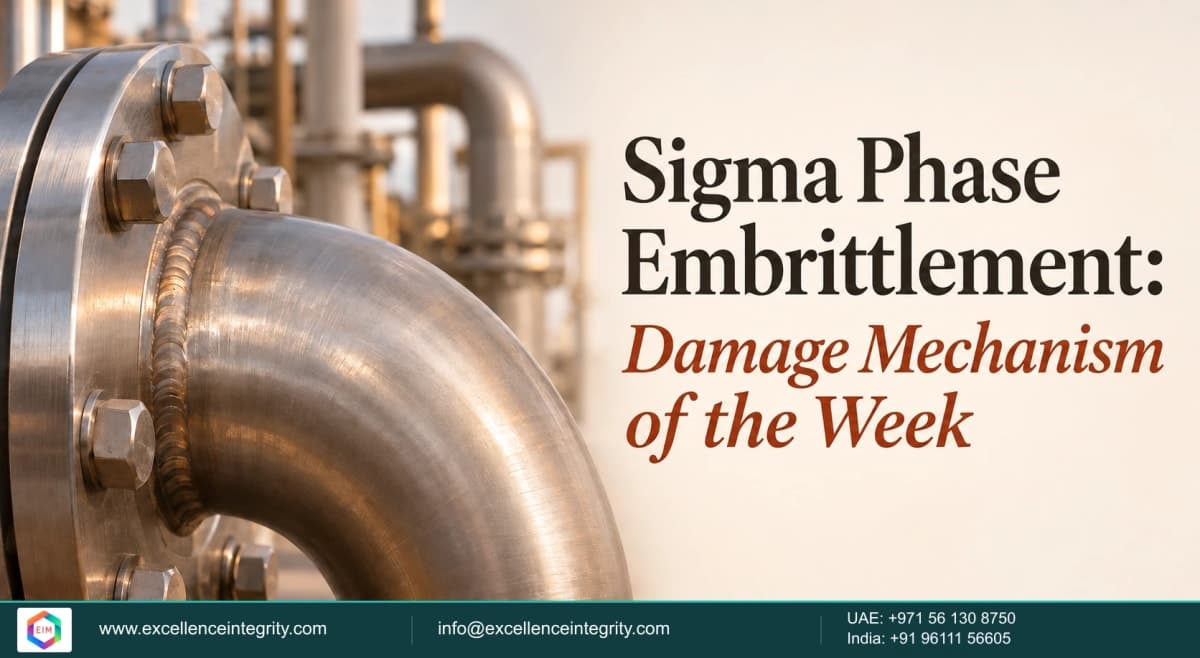
Week 2 of our Damage Mechanism of the Week series moves up the temperature scale. Sigma phase embrittlement affects stainless steels that spend years in very hot service, such as FCC regenerator internals and heater components. Like last week's 885 °F embrittlement, it is harmless in service and dangerous when the equipment is cold.
Short answer: At roughly 1000 to 1750 °F (540 to 955 °C), stainless steels can slowly form sigma, a hard, brittle intermetallic phase. Austenitic grades with some ferrite, stainless weld metal, and ferritic and duplex grades are most affected. Ambient-temperature toughness falls sharply, so cracking tends to happen during shutdowns and maintenance. Detection needs metallography or impact testing; management relies on material choice, careful handling when cold, and solution annealing where practical.
At a glance
What happens in the metal
Sigma is an iron-chromium intermetallic compound. It forms most readily from ferrite, which is why stainless weld metal, cast stainless steels and grades with deliberate ferrite content are more susceptible than fully austenitic wrought material. Sigma particles are hard and brittle. At operating temperature the steel still has some ductility; at ambient temperature, it can behave almost like glass.
Where to expect it
- FCC regenerators: cyclones, plenums, hangers and other stainless internals in long, hot service.
- Reformers and heaters: stainless components and supports in the hot zone.
- Hot stainless piping and welds, especially weld metal with ferrite.
- Duplex stainless steels exposed to high temperatures, even briefly during fabrication or upsets.
Why it bites when cold
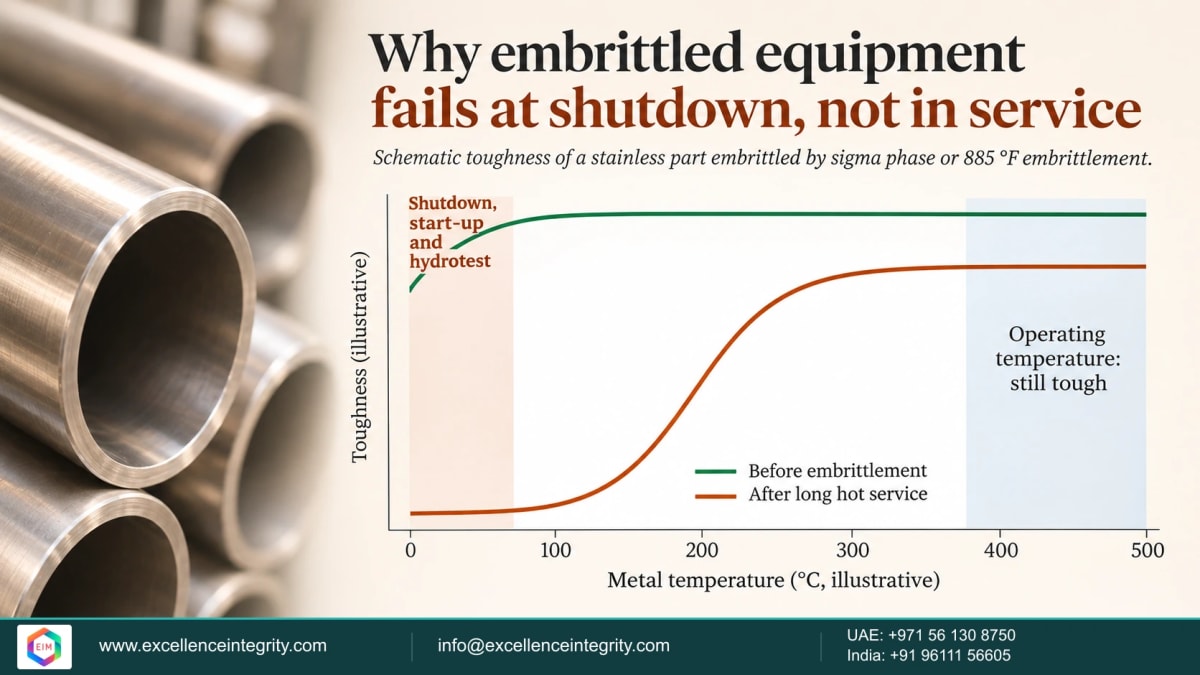
Embrittled parts fail during cold events: a shutdown, a hydrotest, maintenance that involves hammering or bending, or a thermal shock. Cyclone failures found at turnarounds are a classic example.
Detecting it
- Metallography of samples or replicas, which shows the sigma particles.
- Impact testing of removed samples to measure remaining toughness.
- Service history: time spent in the critical range is the first screen.
- Normal NDE does not see it until cracking has started.
Managing it
- Select materials: low-ferrite austenitic grades and weld metal for long, hot service; avoid duplex grades at high temperature.
- Handle cold equipment as brittle: minimise impact and stress during shutdowns and maintenance.
- Solution annealing at high temperature can dissolve sigma, where the component can be heat treated.
- Plan replacement of internals with known embrittlement rather than repairing by welding, which can crack.
Learn more with EIM
Sigma phase embrittlement is one of the mechanisms in API RP 571 (3rd edition), the body of knowledge for the API 571 certification. EIM is an independent training provider; EIM's self-paced API 571 preparation includes a question bank, practice mode with explanations, timed mock tests, study notes and flashcards, with one year of access. See the API 571 page. Last week: 885 °F embrittlement. Next week: temper embrittlement.
Frequently asked questions
What is sigma phase?
A hard, brittle iron-chromium intermetallic phase that can form in stainless steels during long exposure at high temperature.
At what temperature does sigma form?
Roughly 1000 to 1750 °F (540 to 955 °C), depending on the alloy and time.
Which stainless steels are most susceptible?
Grades and welds containing ferrite, cast stainless steels, and ferritic and duplex grades. Fully austenitic wrought grades are less susceptible.
Can sigma phase be removed?
Solution annealing at high temperature can dissolve it, where the component can be heat treated.
How is sigma phase different from 885 °F embrittlement?
Sigma forms at higher temperatures and as a distinct intermetallic phase; 885 °F embrittlement is a lower-temperature change within the ferrite. Both reduce toughness at ambient temperature.
Sources
- API RP 571, Damage Mechanisms Affecting Fixed Equipment in the Refining Industry, 3rd edition: sigma phase embrittlement. Summarised, not quoted.
- Checked 7 October 2026.
Exam preparation
Preparing for API 571?
Practise with exam-style questions, timed mocks and study notes. 3,357 questions in the bank.