RBI Risk Matrix and Risk Targets Explained
How RBI risk matrices and risk targets work: probability and consequence categories, iso-risk lines, and the two levers for bringing an item below target.
By Syed Hasan19 Nov 20263 min read
Part 4 of our API 580 cluster puts probability and consequence together. The risk matrix is the most recognisable output of any RBI study, and the most misread. Two items in different cells can carry similar risk and need completely different actions.
Short answer: Risk combines probability and consequence. A risk matrix places each item by its probability category and consequence category, with colours showing risk levels. The owner sets a risk target. Items above it need action, and there are two levers: reduce probability (inspection, repair, operating limits) or reduce consequence (inventory, detection, isolation, mitigation).
Reading the matrix
A typical matrix has five probability categories and five consequence categories. Each cell has a risk level. Items in the high-probability, high-consequence corner are the priority. But items in the high-probability, low-consequence corner and the low-probability, high-consequence corner can carry similar risk, while the right action differs.
Risk targets
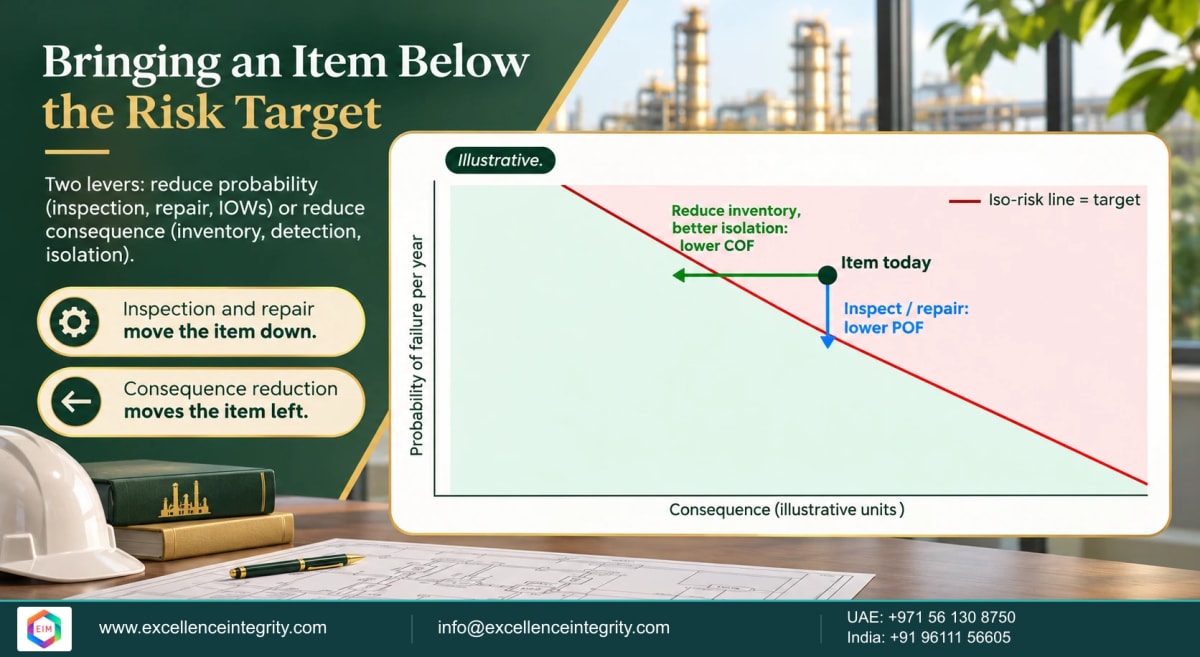
A risk target is the level of risk the owner accepts for an item. In quantitative RBI it is often expressed as a value, and the line of constant risk across probability and consequence (an iso-risk line) separates acceptable from unacceptable. Inspection planning then asks: when will this item's risk reach the target, and what action will keep it below?
Two levers
- Reduce probability: effective inspection (see inspection effectiveness), repair or replacement, material upgrades, integrity operating windows.
- Reduce consequence: smaller inventories, better detection, faster isolation, mitigation systems. See consequence of failure.
- Inspection cannot reduce a high consequence. Items that are high-risk because of consequence need engineering or operational changes.
Common mistakes
- Treating the matrix as the answer rather than a summary of the underlying analysis.
- Comparing matrices from different companies with different category definitions.
- Inspecting your way out of a consequence problem.
- Leaving the target undefined, which makes every decision arbitrary.
Learn more with EIM
EIM is an independent training provider; API certifies inspectors. The API 580 certification exam is based on API RP 580 (4th edition, with Addendum 1) and is closed book; holders of API 510, 570 or 653 qualify automatically. EIM's self-paced API 580 preparation includes a question bank, practice mode with explanations, timed mock tests, study notes and flashcards, with one year of access. See the API 580 page. EIM's live Risk-Based Inspection (RBI) Techniques course with Mr. Deepak Rawtal covers RBI methodology and inspection planning, with an EIM certificate of completion; check the course page for the next batch.
Frequently asked questions
What is a risk matrix in RBI?
A grid that places each item by probability category and consequence category, with colours showing risk levels, to rank and communicate risk.
What is a risk target?
The level of risk an owner accepts for an item. Inspection and mitigation plans are set to keep items below it.
What is an iso-risk line?
A line of constant risk across combinations of probability and consequence. Items on the same line carry the same risk.
How do you reduce risk?
By reducing probability (inspection, repair, operating limits) or consequence (inventory, detection, isolation, mitigation).
Are risk matrices the same everywhere?
No. Each company defines its own categories, boundaries and targets.
Sources
- API RP 580, Risk-Based Inspection, 4th edition with Addendum 1; API RP 581, Risk-Based Inspection Methodology. Concepts summarised, not quoted.
- Illustrations prepared by EIM. Checked 7 October 2026.
Exam preparation
Preparing for API 580?
Practise with exam-style questions, timed mocks and study notes. 912 questions in the bank.