Ammonium Bisulfide Corrosion: Damage Mechanism of the Week
Ammonium bisulfide (alkaline sour water) corrosion: where it attacks hydroprocessing REACs, what drives it, and how to inspect for and control it.
By Siddique18 Nov 20264 min read
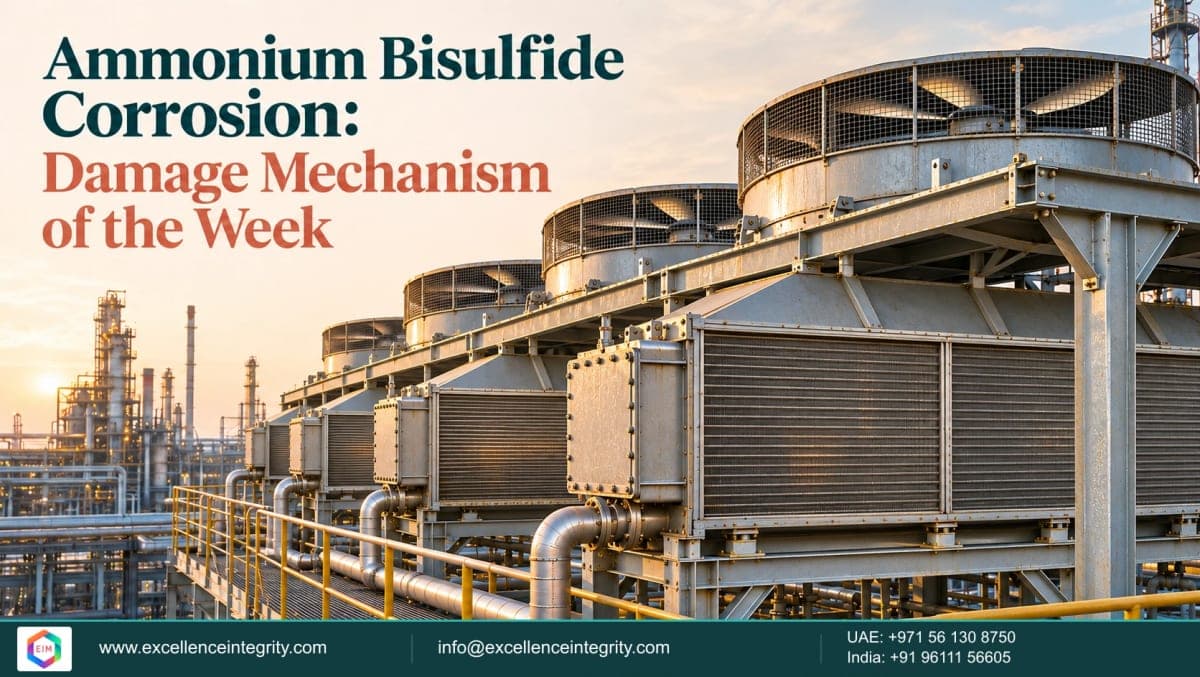
Week 4 of our Damage Mechanism of the Week series looks at one of the most aggressive mechanisms in hydroprocessing units. Ammonium bisulfide corrosion, also called alkaline sour water corrosion, has caused serious failures in reactor effluent air coolers (REACs), where it can thin tubes and headers quickly at turbulent spots.
Short answer: Hydroprocessing converts nitrogen and sulfur in the feed into ammonia and H2S, which combine to form ammonium bisulfide (NH4HS). Dissolved in water, it attacks carbon steel, and the attack accelerates with NH4HS concentration (increasingly corrosive above about 2 wt%) and with velocity and turbulence. Control relies on wash water injection, velocity limits, balanced flow distribution, alloy upgrades where needed, and inspection focused on turbulent locations.
At a glance
How it forms and why it attacks
As reactor effluent cools in the REAC, ammonia and H2S combine. Without water, ammonium bisulfide can deposit as solid salt, plugging tubes. With water, it forms a concentrated alkaline sour solution. The protective iron sulfide film on carbon steel survives in calm conditions but is stripped away where flow is fast or turbulent, leaving fresh metal to corrode.
Where it attacks
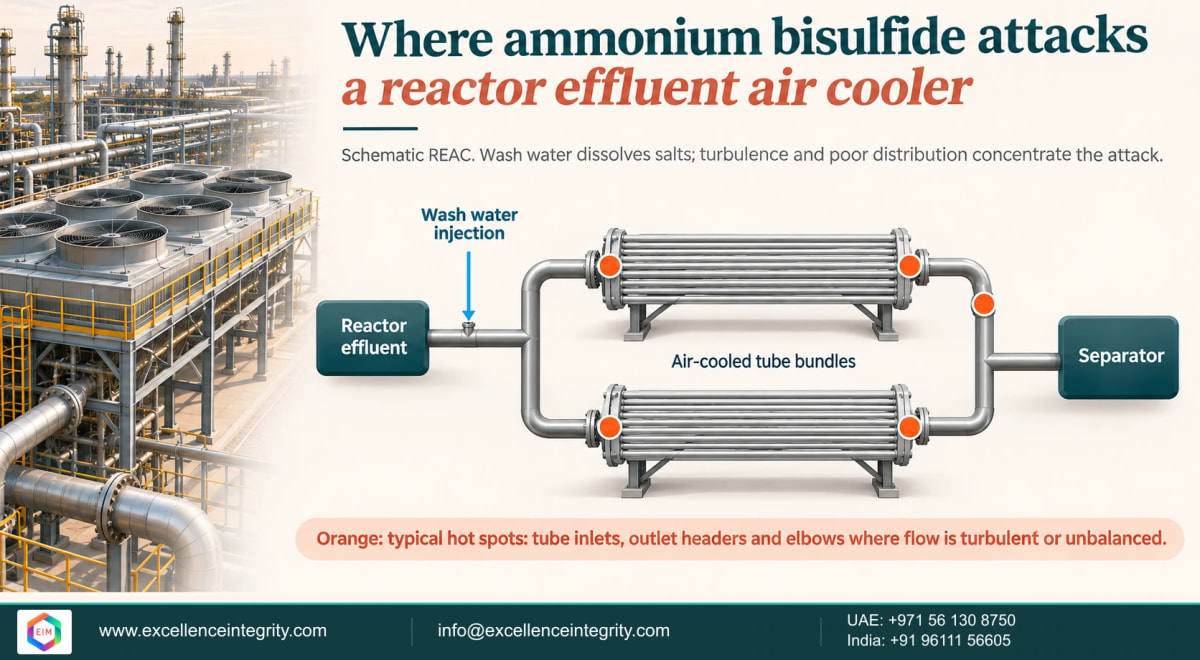
- REAC tube inlets and the first part of each tube, where turbulence is highest.
- Outlet headers, elbows and tees downstream of the bundles.
- Poorly balanced bundles: unequal flow between parallel bundles can push some into high-velocity, high-concentration conditions.
- Sour water stripper overheads and other sour water systems.
What drives the rate
- NH4HS concentration: the more concentrated the solution, the more corrosive. API RP 571 describes corrosion becoming increasingly severe above about 2 wt%.
- Velocity and turbulence: both remove protective films. Design guidance sets velocity ranges for carbon steel.
- Wash water: enough water, injected in the right place and well distributed, dilutes the salt and prevents deposits. Too little, or poorly mixed, concentrates the problem.
- Feed changes: more nitrogen or sulfur in the feed means more NH4HS. Process changes should go through management of change.
Controlling it
- Wash water: quantity, quality and injection design to keep NH4HS diluted and salts dissolved.
- Velocity limits and balanced flow: symmetrical piping and monitoring of bundle flows.
- Integrity operating windows: limits on NH4HS concentration, wash water rate and velocity, with defined responses; see integrity operating windows.
- Alloy upgrades: corrosion-resistant alloys for tubes and headers where conditions are severe.
- Guidance: API RP 932-B covers design, materials, fabrication, operation and inspection for REAC systems.
Inspecting for it
- Target turbulent locations: tube inlets, headers, elbows and tees, not just straight runs. See erosion-corrosion for the same logic.
- Tube inspection with methods suited to the tube material, such as IRIS for carbon steel tubes.
- Scanning of headers and piping rather than spot readings.
- Trend the process data alongside the inspection data: changes in feed, wash water and velocity explain changes in rate.
Learn more with EIM
Ammonium bisulfide corrosion is one of the mechanisms in API RP 571 (3rd edition), the body of knowledge for the API 571 certification. EIM is an independent training provider; EIM's self-paced API 571 preparation includes a question bank, practice mode with explanations, timed mock tests, study notes and flashcards, with one year of access. See the API 571 page. For sour systems more broadly, the self-paced Internal Corrosion Management programme covers sweet and sour corrosion and monitoring. Next week: CO2 corrosion.
Frequently asked questions
What is ammonium bisulfide corrosion?
Corrosion of carbon steel by alkaline sour water containing ammonium bisulfide, formed from ammonia and H2S, especially where flow is fast or turbulent.
Where does it occur?
Mainly in hydroprocessing reactor effluent air coolers and associated piping, sour water strippers and other sour water systems.
What concentration is a concern?
API RP 571 describes corrosion becoming increasingly severe as NH4HS concentration rises above about 2 wt%.
Why is wash water important?
It dilutes ammonium bisulfide and prevents solid salt deposits. Injection rate, water quality and distribution all matter.
Which document covers REAC corrosion control?
API RP 932-B, which covers design, materials, fabrication, operation and inspection for hydroprocessing REAC systems.
Sources
- API RP 571, Damage Mechanisms Affecting Fixed Equipment in the Refining Industry, 3rd edition: ammonium bisulfide corrosion (alkaline sour water). Summarised, not quoted.
- API RP 932-B, Design, Materials, Fabrication, Operation, and Inspection Guidelines for Corrosion Control in Hydroprocessing Reactor Effluent Air Cooler (REAC) Systems. Cited, not quoted.
- Checked 7 October 2026.
Exam preparation
Preparing for API 571?
Practise with exam-style questions, timed mocks and study notes. 3,357 questions in the bank.