CO2 Corrosion (Sweet Corrosion): Damage Mechanism of the Week
CO2 (sweet) corrosion explained: how carbonic acid attacks carbon steel, what drives the rate, why scale matters, where it occurs and how to control it.
By Siddique18 Nov 20263 min read
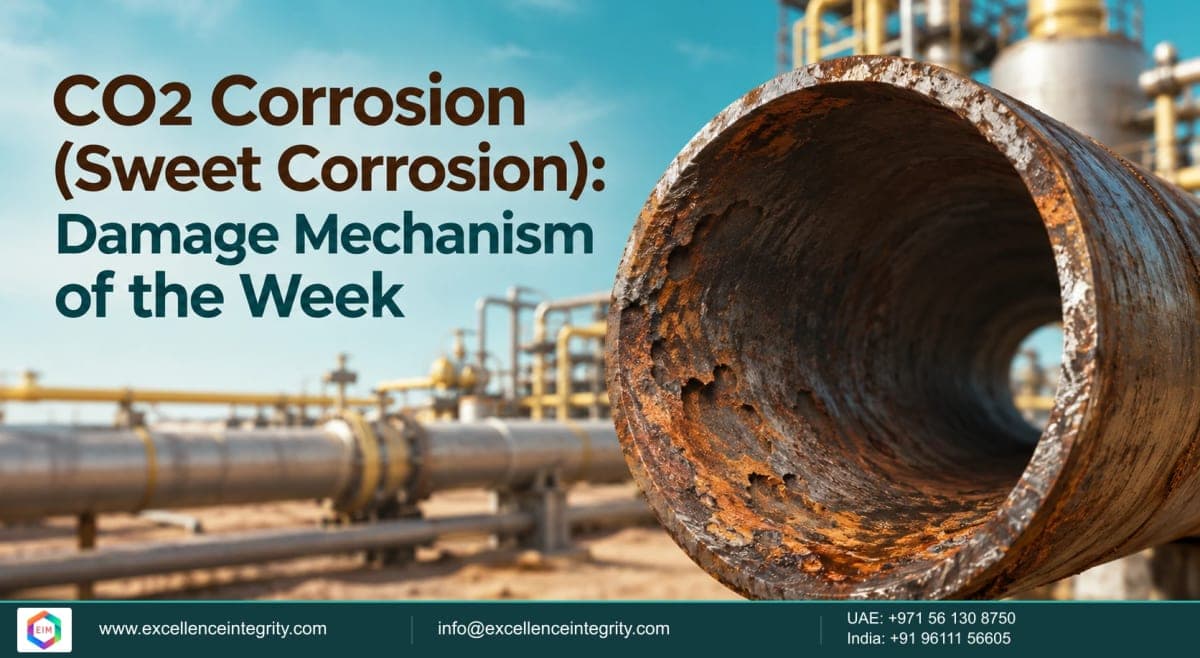
Week 5 of our Damage Mechanism of the Week series covers the most common internal corrosion mechanism in oil and gas production. CO2 corrosion, often called sweet corrosion, affects flowlines, pipelines and process equipment wherever water and carbon dioxide meet carbon steel. It also appears in refinery condensate systems and hydrogen plants.
Short answer: CO2 dissolves in water to form carbonic acid, which corrodes carbon and low-alloy steels. The rate depends on CO2 partial pressure, temperature, pH and flow. At higher temperatures a protective iron carbonate scale can form, but where it breaks down, attack becomes localised and severe (mesa attack). Control relies on inhibitors, pH control, corrosion-resistant alloys such as 13Cr, monitoring and prediction models.
At a glance
How it works
Carbon dioxide dissolves in any free water to form carbonic acid, a weak acid that is nonetheless aggressive to steel. The more CO2 in the gas (its partial pressure), the more acid in the water and the faster the corrosion, other things equal. Unlike wet H2S damage, CO2 corrosion is mainly metal loss rather than cracking, though it can be very localised.
Why temperature and scale matter
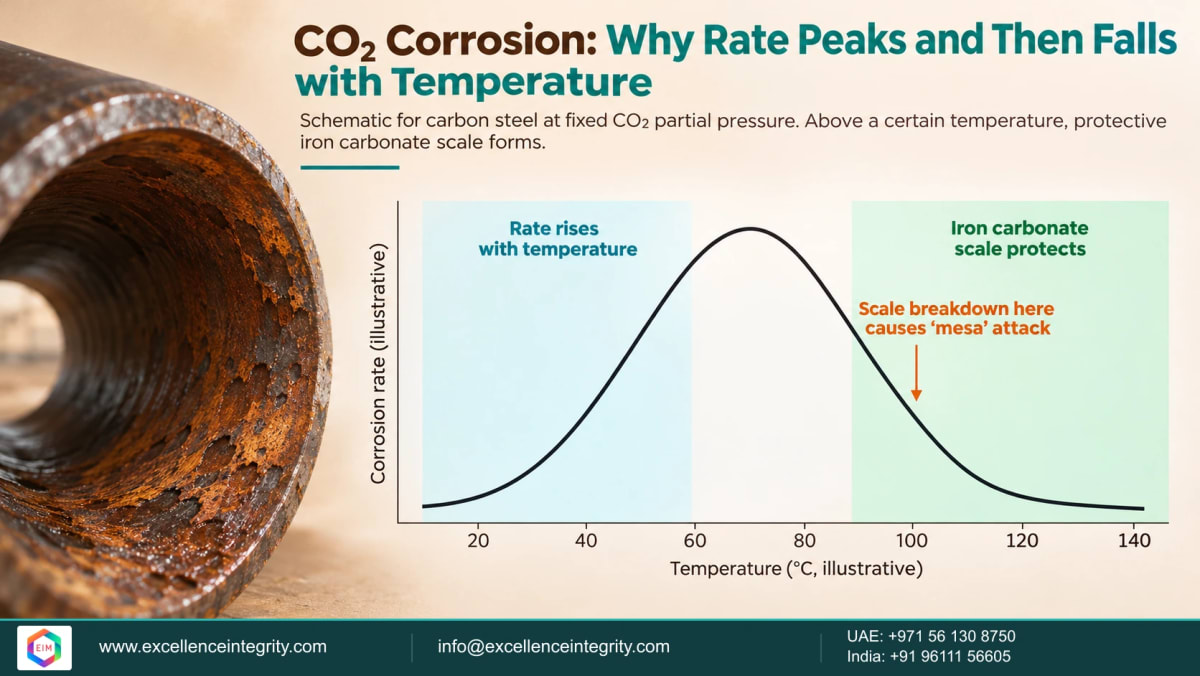
At lower temperatures, corrosion speeds up as temperature rises. At higher temperatures, iron carbonate precipitates on the steel and can form a protective scale, so the rate falls. The risk is in between and at the edges: where flow, chemistry changes or mechanical damage break the scale, the bare patches corrode fast while the scaled areas around them do not. The result is flat-bottomed, steep-sided pits known as mesa attack.
Where it occurs
- Oil and gas production: wells, flowlines, gathering lines and separators with produced water and CO2.
- Refinery and utility condensate systems, where CO2 from boiler feedwater treatment ends up in condensate.
- Hydrogen plants, in condensate downstream of shift conversion.
- Low points and water-wetted areas, where water drops out of the flow.
Controlling it
- Corrosion inhibitors in production systems, with dosing checked by monitoring.
- pH control, for example pH stabilisation in some gas pipelines, or neutralising amines in condensate systems.
- Corrosion-resistant alloys: 13Cr and other CRAs where inhibition is not practical. In sour service, check them against NACE MR0175.
- Prediction models: industry models such as NORSOK M-506 estimate rates from CO2 partial pressure, temperature, pH and flow, for design and corrosion allowance decisions.
- Monitoring and inspection: coupons and probes at the right locations, plus inspection at low points and turbulent areas; see coupons vs ER vs LPR.
CO2 with other mechanisms
CO2 often appears alongside other damage. Small amounts of H2S change the scale and the mechanism; oxygen ingress makes everything worse; organic acids can increase rates; and stagnant water can add microbiological corrosion. See our MIC field guide.
Learn more with EIM
CO2 corrosion is one of the mechanisms in API RP 571 (3rd edition), the body of knowledge for the API 571 certification. EIM is an independent training provider; EIM's self-paced API 571 preparation includes a question bank, practice mode with explanations, timed mock tests, study notes and flashcards, with one year of access. See the API 571 page. For production systems, the self-paced Internal Corrosion Management programme covers sweet and sour corrosion, monitoring and inhibitor programmes.
Frequently asked questions
What is CO2 corrosion?
Corrosion of carbon and low-alloy steels by carbonic acid formed when CO2 dissolves in water. It is often called sweet corrosion.
What controls the corrosion rate?
Mainly CO2 partial pressure, temperature, pH, flow velocity and whether a protective iron carbonate scale forms.
What is mesa attack?
Localised, flat-bottomed, steep-sided corrosion where protective iron carbonate scale has broken down while surrounding areas remain protected.
Which materials resist CO2 corrosion?
Corrosion-resistant alloys such as 13Cr martensitic stainless and duplex stainless steels resist far better than carbon steel.
How is CO2 corrosion predicted?
With industry models such as NORSOK M-506, which estimate rates from CO2 partial pressure, temperature, pH and flow.
Sources
- API RP 571, Damage Mechanisms Affecting Fixed Equipment in the Refining Industry, 3rd edition: CO2 corrosion. Summarised, not quoted.
- NORSOK M-506, CO2 corrosion rate calculation model. Cited by name.
- Checked 7 October 2026.
Exam preparation
Preparing for API 571?
Practise with exam-style questions, timed mocks and study notes. 3,357 questions in the bank.