Inspection Effectiveness in RBI: The A to E Categories Explained
Inspection effectiveness in RBI: the A to E categories, why the same method can rate differently, and how effectiveness changes risk.
By Syed Hasan19 Nov 20263 min read

Part 3 of our API 580 cluster covers the idea that connects inspection to risk. An RBI model does not give credit for "an inspection"; it gives credit for how well that inspection could find the damage that matters. That is inspection effectiveness, rated from A to E.
Short answer: Inspection effectiveness describes how likely an inspection is to correctly identify the actual damage state. API RP 581 uses five categories: A highly effective, B usually effective, C fairly effective, D poorly effective and E ineffective. The rating depends on the method, the coverage and the damage mechanism. A higher rating reduces uncertainty, and therefore probability of failure, more.
The five categories
- A, highly effective: correctly identifies the damage state in nearly every case.
- B, usually effective: identifies it most of the time.
- C, fairly effective: about even odds.
- D, poorly effective: provides little information.
- E, ineffective: no inspection, or a method that cannot find the damage.
Same method, different ratings
Effectiveness is not a property of a technique on its own. Spot UT can be quite effective for uniform thinning and nearly useless for localised pitting or cracking. Coverage matters too: scanning 10% of a susceptible area is not the same as scanning all of it. That is why API RP 581 rates effectiveness separately for each damage mechanism.
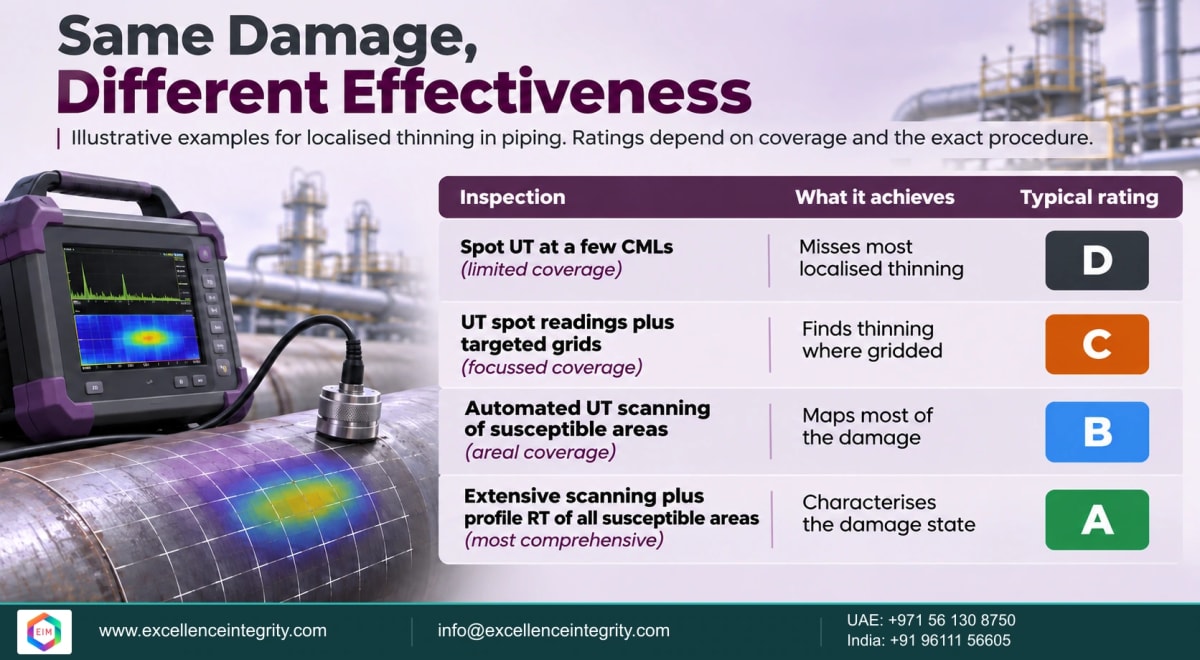
How effectiveness changes risk
In quantitative RBI, the damage factor depends on the number and effectiveness of past inspections. A highly effective inspection can sharply reduce the damage factor because it confirms the actual condition; several poorly effective inspections may not add up to one good one. Planning therefore asks: what is the most effective inspection we can do for the dominant damage mechanism, and where?
Practical tips
- Match the method to the mechanism: scanning for localised thinning, crack-detection methods for cracking, and so on.
- Define coverage explicitly in the inspection plan.
- Record what was actually done, not what was planned; the RBI model should credit the real inspection.
- Do not over-credit: rating every inspection as A defeats the purpose.
- Link to CML strategy: see CML optimisation.
Learn more with EIM
EIM is an independent training provider; API certifies inspectors. The API 580 certification exam is based on API RP 580 (4th edition, with Addendum 1) and is closed book; holders of API 510, 570 or 653 qualify automatically. EIM's self-paced API 580 preparation includes a question bank, practice mode with explanations, timed mock tests, study notes and flashcards, with one year of access. See the API 580 page. EIM's live Risk-Based Inspection (RBI) Techniques course with Mr. Deepak Rawtal covers RBI methodology and inspection planning, with an EIM certificate of completion; check the course page for the next batch.
Frequently asked questions
What is inspection effectiveness?
How likely an inspection is to correctly identify the actual damage state for a particular damage mechanism.
What are the inspection effectiveness categories?
A highly effective, B usually effective, C fairly effective, D poorly effective, and E ineffective, as used in API RP 581.
Why can the same method get different ratings?
Because effectiveness depends on the damage mechanism and the coverage. A method suited to uniform thinning may be poor for pitting or cracking.
Do several poor inspections equal one good one?
Not necessarily. A highly effective inspection reduces uncertainty far more than several poorly effective ones.
Where are the ratings defined?
API RP 581 gives tables of inspection effectiveness by damage mechanism; owners apply them through their procedures.
Sources
- API RP 581, Risk-Based Inspection Methodology (inspection effectiveness). Concepts summarised, not quoted.
- API RP 580, Risk-Based Inspection, 4th edition with Addendum 1.
- Checked 7 October 2026.
Exam preparation
Preparing for API 580?
Practise with exam-style questions, timed mocks and study notes. 912 questions in the bank.