Internal Corrosion Direct Assessment (ICDA): The Four Steps
How internal corrosion direct assessment works on unpiggable pipelines: the four ICDA steps, where water collects, and when ICDA is the right choice.
By Siddique27 Nov 20269 min read
Some pipelines cannot be pigged. They have tight bends, changes in diameter, valves that do not open fully, no launchers or receivers, or a flow too low to push a tool through. The internal corrosion threat on those lines is just as real as on any other, but the most common way of finding it, sending an in-line inspection tool down the bore, is not available.
Internal corrosion direct assessment, usually shortened to ICDA, is the structured answer to that problem. This post explains what ICDA is, the four steps it follows, why flow and elevation decide where corrosion is likely to sit, and when it is the right choice and when it is not. By the end you should be able to read an ICDA report and know which questions to ask about it.
What internal corrosion direct assessment actually is
ICDA is a method for deciding where internal corrosion is most likely along a pipeline, then digging up and examining those few places instead of the whole line. It rests on a simple physical idea: internal corrosion in oil and gas lines needs water, and water does not spread itself evenly. It settles where the flow cannot carry it, mostly at low points and on uphill sections the fluid struggles to climb.
If you can predict those spots from the pipeline's route and its operating conditions, you can examine them directly. In a dry gas line, the reasoning goes one step further: if the places where water would collect first show no corrosion, the sections downstream of them are less likely to be corroded either. That logic is what lets a handful of excavations stand in for an inspection of many kilometres.
AMPP (formerly NACE) publishes separate ICDA standard practices for dry gas, wet gas and liquid petroleum pipelines, because water behaves differently in each. ASME B31.8S, the integrity management standard for gas pipelines, recognises direct assessment as one of the ways to assess a line, alongside in-line inspection and pressure testing.
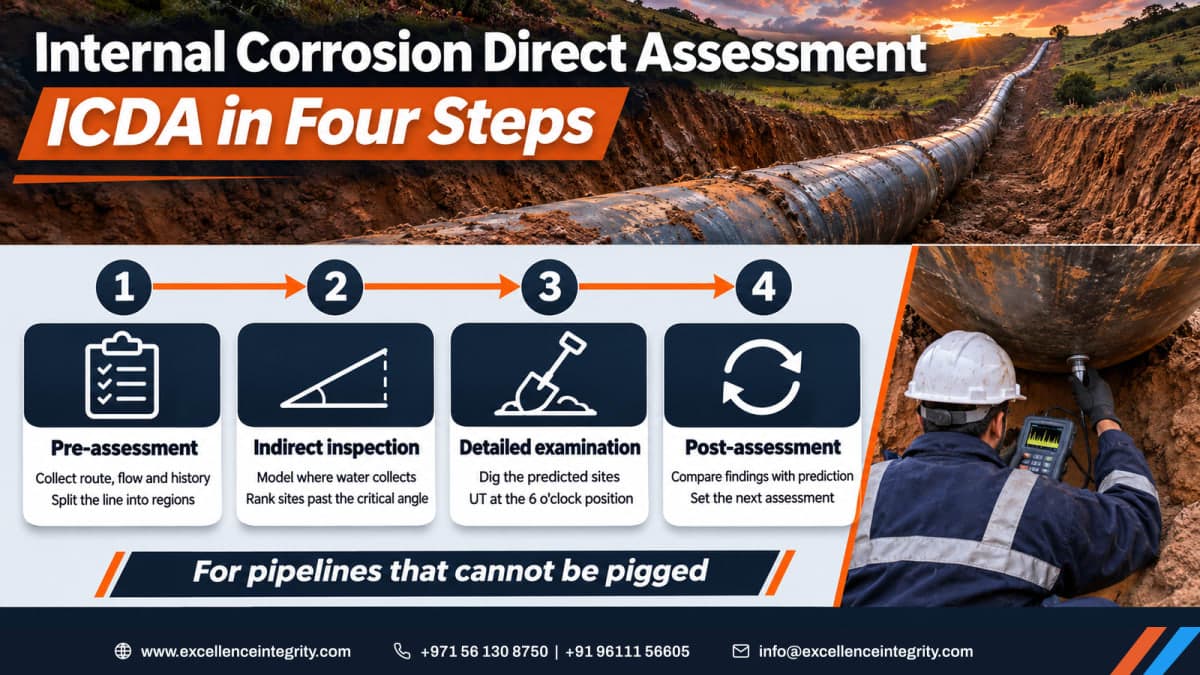
Step 1: Pre-assessment
Pre-assessment is the desk study, and it is where most of the quality of an ICDA is won or lost. You collect everything known about the line and decide whether ICDA can work on it at all.
The data you need is practical and specific:
- the route and an accurate elevation profile, because inclination is the heart of the method;
- pipe diameter, wall thickness and material for each section;
- operating pressure, temperature and flow rates, including how they have changed over the years;
- gas or liquid composition, water content, and any history of upsets that let water or solids in;
- inhibitor injection, cleaning history, leak and repair records, and any previous inspection results.
The output is a decision on feasibility and a division of the line into ICDA regions: stretches with the same inputs and flow conditions, analysed separately. A region begins wherever something changes, such as an inlet that adds fluid or a change in diameter. If the data is too thin to model the flow with confidence, the honest answer at this stage is that ICDA is not suitable yet.
Step 2: Indirect inspection, or predicting where water collects
This step does not involve touching the pipe. It is a calculation of where the fluid would drop out water or solids, laid over the elevation profile of the line.
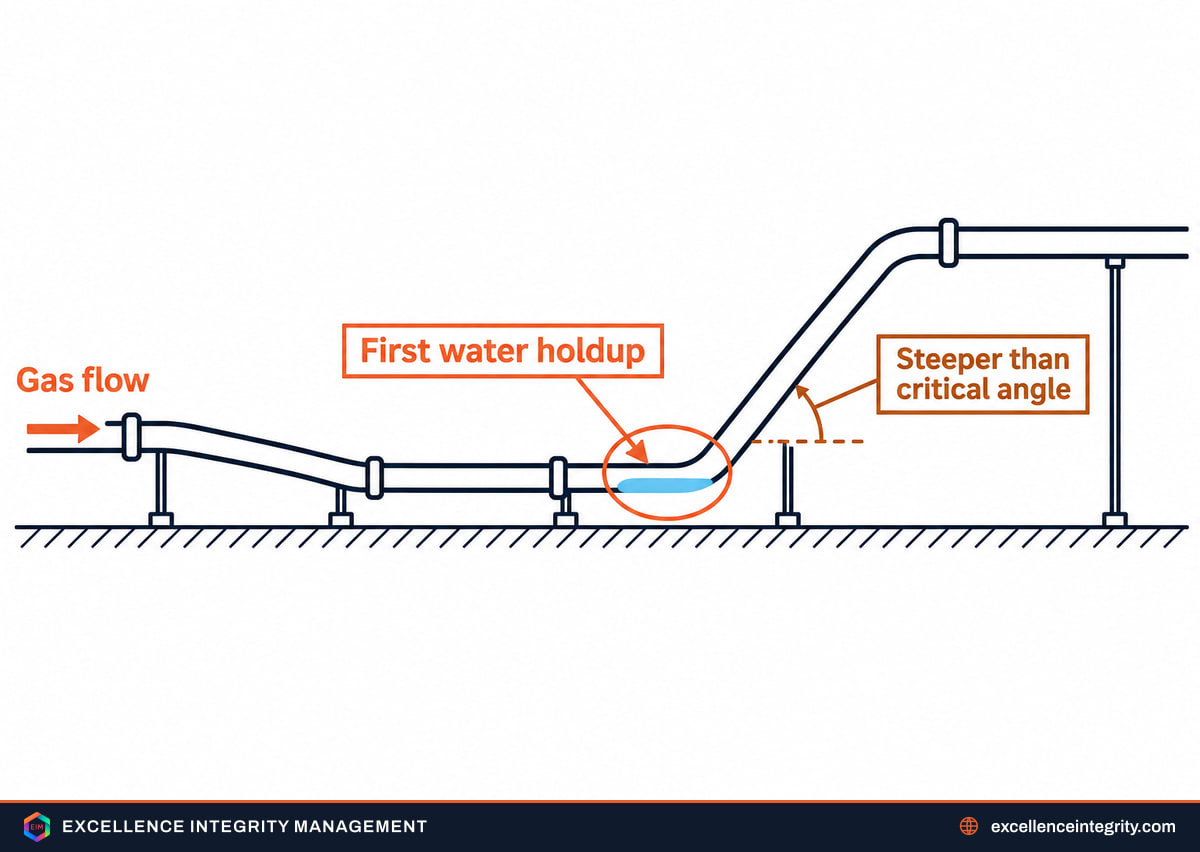
For a gas line, flow modelling gives a critical angle of inclination for each region: the slope steep enough that the gas can no longer carry water up and over it. Any section of the line inclined more steeply than that angle is a place where water would be expected to gather. The first such location downstream of an inlet is the most likely place for corrosion to start, because it is the first place water would hold up.
For liquid lines the question shifts. Water and solids drop out where the velocity falls too low to keep them moving, so low points and sections with reduced flow become the priority. Wet gas lines are harder again, because water is present along much of the length, and the assessment leans more on predicting corrosion rate along the line than on finding a single first collection point.
The deliverable from this step is a ranked list of locations to examine, each with the reason it was chosen. If the list cannot explain why each spot is on it, the indirect inspection has not done its job.
Step 3: Detailed examination, or digging where it matters
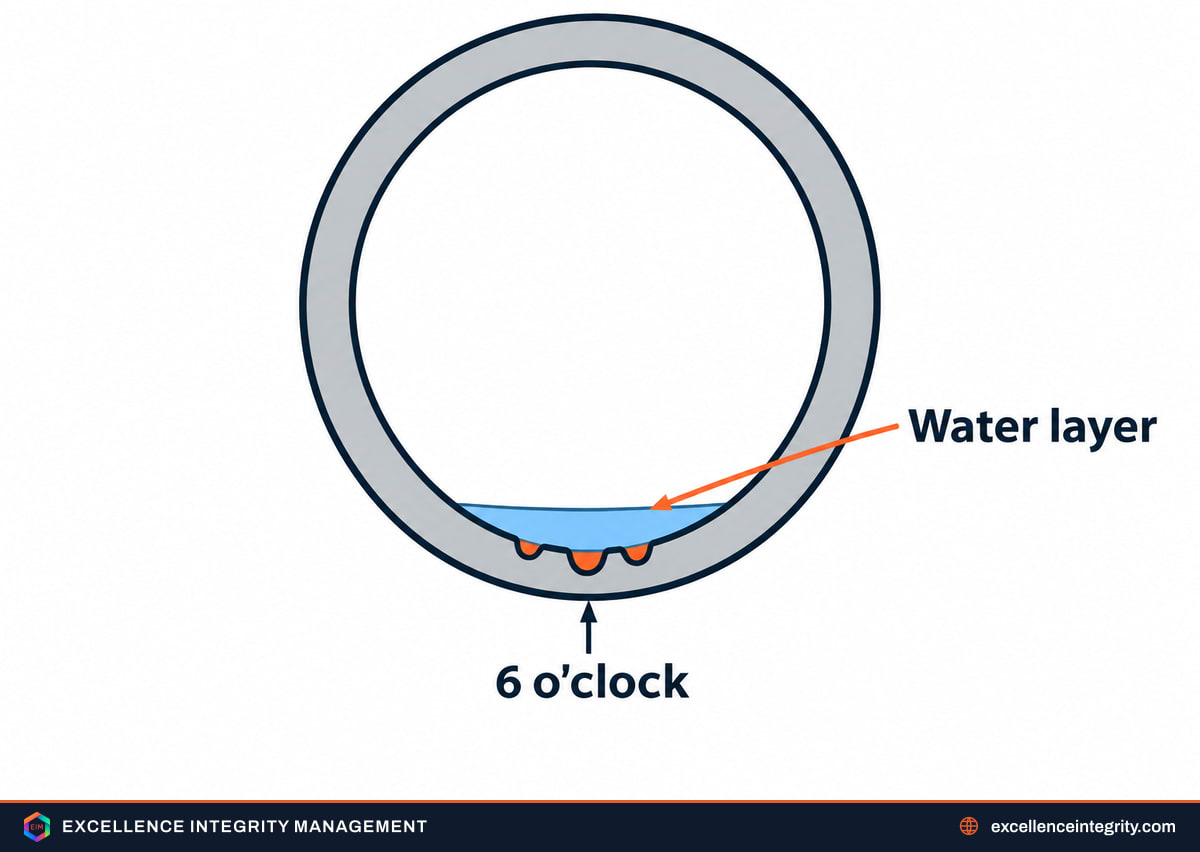
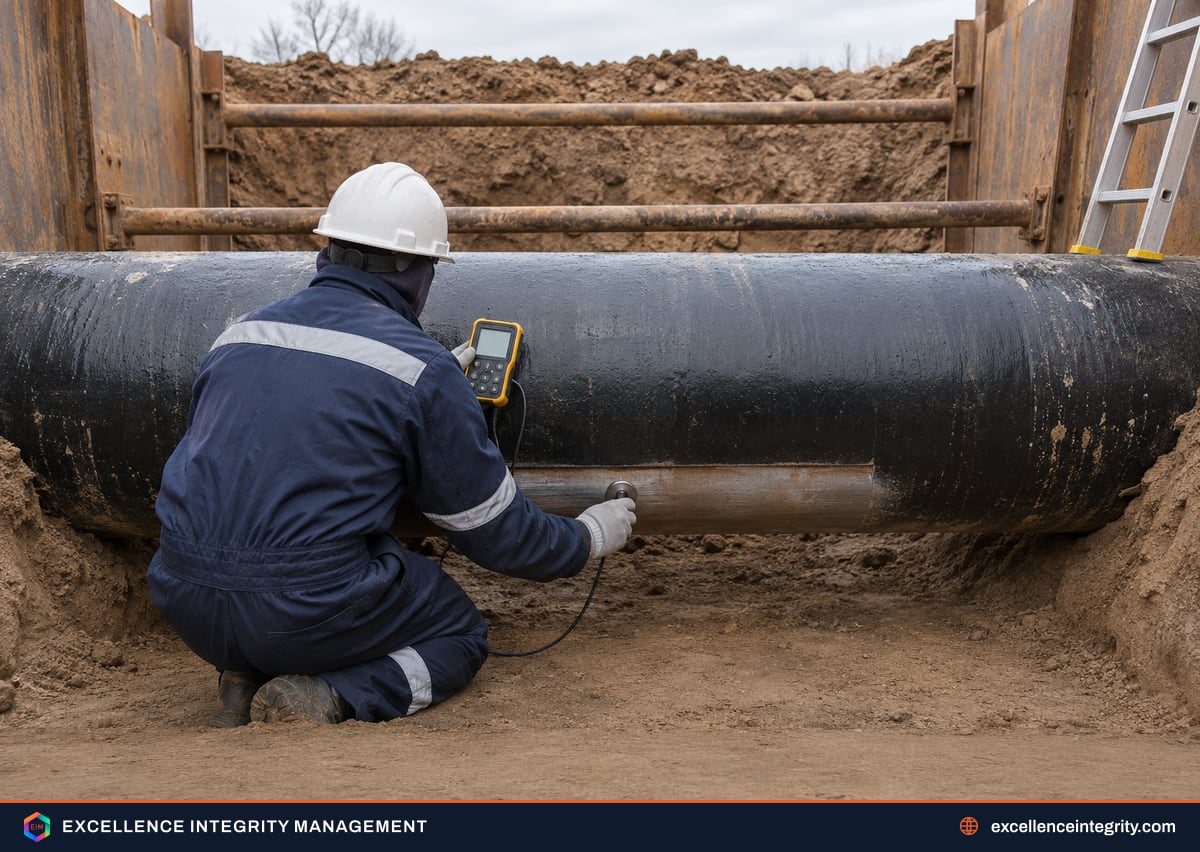
Now the pipe is excavated at the predicted locations and examined directly. On the outside of the pipe, inspectors usually start with ultrasonic thickness measurement or mapping, focused on the bottom of the pipe, around the 6 o'clock position, where water settles. Radiography or other methods may be added where the geometry or the finding calls for it.
Two things matter here more than the choice of tool. First, examine enough length and enough of the circumference at each site to be confident nothing was missed: a single spot reading at 6 o'clock does not prove a section is clean. Second, record what you find in a way that can be compared with the prediction. A site predicted as high risk that shows no damage tells you as much as one that shows heavy pitting.
If corrosion is found at the first priority sites, the scope widens downstream until clean pipe is confirmed. Where wall loss is significant, the damage is assessed for continued operation, which is the subject of fitness-for-service assessment.
Step 4: Post-assessment
Post-assessment closes the loop. You compare what the excavations found with what the model predicted, judge whether the method worked on this line, and decide what happens next.
Typical outputs are an estimate of remaining life where corrosion was found, a reassessment interval, changes to mitigation such as inhibitor dosing or cleaning, and a decision on whether ICDA should be used again or replaced by another method. If the prediction and the findings disagreed badly, that is a signal that the inputs or the model were wrong, and the next assessment needs better data, not just another dig.
This is also where ICDA links back to day-to-day control. Monitoring devices placed at the high-risk locations the assessment identified give a running check between assessments. The trade-offs between coupons, electrical resistance probes and linear polarisation resistance probes are set out in corrosion coupons vs ER probes vs LPR.
ICDA compared with in-line inspection
| Question | ICDA | In-line inspection |
|---|---|---|
| Needs a piggable line? | No | Yes |
| How it finds corrosion | Predicts likely locations, then examines them | Measures the wall along the whole length |
| Coverage | The excavated sites | Most of the pipe |
| Main dependency | Good data and sound flow modelling | A tool suited to the line and the threat |
| Weakness | Misses corrosion not driven by water holdup | Cleaning, access and tool limits |
The two are not rivals. ICDA can be the only practical option on a short, unpiggable line, while in-line inspection gives far better coverage where it can be run. The same thinking also helps on piggable lines, when you need to choose where to dig to check a tool's results.
When ICDA is the right choice, and when it is not
ICDA suits lines where water is the controlling factor and where its behaviour can be predicted: dry gas lines that occasionally take on water, or liquid lines where water and solids settle at known low points. It also needs reliable records. A line with an uncertain route, missing elevation data or an unknown operating history is a poor candidate.
It is a weaker choice where corrosion is not tied to where water collects. Microbiologically influenced corrosion under deposits, damage driven by solids that move with the flow, or erosion at fittings can all sit in places the holdup model would not rank highly. For the mechanisms of pipeline internal corrosion, see the internal pipeline corrosion management guide.
A common mistake with internal corrosion direct assessment is to treat a clean dig as proof that the whole line is clean. That conclusion only holds when the sites were chosen by a sound model, examined thoroughly, and the corrosion mechanism really is the one the model assumes.
Frequently asked questions
What are the four steps of ICDA?
Pre-assessment collects the route, elevation profile, operating history and records, then decides whether ICDA can work and splits the line into regions. Indirect inspection predicts where water or solids would collect. Detailed examination digs up and measures those sites. Post-assessment compares findings with the prediction and sets remaining life and the next interval.
What is the critical inclination angle in ICDA?
It is the slope at which the gas in a given region can no longer carry water up and over the incline, found by flow modelling. Any section inclined more steeply is where water is expected to gather, and the first such section downstream of an inlet is the most likely place for corrosion to start.
Is ICDA an alternative to in-line inspection?
Only where pigging is not practical. ICDA predicts likely corrosion sites and examines those few excavations, while in-line inspection measures the wall along most of the pipe. On a short unpiggable pipeline ICDA may be the only realistic option, but where a tool can be run it gives far better coverage.
Which standards cover internal corrosion direct assessment?
AMPP (formerly NACE) publishes separate standard practices for dry gas, wet gas and liquid petroleum pipelines, because water behaves differently in each. ASME B31.8S, the integrity management standard for gas pipelines, recognises direct assessment as one way to assess a line, alongside in-line inspection and pressure testing.
What to do next
If you are reviewing an ICDA report, or scoping any internal corrosion pipeline inspection, start with the pre-assessment: check the elevation data and the region boundaries, then ask why each excavation site was chosen. Most weak assessments fail there, long before anyone digs.
Internal corrosion assessment is a core part of the AMPP internal corrosion certifications. The differences between the two levels are explained in ICT vs SICT, and the SICT certification preparatory course works through assessment, monitoring and mitigation in depth. For the wider integrity picture, the pipeline integrity management programme covers how ICDA fits alongside in-line inspection and pressure testing.
Exam preparation
Preparing for AMPP ICT?
Practise with exam-style questions, timed mocks and study notes. 1,080 questions in the bank.
Preparing for a different exam? Try a free mock test:
Also relevant: AMPP SICT Senior Internal Corrosion Technologist