Asset Integrity Management System and ISO 55001: How the Two Fit
How an asset integrity management system and ISO 55001 fit together: what each contains, where they overlap, and why a certificate does not prove integrity.
By Syed Hasan27 Nov 20268 min read
Sooner or later someone in management asks whether the plant should "get ISO 55001", usually right after an audit, an insurance review or a contract that mentions asset management. The integrity team then has to explain how the standard relates to the asset integrity management system they already run, and whether certification would change anything about leaks, inspections and remaining life.
This post sets the two side by side. You will see what an asset integrity management system contains, what ISO 55001 actually asks for, where they overlap, where they do not, and how a plant can run one inside the other without writing everything twice. It also explains why a certificate on the wall does not, by itself, prove that a pressure vessel is safe.
What an asset integrity management system is
The system, often shortened to AIMS, is the written and working framework a company uses to keep its equipment from failing and losing containment. If you want the basic idea of integrity first, start with the complete guide to asset integrity management. The system is what turns that idea into repeatable practice.
Look at any asset integrity management system: oil and gas plants, refineries and petrochemical sites build theirs from the same blocks, whatever they are called locally:
- An integrity policy and objectives, signed by senior management.
- Roles, responsibilities and competence requirements for inspectors, engineers and operations.
- An equipment register with criticality, and a review of the damage mechanisms each item can suffer.
- An inspection strategy, often set by risk-based inspection, plus maintenance and testing of safety-critical equipment.
- Operating limits for the process variables that drive damage, known as integrity operating windows.
- Anomaly management: how findings, deferrals and temporary repairs are recorded, assessed and closed.
- Management of change, data management, key performance indicators, audit and review.
In integrity management, oil and gas and petrochemical plants lean on industry codes and practices for the technical content. For pressure equipment in refining and petrochemical plants these include the API inspection codes (API 510, API 570, API 653), API 580 and API 581 for risk-based inspection, API RP 584 for integrity operating windows and API 579-1/ASME FFS-1 for fitness-for-service. The system says who uses them, when, and what happens with the result.
What ISO 55001 is
ISO 55001 is the requirements standard in the ISO 55000 family on asset management. ISO 55000 gives the overview, principles and vocabulary, ISO 55001 sets the requirements for an asset management system, and ISO 55002 gives guidance on applying them. Because ISO 55001 is written as requirements, an organisation can be audited and certified against it by a certification body.
Its subject is wider than integrity. Asset management in the ISO sense means getting value from assets over their whole life: balancing cost, risk and performance so that the assets support what the organisation is trying to achieve. A pipeline operator, a water utility, a railway and a hospital can all use it.
The standard follows the same high-level structure as other ISO management system standards such as ISO 9001 for quality. In broad terms it asks the organisation to:
- understand its context and what its stakeholders need from the assets;
- set an asset management policy and objectives linked to the organisation's own objectives;
- write a strategic asset management plan and asset management plans to deliver it;
- manage risks and opportunities, and provide resources, competence and information;
- control the work, including changes and outsourced activities;
- monitor performance, run internal audits and management reviews, and correct and improve.
What it does not do is tell you how to inspect anything. ISO 55001 will not give you a corrosion rate formula, an inspection interval or a minimum thickness. It asks that you have a sound, risk-based way of deciding those things and that you follow it. The engineering comes from elsewhere.
The two side by side
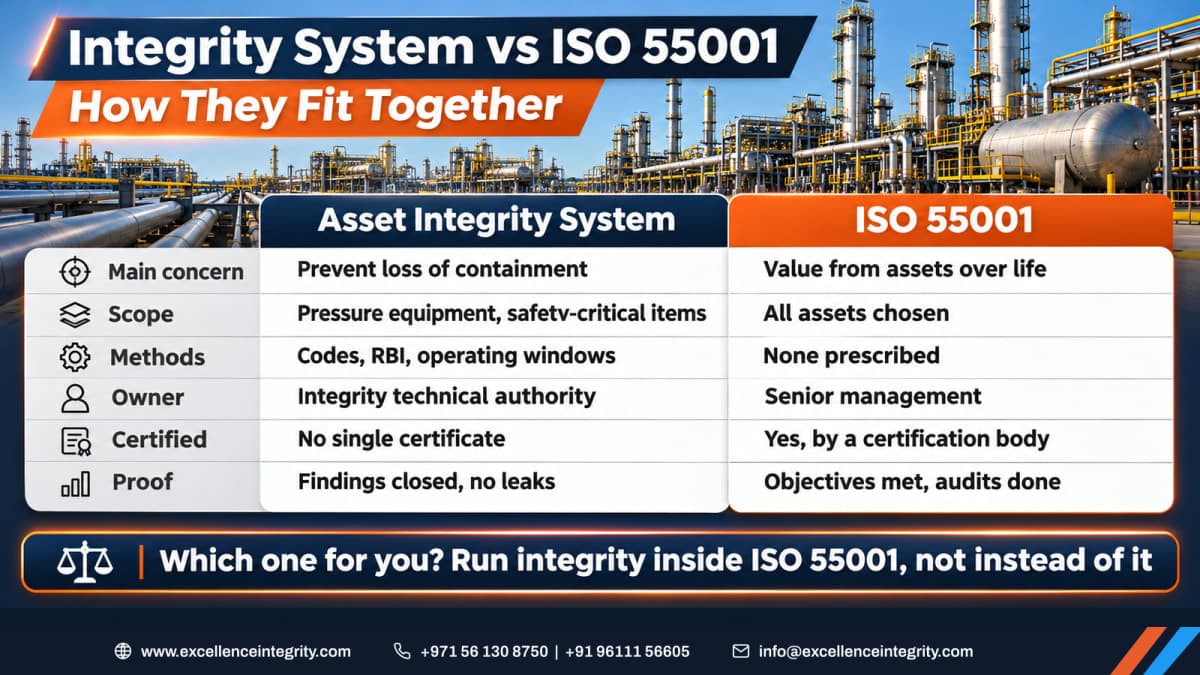
| Question | Integrity system (AIMS) | ISO 55001 asset management system |
|---|---|---|
| Main concern | Preventing failure and loss of containment | Value from assets: cost, risk and performance over the life |
| Scope | Mainly pressure equipment, structures, safety-critical items | All assets the organisation chooses to include |
| Technical methods | Inspection codes, RBI, operating windows, fitness-for-service | None prescribed; asks for a suitable, risk-based approach |
| Typical owner | Integrity or technical authority | Senior management, across functions |
| Can be certified | No single certification; audited against company and code requirements | Yes, by a certification body |
| Shown working by | Inspections on time, findings closed, no loss of containment | Objectives met, audits and reviews done, improvement shown |
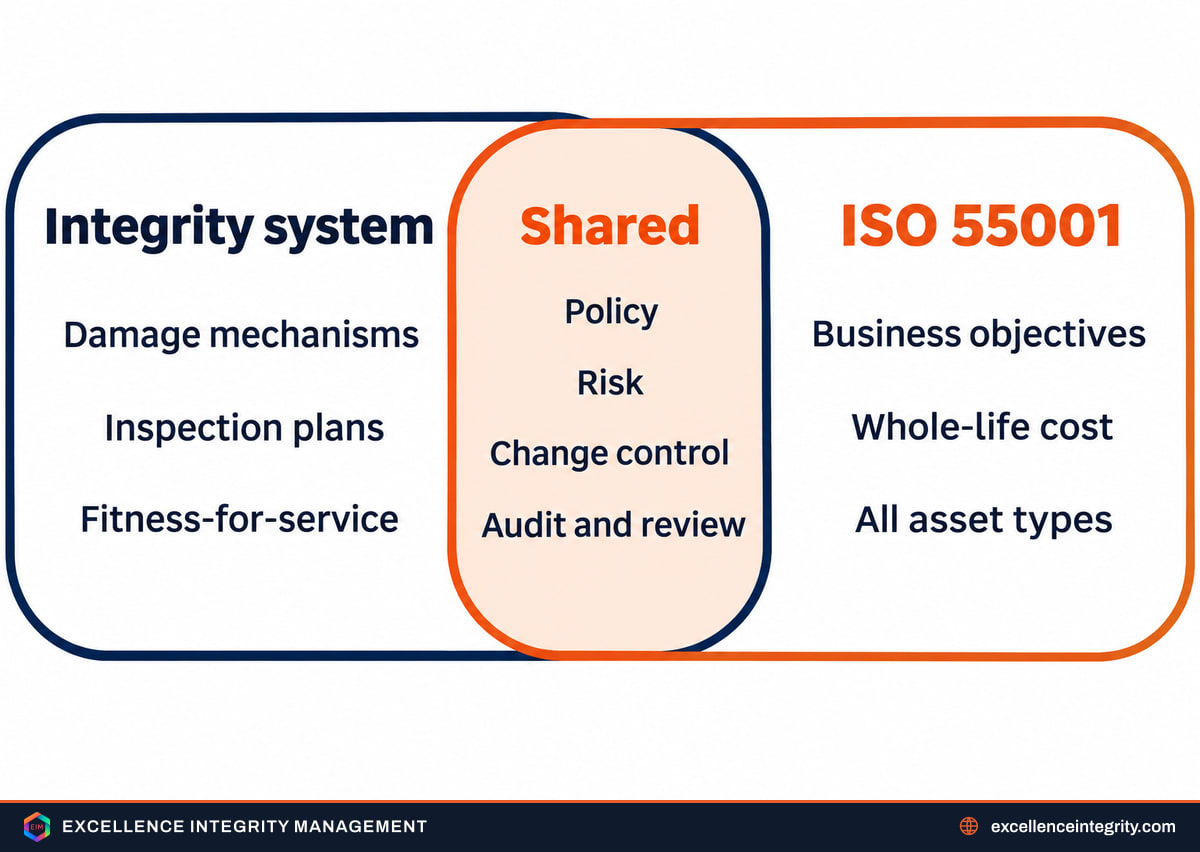
The overlap is in the management machinery: policy, objectives, roles, competence, risk, change control, data, performance measurement, audit and review. The difference is in the content. An integrity system is deep and narrow. ISO 55001 is broad and does not go down to the level of a corrosion loop.
How they fit together
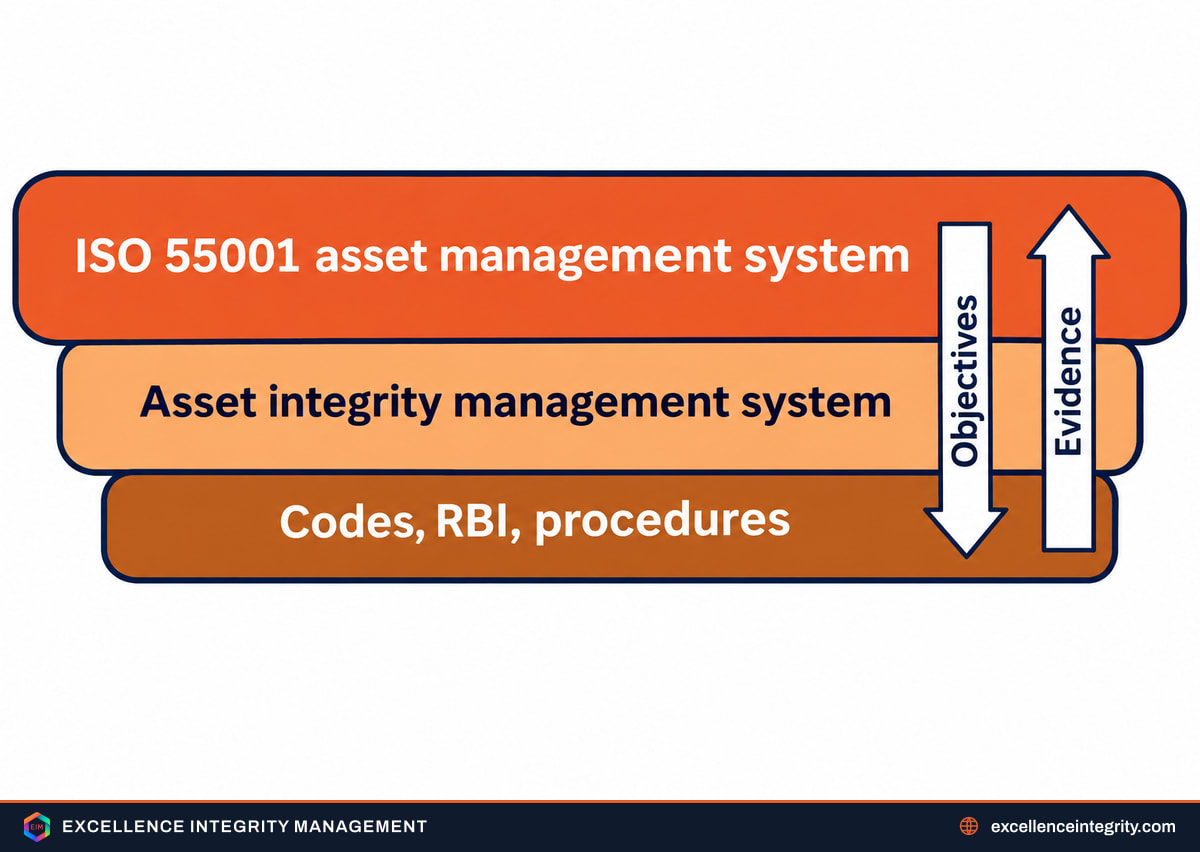
The cleanest way to see it is in layers. ISO 55001 sits at the top as the framework for managing all assets. Inside it, the integrity system is one of the most important parts for a process plant, because integrity failures carry some of the largest safety, environmental and financial risks. Below that sit the technical practices, the codes and procedures the inspectors and engineers actually use.
In practice, a plant with a working integrity system already holds much of the evidence an ISO 55001 auditor looks for: a documented risk method, competence records, an equipment register, change control and performance reviews. What it often lacks is the top layer. That means a clear line from company objectives to integrity objectives, a strategic plan that covers all asset types rather than only pressure equipment, and management reviews that weigh cost and performance alongside risk.
The reverse is also true. A company can build an ISO 55001 system that looks complete on paper while the integrity content underneath is thin. Nothing in the standard checks that your damage mechanism review is right or that your RBI model uses real thickness data.
Why certification is not the same as integrity
A certificate shows that an auditor sampled the management system and found it met the standard's requirements. It does not show that every vessel has a valid inspection, that every temporary repair is still within its review date, or that the corrosion rates are realistic. Those are technical questions, and they are answered by technical assurance: competent inspection, independent review and audits by people who understand the codes.
So treat the two as complementary. Use ISO 55001, if you choose to adopt it, to connect integrity to business decisions and to make sure management reviews ask the right questions. Keep the integrity system and its technical audits as the proof that equipment is fit to run.
Where to start if you have one but not the other
If you run an integrity system and management wants ISO 55001, start with a gap check against the standard's requirements and map each one to an existing procedure. Most gaps will sit at the top layer: objectives, the strategic plan and the management review. Do not rewrite the integrity procedures to sound like ISO language; reference them.
If you have an ISO 55001 system and are unsure about integrity, test it from the bottom. Pick three critical items of equipment and follow each one through its damage mechanisms, latest inspection, remaining life and open findings. If that trail is hard to follow, the integrity layer needs work whatever the certificate says.
Frequently asked questions
What are the elements of an asset integrity management system?
The usual blocks are an integrity policy and objectives, roles and competence, an equipment register with criticality and a damage mechanism review, an inspection strategy often set by risk-based inspection, integrity operating windows, anomaly management for findings and temporary repairs, and management of change, data, KPIs, audit and review.
Does ISO 55001 replace the API inspection codes?
No. The inspection codes and recommended practices tell you how to inspect, assess and repair equipment. ISO 55001 asks that you have a suitable way of managing assets and that you follow it. A plant certified to ISO 55001 still inspects its vessels and piping to the codes that apply to them.
Do you need ISO 55001 to have a good integrity system?
No. Many plants run strong integrity systems without it. The standard helps most where integrity sits apart from business planning, for example where inspection budgets are cut without anyone weighing the risk, or where reliability, maintenance and integrity each report on their own.
Who owns the integrity system under ISO 55001?
Senior management owns an ISO 55001 system, because it spans functions. The integrity or technical authority still owns the integrity content. Where reliability and integrity sit together, as in the reliability and asset integrity programme, the link between the two layers is easier to keep.
What to do next
The technical layer is where most plants gain or lose. For the risk method at its centre, see the API 580 risk-based inspection certification preparation. For setting process limits that protect equipment, the integrity operating windows and corrosion control documents programme covers the method. If your role is closer to reliability and maintenance management across all assets, the SMRP CMRP exam preparation fits the wider asset management view.
Exam preparation
Preparing for API 580?
Practise with exam-style questions, timed mocks and study notes. 912 questions in the bank.
Also relevant: SMRP CMRP Exam Preparation — Maintenance & Reliability