Corrosion Management Plan: What It Contains and How to Write One
What a corrosion management plan contains, section by section: scope, threats, mitigation, monitoring, inspection, KPIs, roles and review, with a template.
By Siddique27 Nov 20268 min read
Most facilities already do the work of corrosion management. Someone doses inhibitor, someone pulls coupons, inspectors take thickness readings, and a list of repairs gets worked through at each shutdown. What is often missing is the document that ties those activities together, says why each one exists, and shows whether any of them is working.
That document is the corrosion management plan. This post is a practical corrosion management plan template rather than theory: the sections a plan needs, what goes into each one, the mistakes that make plans useless, and an order of work for writing one from scratch. If you have been asked to produce or review a plan for a unit, a field or a pipeline system, you should be able to start after reading it.
What a corrosion management plan is, and what it is not
A corrosion management plan is the written arrangement for controlling corrosion on a defined set of assets. It names the threats, the barriers against them, the checks that show the barriers are holding, and the people responsible for each part. It is a management document: it should tell a new engineer what is done, where, how often and by whom, and what happens when a check fails.
It is not a corrosion textbook, and it is not an inspection plan or the whole corrosion management system around it. The inspection plan is one input to it. Nor is it the same as a corrosion control document, which records the damage mechanisms for a specific process unit in depth. A plan can point to those documents and to the operating limits that sit with them, which are explained in integrity operating windows, without copying their content.
Section 1: Scope and assets
Start by saying exactly what the plan covers. List the systems, pipelines, vessels and tanks by tag or line number, state where the boundaries sit (for example, from the wellhead flange to the export pig receiver), and name anything deliberately excluded. A plan with a vague scope will slowly stop covering the equipment that changed after it was written.
Then group the equipment into corrosion circuits: sections of plant where the material, the fluid and the operating conditions are similar enough that the same threats apply. Circuits are the unit everything else in the plan is organised around.
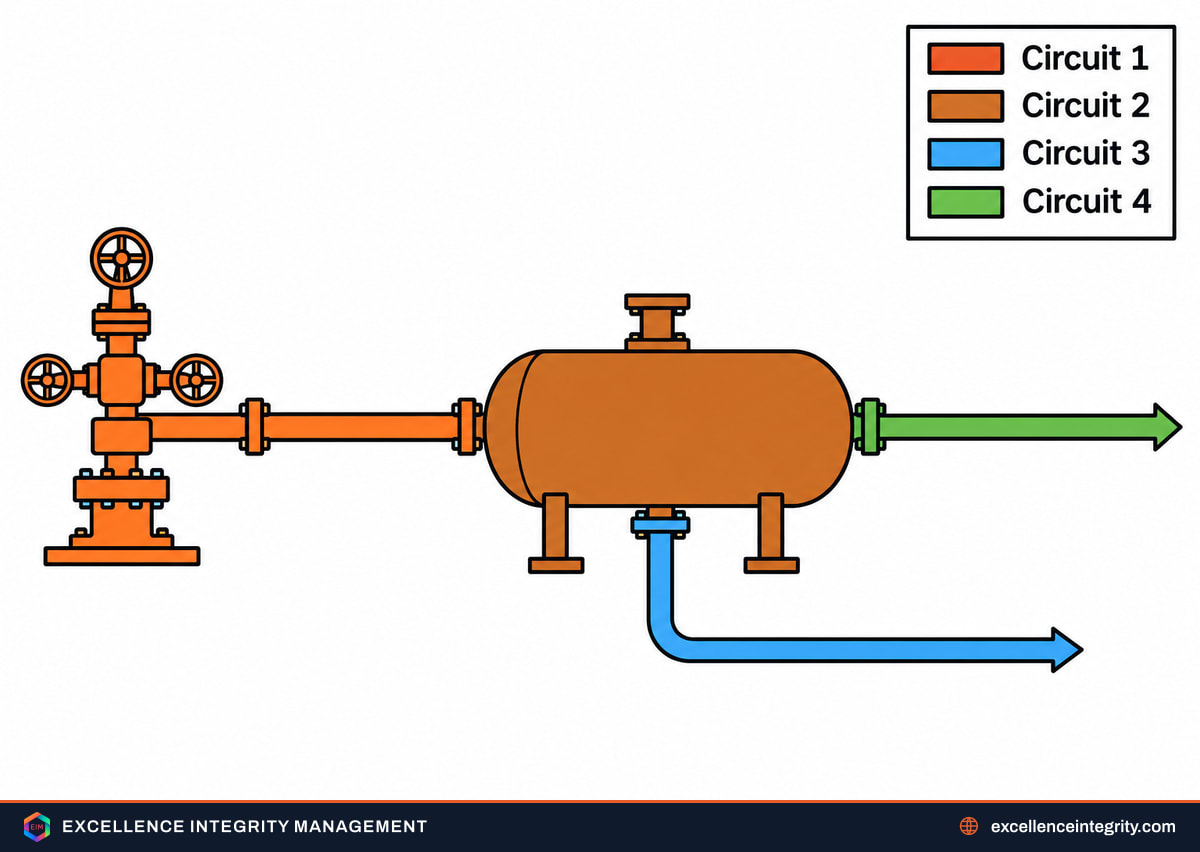
Section 2: Corrosion threats by system
For each circuit, record the credible threats and why they are credible. Internal threats in oil and gas systems commonly include carbon dioxide corrosion, hydrogen sulphide related damage, microbiologically influenced corrosion, under-deposit attack and erosion-corrosion. External threats include atmospheric corrosion, corrosion under insulation and soil-side corrosion on buried lines.
Write the driver beside each threat: water present, a level of CO2, stagnant flow, temperature in a range where insulation stays wet. The driver is what the rest of the plan will control and monitor, so this column matters more than the threat name. If you need a reference for recognising the mechanisms, the API 571 corrosion and materials certification preparation is built around exactly that.
Section 3: Mitigation
List each barrier against each threat: corrosion inhibitor injection, biocide treatment, coatings, cathodic protection, material selection, dehydration, pigging to remove water and solids, and process controls such as keeping velocity in a range. For chemical barriers, record the chemical, the injection point, the target dose and how availability is proven, because an inhibitor programme only protects the line while the pump is running and the chemical is reaching it.
Be specific about which threat each barrier addresses. "Inhibitor injection" against "CO2 corrosion in circuit 3" can be checked; "corrosion control measures in place" cannot.
Section 4: Monitoring
Monitoring tells you whether the barriers are working between inspections. Record each device or measurement, its location, what it measures and how often it is read: coupons, electrical resistance and linear polarisation resistance probes, water analysis for iron and manganese counts, residual inhibitor, bacteria counts, and process data such as water cut and temperature. The strengths and limits of the main probe types are compared in corrosion coupons vs ER probes vs LPR.
Place monitoring where the threat is worst, not where access is easiest. A coupon at the top of a line in a convenient spot says little about water lying at the bottom of a low point.
Section 5: Inspection
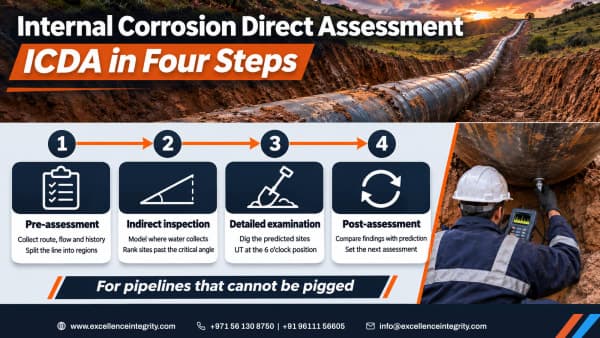
Inspection finds the damage that monitoring cannot see and confirms what monitoring suggests. For each circuit, state the methods, the locations, the coverage and the interval, and how the interval was set, whether by risk-based inspection, by the applicable code, or by the remaining life calculated from previous readings. Link the plan to the inspection system rather than duplicating it, so there is one schedule, not two that drift apart.

Section 6: KPIs
Corrosion KPIs turn the plan from a description into something that can be checked. Good ones measure whether barriers are available and whether the work is being done, not only whether something has already corroded:
- inhibitor availability: the share of time injection was running at the target dose;
- monitoring compliance: coupons pulled and probes read on schedule;
- inspection compliance: inspections completed by their due date;
- measured corrosion rate against the rate assumed in the design or the plan;
- open actions from the last review, and how many are overdue.
Set each KPI a target and a trigger. A target says what good looks like; a trigger says when someone has to act. Leave the numbers to the asset's own design basis and history rather than borrowing them from another facility.
Section 7: Responsibilities
Name roles, not people, for every activity: who owns the plan, who runs chemical injection, who reads probes, who analyses results, who approves a change and who closes actions. Include the contractors who do the work, such as the chemical vendor or the inspector network, and state what they report and to whom. Plans fail quietly when everyone assumes someone else is watching the probe data.
Section 8: Review cycle
Finally, set how the plan stays alive. Most plans combine a routine review of KPIs and monitoring data with a fuller periodic review of the whole plan, and a trigger to review early after any change: a new well, a higher water cut, a different crude, a change of chemical, or a failure. Each review should end with dated actions and an updated revision of the plan.
| Section | What goes in it | Common gap |
|---|---|---|
| Scope and assets | Tags, boundaries, corrosion circuits | Equipment added later is not covered |
| Threats | Mechanism and its driver per circuit | Threat named, driver missing |
| Mitigation | Barrier per threat, with injection details | No proof the barrier is available |
| Monitoring | Device, location, frequency | Devices placed for access, not risk |
| Inspection | Method, location, interval and its basis | A second schedule that drifts |
| KPIs | Target and trigger for each | Only lagging measures |
| Responsibilities | Role for every activity | Contractor reporting unclear |
| Review cycle | Routine, periodic and change triggers | Actions never closed |
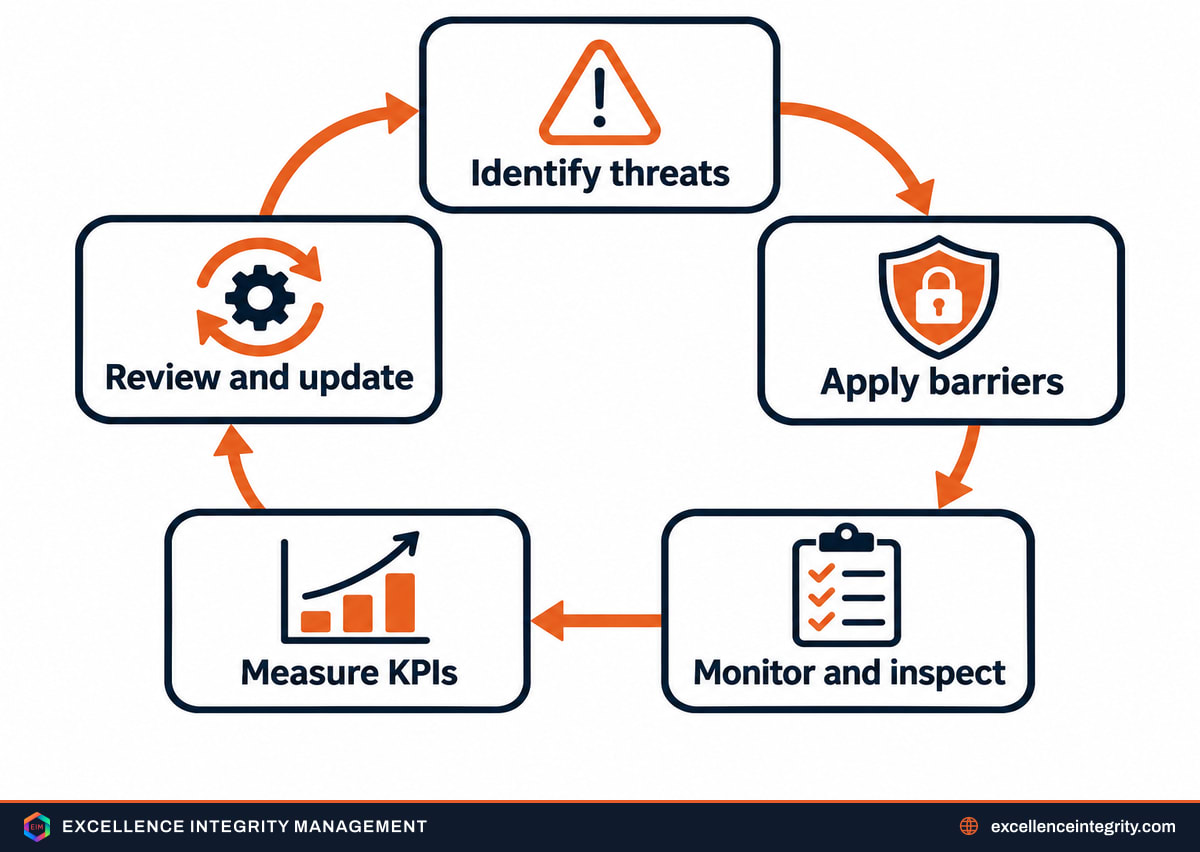
How to write one: an order of work
Do not write the sections in the order they appear. Start with the scope and the circuits, because nothing else can be written without them. Then do threats and drivers circuit by circuit, ideally in a workshop with process, operations, inspection and the chemical vendor in the room, because each sees a different part of the picture. Mitigation and monitoring follow directly from the drivers. KPIs come next, once you know which barriers matter. Responsibilities and the review cycle are written last, and then the whole draft is walked through against one real circuit to see whether a new engineer could run it.
A plan for a large system does not need to be finished in one pass. Cover the highest-risk circuits fully first, mark the rest as pending, and close them over the following reviews. A partial plan that is true is more useful than a complete one that is guessed.
Frequently asked questions
What should a corrosion management plan include?
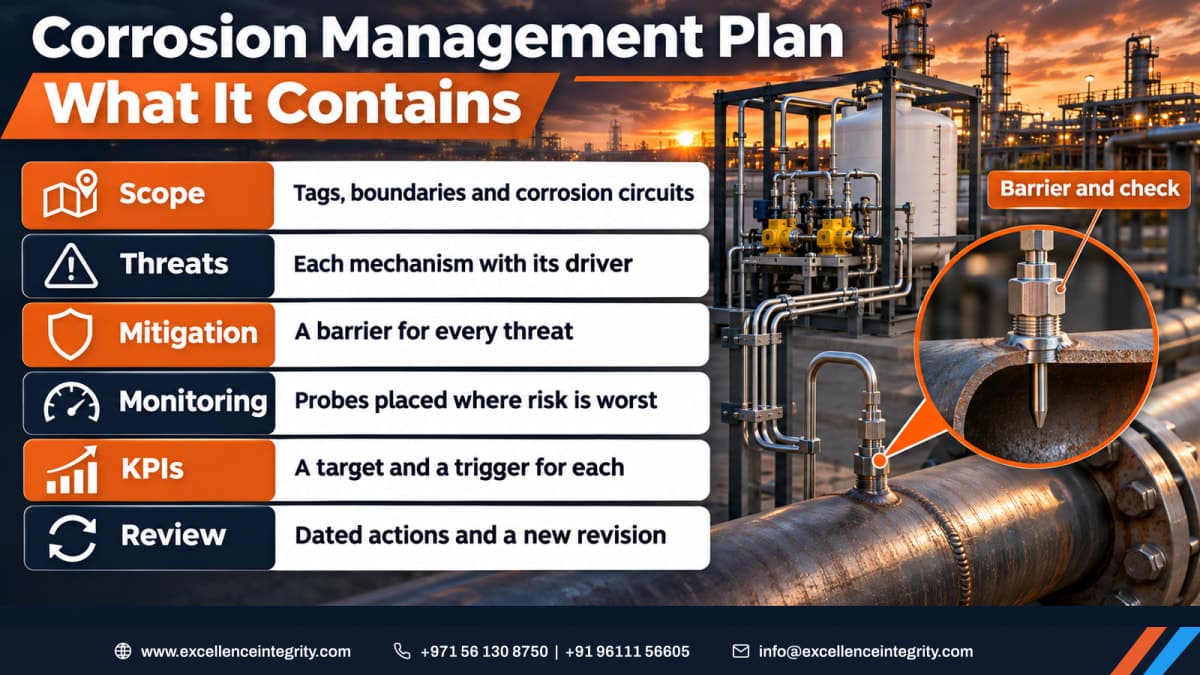
Eight parts cover it: the scope and the corrosion circuits, the credible threats and their drivers for each circuit, the barriers against each threat, the monitoring that shows they are working, the inspection methods and intervals, KPIs with targets and triggers, named roles for every activity, and a review cycle that keeps the document current.
Is an inspection plan enough for corrosion control?
No. The inspection plan is one input to the management plan, which also names the threats and their drivers, the barriers such as inhibitor, coatings and cathodic protection, the monitoring between inspections, the KPIs and who is responsible. It should link to the inspection system rather than copy it, so there is one schedule instead of two that drift apart.
How often should the plan be reviewed?
Most plans combine a routine review of KPIs and monitoring data with a fuller periodic review of the whole document. They also review early after any change, such as a new well, a higher water cut, a different crude, a change of chemical or a failure. Each review should end with dated actions and a new revision.
What are good corrosion KPIs?
Good ones show whether barriers are available and work is being done, not only whether something has already corroded: inhibitor availability at the target dose, coupons and probes read on schedule, inspections completed by their due date, measured corrosion rate against the assumed rate, and overdue actions. Give each a target and a trigger for action.
What to do next
Take one circuit you know well and write its threats, drivers, barriers and checks on a single page. If you cannot say how you would know a barrier had failed, that is the first gap your plan needs to close. For the full discipline of internal corrosion control, the internal corrosion management programme covers threat assessment, mitigation, monitoring and review. For pipeline systems specifically, the internal pipeline corrosion management guide covers the causes and controls in more detail.
Exam preparation
Preparing for API 571?
Practise with exam-style questions, timed mocks and study notes. 3,357 questions in the bank.