Pressure Testing Under API 510: Hydrostatic vs Pneumatic
When API 510 requires a pressure test, hydrostatic vs pneumatic test pressures in ASME VIII, temperature and safety, and when NDE can be used instead.
By Syed Hasan21 Nov 20263 min read
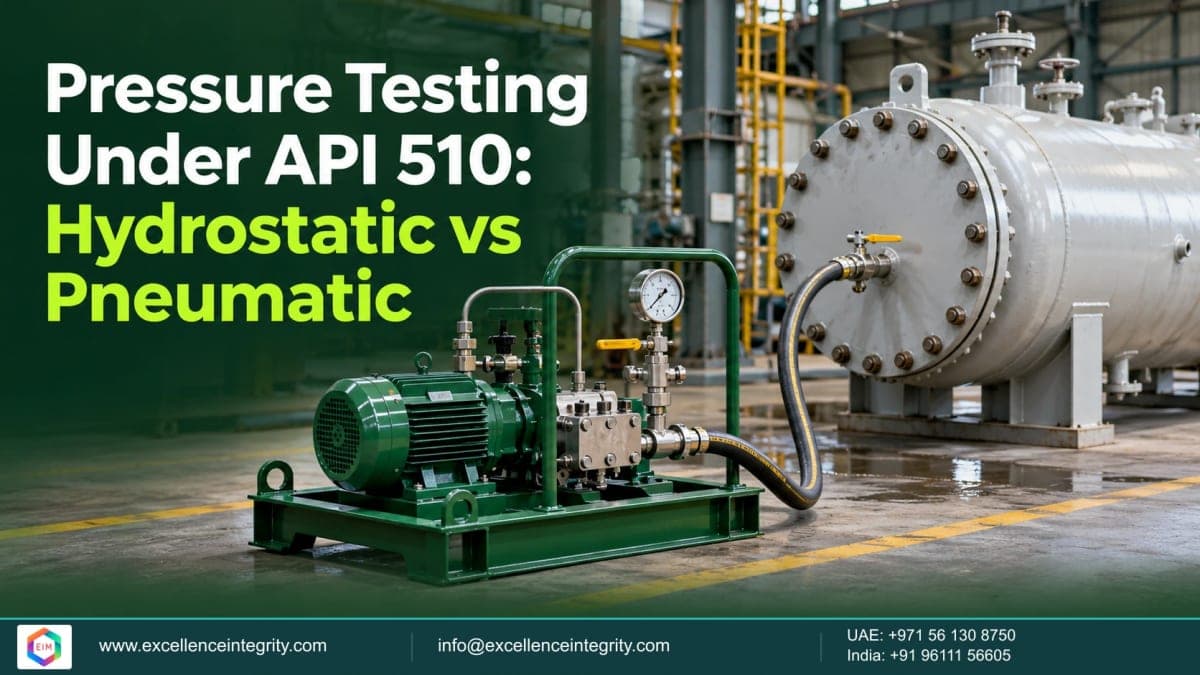
Part 3 of our API 510 cluster covers the test that proves a repair or alteration holds pressure. Pressure testing is also one of the most hazardous activities in a turnaround: a vessel at test pressure stores a lot of energy, and a pneumatic test stores far more.
Short answer: Under ASME VIII Division 1, the standard hydrostatic test pressure is 1.3 × MAWP × the ratio of allowable stress at test temperature to that at design temperature; a pneumatic test is 1.1 × MAWP × the same ratio. API 510 normally requires a pressure test after an alteration, and leaves it to the inspector after repairs. Keep the metal well above the MDMT during the test (ASME recommends at least 30 °F, 17 °C, above), prefer hydrostatic testing, and use pneumatic testing only with engineering review. Approved NDE can sometimes substitute.
Hydrostatic vs pneumatic
When API 510 calls for a test
- After alterations: a pressure test is normally required.
- After repairs: at the inspector's discretion, depending on the nature and extent of the work.
- Alternatives: where a test is impractical, API 510 allows approved NDE in place of the pressure test under conditions, with engineering and inspector agreement.
- Reratings: a pressure test, or an approved alternative, supports the new rating; see repairs, alterations and rerating.
Worked example
A vessel with an MAWP of 1.5 MPa is tested at ambient temperature, where its allowable stress is the same as at design temperature (ratio 1.0). Hydrostatic test pressure = 1.3 × 1.5 × 1.0 = 1.95 MPa. A pneumatic test, if justified, would be 1.1 × 1.5 × 1.0 = 1.65 MPa, but with far greater stored energy.
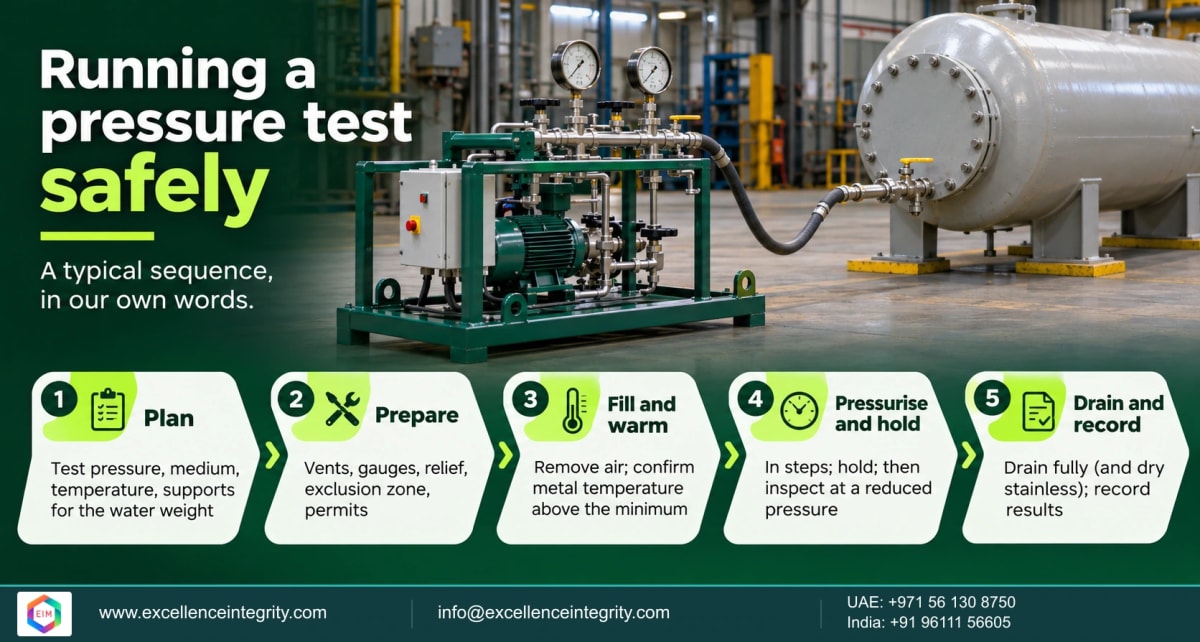
Running the test safely
Temperature and brittle fracture
A pressure test applies the highest stress the vessel may ever see. If the metal is cold, brittle fracture is possible; see brittle fracture and MDMT. Check the water and metal temperature before pressurising, and for stainless vessels, use water with low chlorides and drain and dry promptly; see chloride SCC.
Learn more with EIM
EIM is an independent training provider; API certifies pressure vessel inspectors. Our API 510 exam page explains the certification, eligibility, exam day and codebooks; read API exam day, hour by hour before you sit. The EIM Calculator includes MAWP, retirement thickness, corrosion rate and remaining life tools. For operators, EIM's inspection services include in-service inspection and turnaround support.
Frequently asked questions
What is the hydrostatic test pressure in ASME VIII Div. 1?
1.3 × MAWP × the ratio of allowable stress at test temperature to allowable stress at design temperature.
What is the pneumatic test pressure?
1.1 × MAWP × the same stress ratio.
Is a pressure test required after every repair?
No. API 510 leaves it to the inspector after repairs; a test is normally required after alterations.
Why is pneumatic testing more dangerous?
Gas stores far more energy than liquid at the same pressure, so a failure can be explosive.
Can NDE replace a pressure test?
In some cases API 510 allows approved NDE as an alternative, with engineering and inspector agreement.
Sources
- ASME Boiler and Pressure Vessel Code, Section VIII Division 1, UG-99 and UG-100. Cited, not quoted.
- API 510, Pressure Vessel Inspection Code (pressure testing). Summarised, not quoted.
- Worked example prepared by EIM. Checked 7 October 2026.
Exam preparation
Preparing for API 510?
Practise with exam-style questions, timed mocks and study notes. 2,549 questions in the bank.