Pressure Vessel Heads: Thickness Formulas Compared
Pressure vessel head thickness compared: hemispherical, 2:1 ellipsoidal, torispherical and flat heads, the ASME VIII formulas, and a worked example.
By Syed Hasan21 Nov 20263 min read
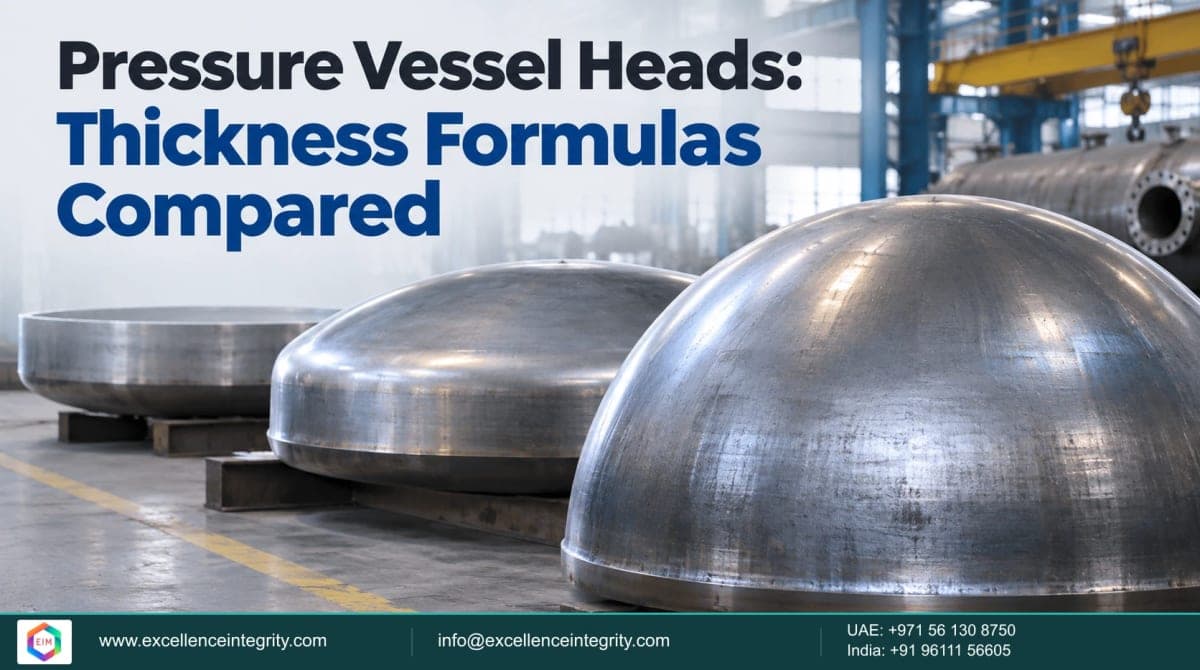
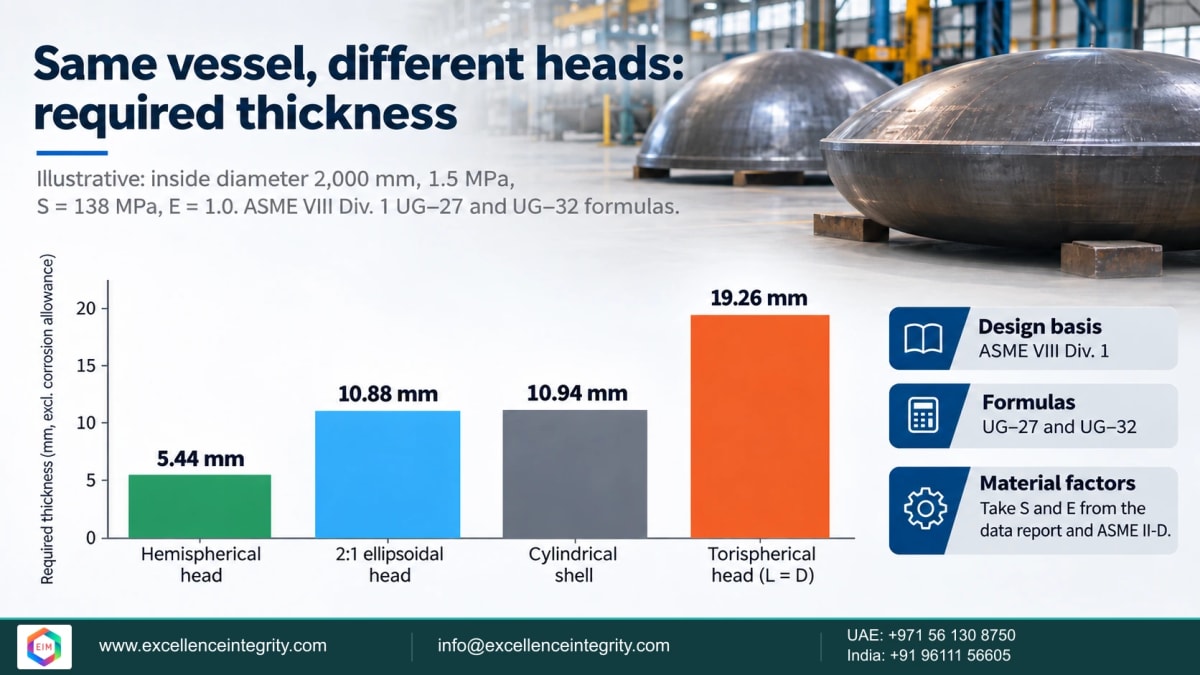
Part 2 of our API 510 cluster looks at the ends of the vessel. Heads come in several shapes, and the shape changes how the metal carries pressure: for the same vessel, a hemispherical head needs about half the shell thickness, while a torispherical head can need nearly twice as much. API 510 calculations for corroded heads use the same ASME formulas.
Short answer: For internal pressure under ASME VIII Division 1: a 2:1 ellipsoidal head needs t = PD / (2SE − 0.2P), close to the shell thickness. A hemispherical head needs t = PL / (2SE − 0.2P), where L is the inside radius, about half the shell. A standard torispherical (flanged and dished) head needs t = 0.885PL / (SE − 0.1P), with L the crown radius, often the thickest of the three. Flat heads are much less efficient and use separate rules.
The shapes
The formulas
- Shell (UG-27, circumferential stress): t = PR / (SE − 0.6P), R = inside radius.
- 2:1 ellipsoidal head: t = PD / (2SE − 0.2P), D = inside diameter.
- Hemispherical head: t = PL / (2SE − 0.2P), L = inside radius.
- Torispherical head (6% knuckle, crown radius L): t = 0.885PL / (SE − 0.1P).
- Flat heads use their own rules (UG-34) and are far less efficient.
Worked example
One vessel: inside diameter 2,000 mm (R = 1,000 mm), P = 1.5 MPa, S = 138 MPa (example), E = 1.0. Shell: 1.5 × 1,000 / (138 − 0.9) = 10.94 mm. 2:1 ellipsoidal head: 1.5 × 2,000 / (276 − 0.3) = 10.88 mm. Hemispherical head: 1.5 × 1,000 / (276 − 0.3) = 5.44 mm. Torispherical head with L = 2,000 mm: 0.885 × 1.5 × 2,000 / (138 − 0.15) = 19.26 mm.
Using head formulas in API 510 work
- Corroded condition: use the corroded dimensions and the thickness expected at the next inspection, as in our MAWP worked example.
- Knuckles: torispherical knuckles are highly stressed; inspect them carefully, especially for thinning and cracking.
- Joint efficiency: seamless heads often take E = 1.0; welded heads depend on the weld and radiography.
- MAWP: rearranging each formula gives the head's MAWP; the vessel MAWP is set by its weakest component.
Learn more with EIM
EIM is an independent training provider; API certifies pressure vessel inspectors. Our API 510 exam page explains the certification, eligibility, exam day and codebooks; read API exam day, hour by hour before you sit. The EIM Calculator includes MAWP, retirement thickness, corrosion rate and remaining life tools. For operators, EIM's inspection services include in-service inspection and turnaround support.
Frequently asked questions
What is the formula for a 2:1 ellipsoidal head?
t = PD / (2SE − 0.2P) under ASME VIII Division 1, with D the inside diameter.
Why is a hemispherical head thinner?
Its shape spreads pressure stress evenly in two directions, so it needs about half the shell thickness.
What is the torispherical head formula?
For a standard 6% knuckle, t = 0.885PL / (SE − 0.1P), with L the crown radius.
Which head is thickest for the same pressure?
Of the dished heads, the torispherical head usually needs the most thickness; flat heads need far more again.
Are these formulas used in API 510?
Yes. API 510 evaluations of corroded heads use the ASME construction-code formulas with corroded dimensions.
Sources
- ASME Boiler and Pressure Vessel Code, Section VIII Division 1, UG-27, UG-32 and UG-34. Formulas cited, not reproduced in context.
- Worked example prepared by EIM. Checked 7 October 2026.
Exam preparation
Preparing for API 510?
Practise with exam-style questions, timed mocks and study notes. 2,549 questions in the bank.