Cooling Water Corrosion: Damage Mechanism of the Week
Cooling water corrosion explained: what drives it in towers and seawater systems, where exchangers suffer, how to monitor it and how treatment controls it.
By Siddique21 Nov 20263 min read
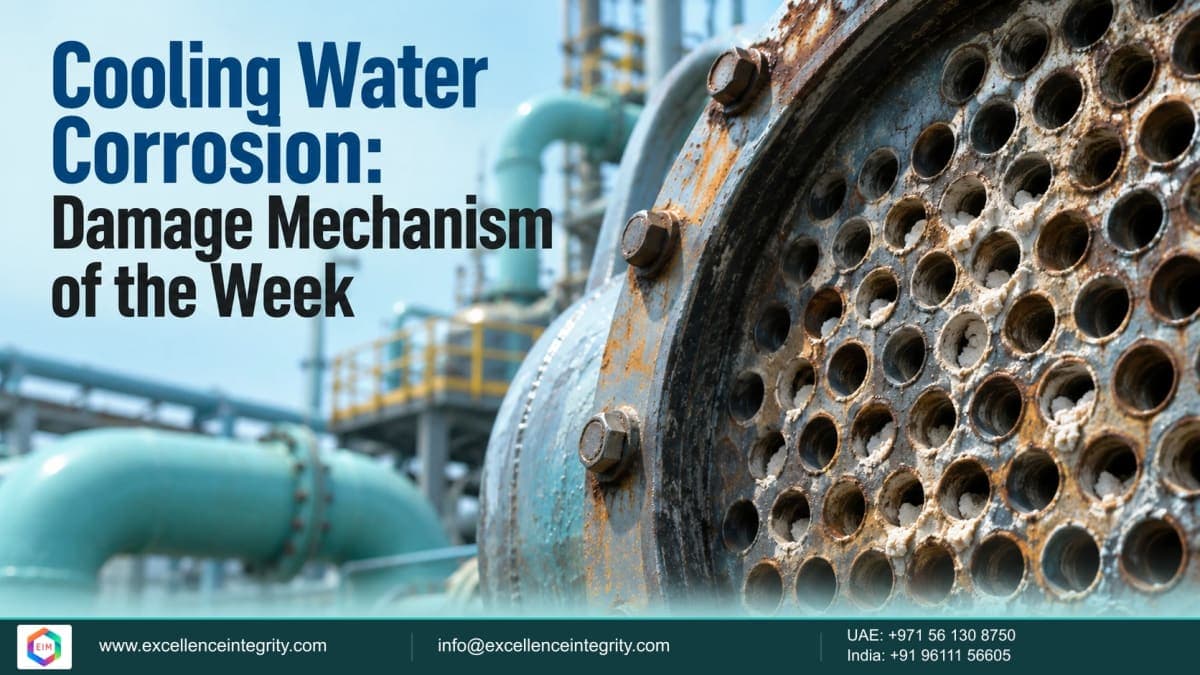
Week 15 of our Damage Mechanism of the Week series covers the water side of heat exchangers. Cooling water corrosion causes a steady stream of tube leaks and exchanger replacements, and in the Gulf, where many plants cool with seawater or high-chloride water, materials and treatment choices matter even more.
Short answer: Cooling water corrodes exchanger tubes, tubesheets, water boxes and piping through general corrosion, pitting, under-deposit attack, microbiologically influenced corrosion and erosion. The drivers are oxygen, temperature, velocity (too low lets deposits form, too high erodes), chlorides, pH, deposits and microbes. Control relies on water treatment (inhibitors, biocides, pH control), velocity management, suitable materials, and monitoring of both the water and the equipment.
At a glance
Where it attacks
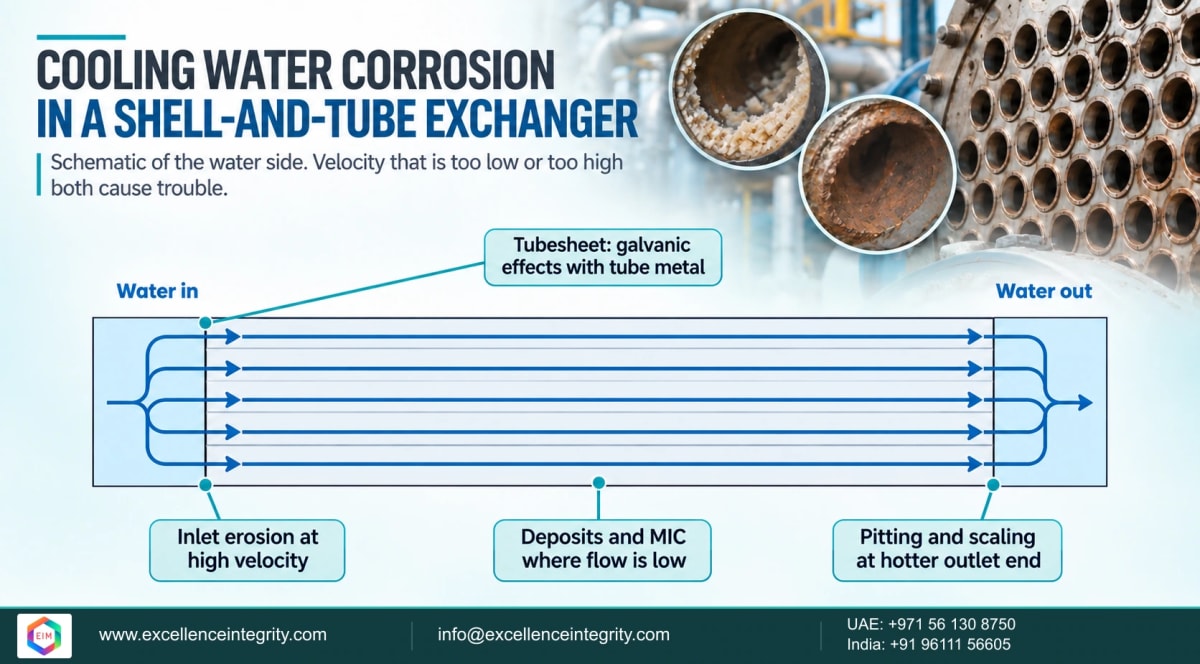
Velocity: not too slow, not too fast
Low velocity lets suspended solids settle and biofilms grow, causing under-deposit corrosion and MIC; see our MIC field guide. High velocity, especially at tube inlets, can erode protective films, particularly in copper alloys. Good design keeps water velocity within a range suited to the tube material, and operations avoid throttling cooling water to control process temperature in ways that drop velocity too far.
Materials for seawater and high-chloride water
- Copper-nickel alloys: widely used for seawater, with velocity limits.
- Titanium: highly resistant to seawater, at higher cost.
- Duplex and super duplex stainless steels: resist chloride pitting better than 300-series grades.
- Mixed materials: tube and tubesheet combinations can create galvanic corrosion.
Monitoring and control
- Water treatment: corrosion and scale inhibitors, biocides, pH control and cycles of concentration in recirculating systems.
- Monitoring: coupons and probes, water chemistry, microbiological counts and exchanger performance; see coupons vs ER vs LPR.
- Tube inspection: eddy current, IRIS or other methods matched to the tube material; see heat exchanger tube inspection.
- Operating discipline: avoid low-flow conditions and stagnant periods.
Learn more with EIM
Cooling water corrosion is one of the damage mechanisms in API RP 571 (3rd edition), the body of knowledge for the API 571 certification. EIM is an independent training provider; API certifies inspectors. EIM's self-paced API 571 preparation includes a question bank, practice mode with explanations, timed mock tests, study notes and flashcards, with one year of access, and EIM's live API 571 Damage Mechanisms - Exam Preparation course with Mr. Deepak Rawtal runs weekend batches. See the API 571 page This post is part of our weekly Damage Mechanism of the Week series.
Frequently asked questions
What causes cooling water corrosion?
Oxygen, temperature, chlorides, pH, deposits, microbes and velocity that is too low or too high.
Why is low velocity a problem?
It allows deposits and biofilms to form, leading to under-deposit corrosion and MIC.
Which materials suit seawater cooling?
Copper-nickel alloys, titanium and duplex or super duplex stainless steels are common choices, each with its own limits.
How is cooling water corrosion monitored?
With corrosion coupons and probes, water chemistry and microbiological testing, exchanger performance trends and tube inspection.
How is it controlled?
Through water treatment, velocity control, suitable materials and avoiding low-flow or stagnant conditions.
Sources
- API RP 571, 3rd edition: cooling water corrosion. Summarised, not quoted.
- Checked 7 October 2026.
Exam preparation
Preparing for API 571?
Practise with exam-style questions, timed mocks and study notes. 3,357 questions in the bank.