API 510 Inspection Intervals and On-Stream Inspection
API 510 inspection intervals: internal, on-stream, thickness and external maximums, the half-life rule, and when on-stream can replace internal inspection.
By Syed Hasan21 Nov 20263 min read
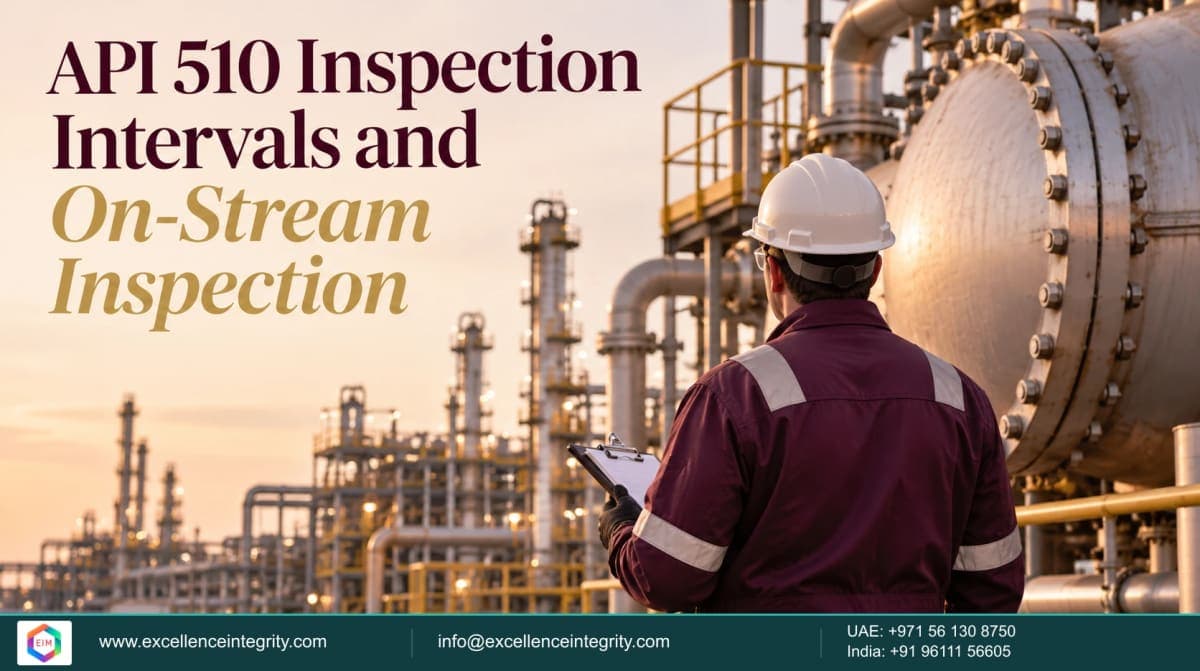
This is the first post in our API 510 cluster, for pressure vessel inspectors. API 510 sets maximum intervals for internal, on-stream, thickness and external inspections, with a half-life rule, a special case for short remaining life, and conditions under which an on-stream inspection can replace an internal one.
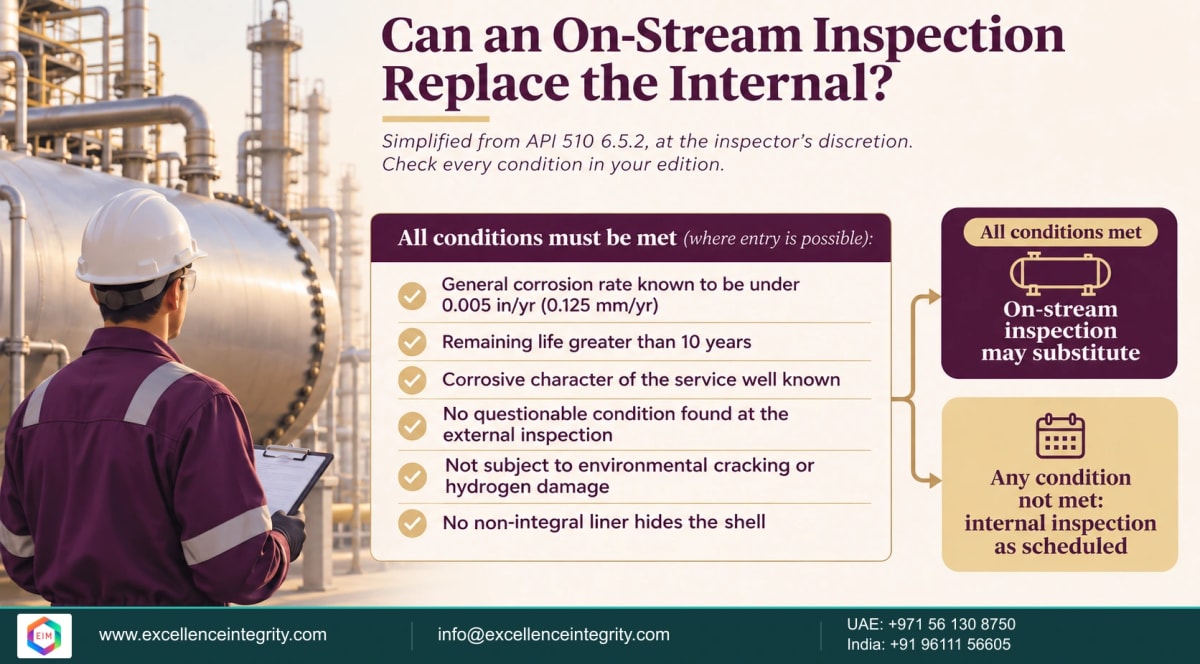
Short answer: Internal or on-stream inspection: at least every half the remaining life or 10 years, whichever is less. Thickness measurement: the same rule. External visual: the lesser of 5 years or the internal/on-stream interval. If remaining life is under 4 years, the interval may be the full remaining life, up to 2 years. An on-stream inspection may substitute for the internal at the inspector's discretion when conditions are met, including a general corrosion rate below 0.005 in/yr (0.125 mm/yr), remaining life over 10 years, and no environmental cracking or hydrogen damage expected. RBI can set intervals instead.
The intervals
Worked examples
- Remaining life 14 years: half is 7 years, under the 10-year cap, so internal (or on-stream) inspection is due within 7 years; external within 5.
- Remaining life 30 years: half is 15, so the 10-year cap governs.
- Remaining life 3 years: under 4 years, so the interval may be the full remaining life up to 2 years: 2 years.
On-stream in lieu of internal
Why the conditions matter
An on-stream inspection works from the outside, mainly with UT and other external methods. It cannot see internal cracking, lining condition or localised internal damage the way an internal inspection can. The conditions limit substitution to vessels where damage is slow, uniform and well understood, and where nothing like environmental cracking or a hidden liner could be missed.
RBI and intervals
API 510 allows RBI to set intervals in place of the defaults. Where an RBI interval for internal or on-stream inspection goes beyond 10 years, the RBI assessment itself must be reviewed at intervals not exceeding 10 years. See our API 580 cluster, starting with probability of failure.
Learn more with EIM
EIM is an independent training provider; API certifies pressure vessel inspectors. Our API 510 exam page explains the certification, eligibility, exam day and codebooks; read API exam day, hour by hour before you sit. The EIM Calculator includes MAWP, retirement thickness, corrosion rate and remaining life tools. For operators, EIM's inspection services include in-service inspection and turnaround support.
Frequently asked questions
What is the maximum internal inspection interval under API 510?
The lesser of half the remaining life or 10 years, unless justified by RBI.
What if remaining life is under 4 years?
The interval may be the full remaining life, up to a maximum of 2 years.
What is the external inspection interval?
The lesser of 5 years or the required internal/on-stream interval.
When can on-stream inspection replace internal inspection?
At the inspector's discretion, when conditions are met, including a general corrosion rate below 0.005 in/yr, remaining life over 10 years, and no environmental cracking or hydrogen damage expected.
Can RBI extend intervals beyond 10 years?
Yes, but the RBI assessment must then be reviewed at intervals not exceeding 10 years.
Sources
- API 510, Pressure Vessel Inspection Code, 6.5.1 and 6.5.2. Paraphrased from published quotations.
- Reliability Magazine: API 510, 570 and 653 inspection intervals
- Checked 7 October 2026.
Exam preparation
Preparing for API 510?
Practise with exam-style questions, timed mocks and study notes. 2,549 questions in the bank.