Galvanic Corrosion: Damage Mechanism of the Week
Galvanic corrosion explained: why dissimilar metals corrode, the galvanic series, why area ratio matters, where it occurs and how to prevent it.
By Siddique20 Nov 20263 min read
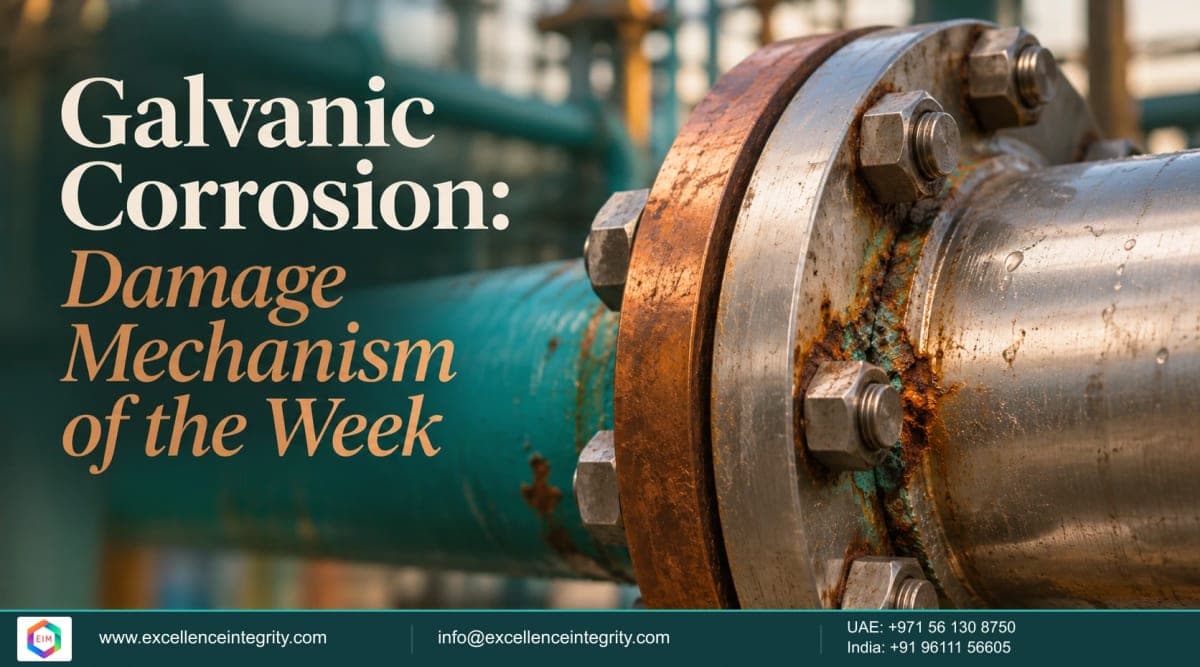
Week 13 of our Damage Mechanism of the Week series covers a mechanism every designer of seawater systems meets. Join two different metals in an electrolyte and one becomes the anode of a battery. It corrodes faster; the other is protected. In Gulf plants with seawater cooling and coastal air, galvanic corrosion is a daily design question.
Short answer: When two different metals are electrically connected in an electrolyte, the more active one (the anode) corrodes faster and the more noble one (the cathode) is protected. The effect grows with the potential difference, with the conductivity of the electrolyte (seawater is severe), and above all with the area ratio: a small anode connected to a large cathode corrodes fastest. Prevention: compatible materials, insulation between metals, coating the cathode rather than the anode, and sacrificial anodes.
At a glance
The galvanic series

Why area ratio matters most
The corrosion current is shared over the anode's surface. A small anode connected to a large cathode concentrates all of it on a small area, so it corrodes rapidly. A carbon steel bolt in a stainless flange corrodes fast; a stainless bolt in a carbon steel flange barely affects the flange. That is also why you should coat the cathode, not the anode: a coated anode with a small defect becomes a tiny anode facing a huge cathode.
Where to look
- Exchanger tubes and tubesheets of different alloys in seawater or cooling water; see cooling water corrosion.
- Joints between dissimilar piping, such as carbon steel to stainless or copper alloy.
- Bolting of a different material from the flanges it joins.
- Buried and marine structures, where galvanic effects interact with cathodic protection.
Preventing it
- Choose compatible materials close together in the galvanic series.
- Insulate: dielectric flange kits and sleeves break the electrical path.
- Coat the cathode, or both, never only the anode.
- Use sacrificial anodes or cathodic protection deliberately.
- Make the anode large and the cathode small where mixed metals are unavoidable.
Learn more with EIM
Galvanic corrosion is one of the damage mechanisms in API RP 571 (3rd edition), the body of knowledge for the API 571 certification. EIM is an independent training provider; API certifies inspectors. EIM's self-paced API 571 preparation includes a question bank, practice mode with explanations, timed mock tests, study notes and flashcards, with one year of access, and EIM's live API 571 Damage Mechanisms - Exam Preparation course with Mr. Deepak Rawtal runs weekend batches. See the API 571 page This post is part of our weekly Damage Mechanism of the Week series.
Frequently asked questions
What is galvanic corrosion?
Accelerated corrosion of the more active metal when two different metals are electrically connected in an electrolyte.
What is the galvanic series?
An ordering of metals by their tendency to corrode in a given electrolyte, such as seawater. Metals far apart in the series form stronger galvanic couples.
Why is a small anode bad?
The corrosion current concentrates on the small anode area, so it corrodes rapidly.
Why coat the cathode rather than the anode?
A defect in an anode coating leaves a tiny exposed anode facing a large cathode, accelerating attack at the defect.
How do insulating kits help?
They break the electrical connection between the metals, stopping the galvanic current.
Sources
- API RP 571, 3rd edition: galvanic corrosion. Summarised, not quoted.
- Checked 7 October 2026.
Exam preparation
Preparing for API 571?
Practise with exam-style questions, timed mocks and study notes. 3,357 questions in the bank.