Mechanical Fatigue: Damage Mechanism of the Week
Mechanical fatigue explained: how cyclic stress below yield cracks equipment, endurance limits, where fatigue strikes, and how to detect and prevent it.
By Harish Haseeb20 Nov 20263 min read
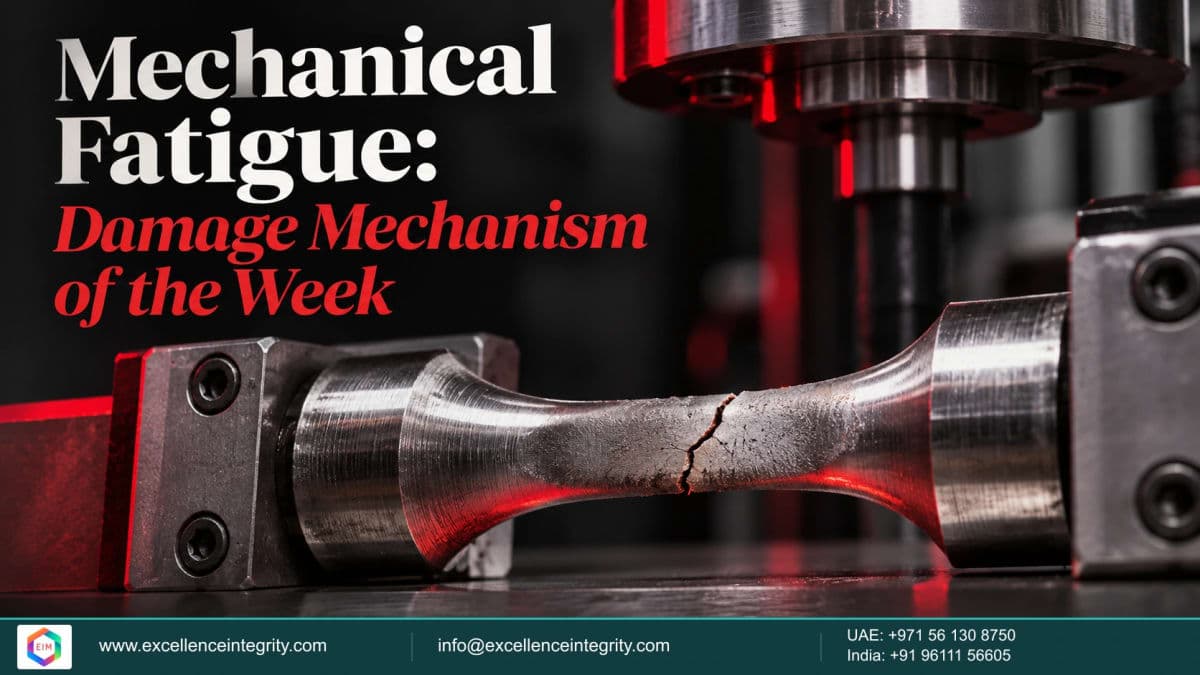
Week 11 of our Damage Mechanism of the Week series covers the mechanism behind many sudden cracks in rotating equipment, vibrating piping and cycling vessels. Mechanical fatigue needs no corrosion and no high temperature: just stress that goes up and down, enough times.
Short answer: Metal under repeated cyclic stress can crack even when every individual load is well below its yield strength. Cracks start at stress raisers such as notches, weld toes and sharp corners, and grow a little with each cycle. Carbon steels have an endurance limit below which fatigue cracks should not start; many other alloys do not. Prevention is about design (removing stress raisers), reducing cycles and vibration, and inspecting where cycling is known.
At a glance
The S-N curve
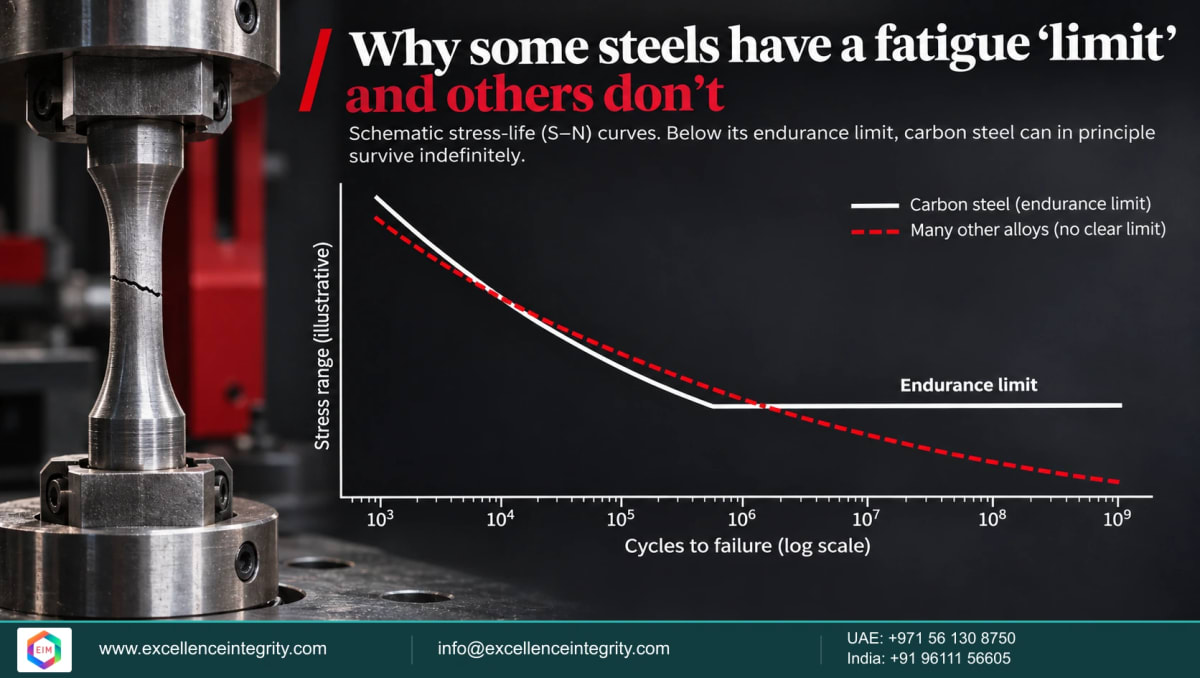
Fatigue behaviour is described by a stress-life (S-N) curve: the larger the stress range, the fewer cycles to failure. Carbon and low-alloy steels show a flattening, the endurance limit, below which they can in principle survive indefinitely. Austenitic stainless steels, aluminium and many other alloys show no clear limit: enough cycles at any stress can eventually crack them. Corrosion reduces fatigue strength further.
Where it strikes
- Rotating equipment: shafts, impellers and couplings, especially at keyways and shoulders.
- Vibrating piping, above all small-bore connections; see small-bore piping and vibration fatigue.
- Cycling pressure vessels, such as pressure swing adsorption vessels and batch reactors.
- Supports, attachments and welded details on vibrating structures.
What it looks like
Fatigue cracks are usually flat and show little deformation. The fracture surface often has 'beach marks', curved lines showing how the crack front advanced, pointing back to the origin at a stress raiser. The final fracture zone, where the remaining section gave way, is rougher.
Detecting and preventing it
- Inspect stress raisers: visual, PT, MT or UT at weld toes, notches and changes in section.
- Measure vibration where cycling is suspected.
- Design out stress raisers: generous radii, smooth weld profiles, avoid abrupt changes in section.
- Reduce cycles and amplitude: supports, bracing, dampers, operating changes.
- Select materials with fatigue in mind for high-cycle duty.
Learn more with EIM
Mechanical fatigue is one of the damage mechanisms in API RP 571 (3rd edition), the body of knowledge for the API 571 certification. EIM is an independent training provider; API certifies inspectors. EIM's self-paced API 571 preparation includes a question bank, practice mode with explanations, timed mock tests, study notes and flashcards, with one year of access, and EIM's live API 571 Damage Mechanisms - Exam Preparation course with Mr. Deepak Rawtal runs weekend batches. See the API 571 page This post is part of our weekly Damage Mechanism of the Week series.
Frequently asked questions
What is mechanical fatigue?
Cracking caused by repeated cyclic stress, often well below the material's yield strength.
What is an endurance limit?
A stress range below which a material, such as carbon steel, can in principle withstand an unlimited number of cycles.
Where does fatigue usually start?
At stress raisers: notches, weld toes, sharp corners and changes in section.
What are beach marks?
Curved lines on a fatigue fracture surface showing successive positions of the crack front.
How is fatigue prevented?
By removing stress raisers, reducing the number and size of stress cycles, controlling vibration and choosing suitable materials.
Sources
- API RP 571, 3rd edition: mechanical fatigue. Summarised, not quoted.
- Checked 7 October 2026.
Exam preparation
Preparing for API 571?
Practise with exam-style questions, timed mocks and study notes. 3,357 questions in the bank.