Ammonium Chloride Corrosion: Damage Mechanism of the Week
Ammonium chloride and amine hydrochloride corrosion: why salts form above the water dew point, where they attack, and how to control them.
By Siddique19 Nov 20263 min read
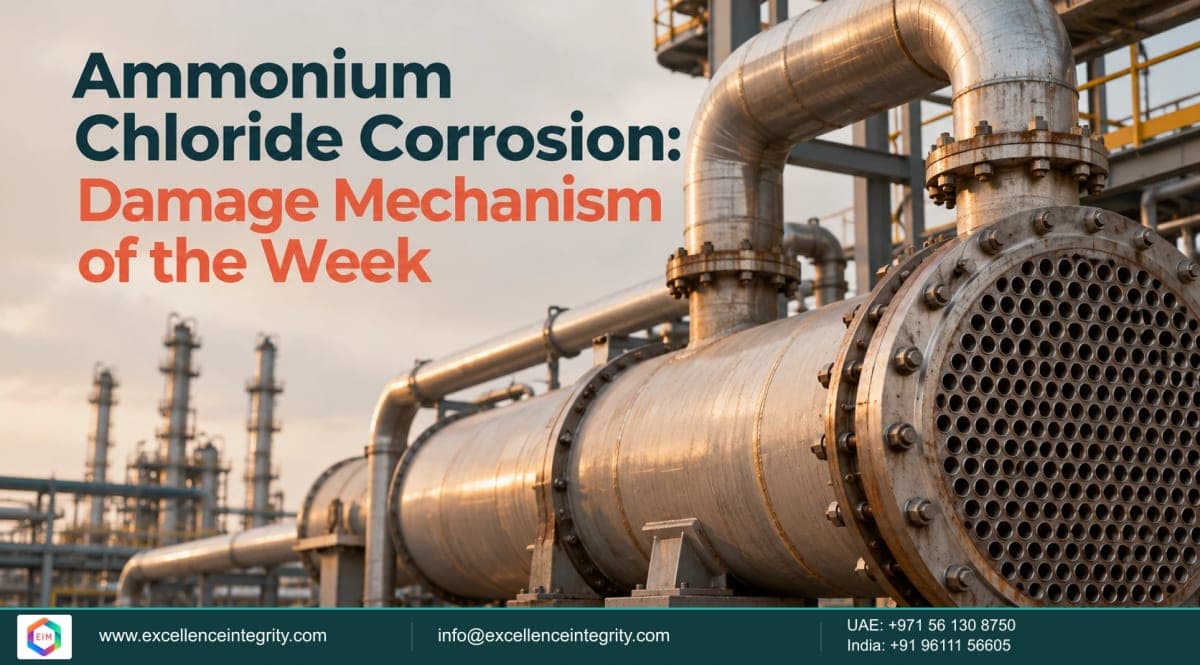
Week 10 of our Damage Mechanism of the Week series covers a mechanism that catches people out because the line looks dry. Ammonium chloride and amine hydrochloride salts can deposit before any water condenses, then pull moisture out of the stream and corrode the metal underneath, in crude unit overheads, hydroprocessing trains and reformer effluent systems.
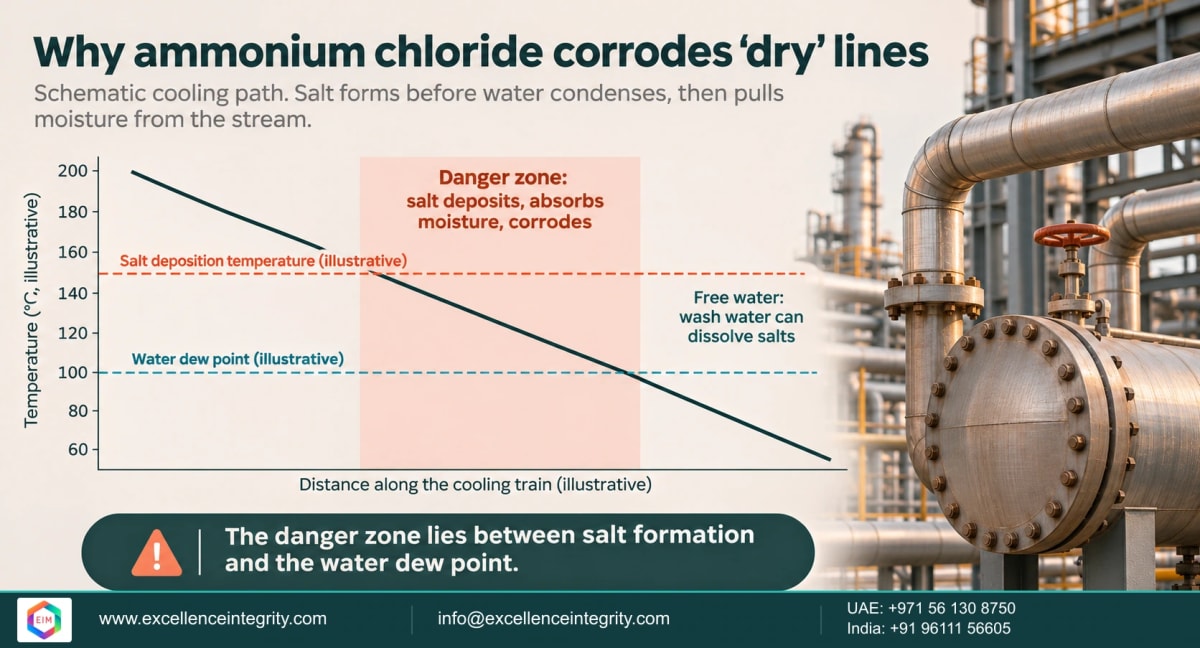
Short answer: Ammonia (or neutralising amines) and hydrogen chloride in a cooling stream combine into salts that can deposit at temperatures above the water dew point. The salts are hygroscopic: they absorb water from the gas and form a highly corrosive wet film under the deposit. Attack is localised and often hidden until a leak. Control relies on desalting and chloride control, wash water, neutraliser management, temperature control and, where needed, more resistant alloys.
At a glance
Why 'dry' lines corrode
Where to look
- Crude unit overhead systems: exchangers, piping and the top of the column.
- Hydroprocessing effluent trains, upstream of where wash water is injected.
- Catalytic reformer effluent and recycle systems.
- FCC main fractionator overheads.
- Anywhere neutralising amines are overdosed, which can form amine hydrochloride salts.
What it looks like
Localised pitting and thinning under white or greenish salt deposits, often in areas that do not see free water in normal operation. Because deposits are patchy, damage can be very uneven; spot readings can miss it.
Controlling it
- Reduce chlorides at the source: good desalting and caustic or chloride management upstream.
- Wash water: inject enough water, in the right place, to dissolve salts before they deposit.
- Neutraliser and amine control: the right chemical and dose, avoiding salt-forming overdoses.
- Temperature management: keep metal temperatures out of the deposition range where practical.
- Materials: titanium and some nickel alloys resist far better in severe cases.
- Inspection: scanning rather than spot readings in susceptible zones; see CML optimisation.
Learn more with EIM
Ammonium chloride corrosion is one of the damage mechanisms in API RP 571 (3rd edition), the body of knowledge for the API 571 certification. EIM is an independent training provider; API certifies inspectors. EIM's self-paced API 571 preparation includes a question bank, practice mode with explanations, timed mock tests, study notes and flashcards, with one year of access, and EIM's live API 571 Damage Mechanisms - Exam Preparation course with Mr. Deepak Rawtal runs weekend batches. See the API 571 page This post is part of our weekly Damage Mechanism of the Week series.
Frequently asked questions
What is ammonium chloride corrosion?
Corrosion under ammonium chloride (or amine hydrochloride) salt deposits that absorb moisture and form a corrosive film, even in lines without free water.
Why does it happen above the water dew point?
The salts form and deposit at temperatures higher than the water dew point, then absorb moisture from the stream.
Where does it occur?
Crude overheads, hydroprocessing and reformer effluent trains, and FCC fractionator overheads, among others.
How is it controlled?
Desalting and chloride control, wash water, neutraliser management, temperature control and alloy upgrades.
How is it related to ammonium bisulfide corrosion?
Both involve ammonium salts in hydroprocessing trains, but ammonium chloride is a chloride salt that deposits above the dew point, while ammonium bisulfide attacks in alkaline sour water. See our ammonium bisulfide guide.
Sources
- API RP 571, 3rd edition: ammonium chloride and amine hydrochloride corrosion. Summarised, not quoted.
- Checked 7 October 2026.
Exam preparation
Preparing for API 571?
Practise with exam-style questions, timed mocks and study notes. 3,357 questions in the bank.