Atmospheric Corrosion: Damage Mechanism of the Week
Atmospheric corrosion explained: what drives it, why Gulf coastal sites are aggressive, where it hides on pipe racks and supports, and how to manage it.
By Siddique20 Nov 20263 min read
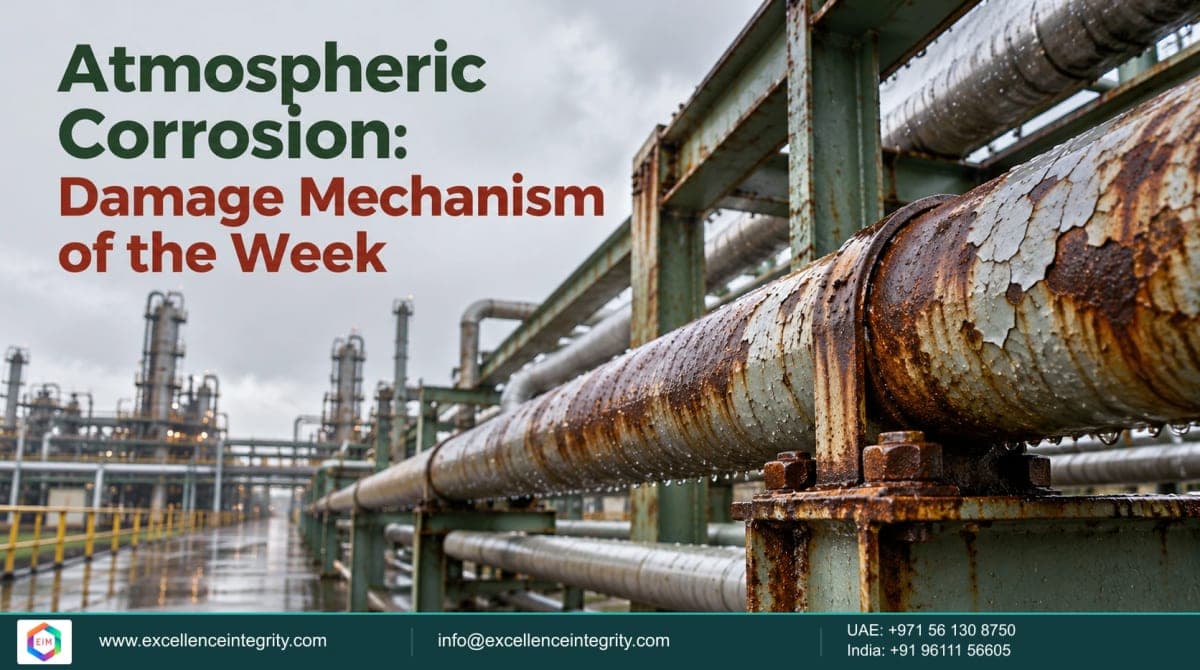
Week 14 of our Damage Mechanism of the Week series covers the most visible mechanism of all, and one of the most underestimated. Atmospheric corrosion attacks the outside of uninsulated equipment and piping. On Gulf coastal sites, with humidity, salt, dust and heat, it can be aggressive enough to dominate external inspection findings.
Short answer: Carbon steel exposed to the air corrodes whenever its surface is wet long enough. Chlorides from sea air, industrial pollutants and deposits that hold moisture all speed it up. It is worst where water and salt collect and cannot dry: pipe supports and contact points, low points, splash zones and under deposits. Management relies on coatings and their maintenance, good drainage, support pads and regular external inspection.
At a glance
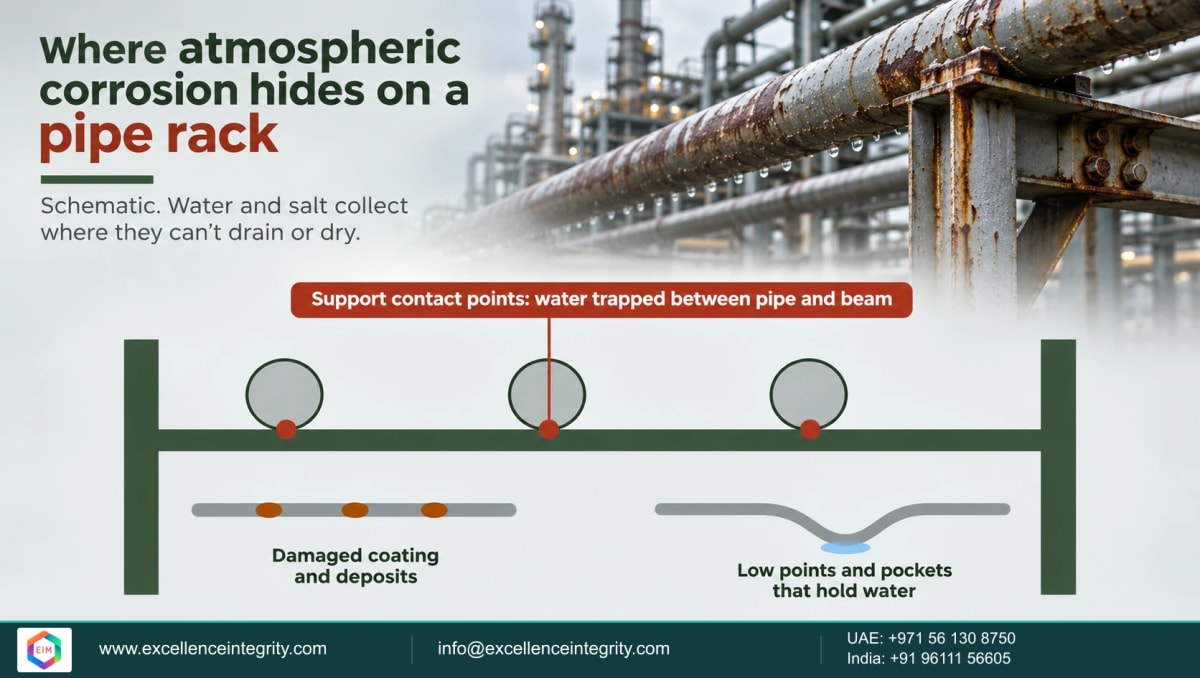
Where it hides
Why Gulf sites are aggressive
Coastal Gulf plants combine high humidity, frequent condensation at night, salt carried from the sea, and dust that holds moisture and salt on surfaces. Heat speeds the reactions. The result is that coatings fail sooner and bare steel corrodes faster than at many inland sites. Coating selection, surface preparation and maintenance cycles should reflect that.
Pipe supports: the classic problem
Where a pipe rests on a beam, water and dirt are trapped in the crevice, coating is damaged by movement, and the area cannot dry. Corrosion at supports can be severe while the visible pipe looks fine. Lifting pipes, using support pads or saddles, and targeted inspection methods help.
Managing it
- Coatings, applied to a specification suited to the environment, with inspection and maintenance; see our guide to AMPP CIP Levels 1 to 3.
- Drainage: avoid pockets, slope where possible, seal crevices.
- Support details: pads, saddles or non-metallic wear strips at contact points.
- External inspection: visual surveys, with UT or other methods at supports and suspect areas.
- Watch the related mechanism: where insulation is present, see corrosion under insulation.
Learn more with EIM
Atmospheric corrosion is one of the damage mechanisms in API RP 571 (3rd edition), the body of knowledge for the API 571 certification. EIM is an independent training provider; API certifies inspectors. EIM's self-paced API 571 preparation includes a question bank, practice mode with explanations, timed mock tests, study notes and flashcards, with one year of access, and EIM's live API 571 Damage Mechanisms - Exam Preparation course with Mr. Deepak Rawtal runs weekend batches. See the API 571 page This post is part of our weekly Damage Mechanism of the Week series.
Frequently asked questions
What causes atmospheric corrosion?
Moisture on the metal surface, made worse by chlorides, industrial pollutants, deposits and higher temperature.
Why are coastal sites more corrosive?
Sea salt deposits chlorides on surfaces and humidity keeps them wet, which speeds corrosion.
Why do pipe supports corrode so badly?
Water and dirt are trapped at the contact point, coating is damaged by movement, and the area cannot dry.
How is atmospheric corrosion prevented?
With suitable coatings and maintenance, good drainage, support pads and regular external inspection.
How does it relate to CUI?
Both are external corrosion. CUI occurs under insulation, where water is trapped against the metal; atmospheric corrosion affects exposed surfaces.
Sources
- API RP 571, 3rd edition: atmospheric corrosion. Summarised, not quoted.
- Checked 7 October 2026.
Exam preparation
Preparing for API 571?
Practise with exam-style questions, timed mocks and study notes. 3,357 questions in the bank.