AMPP CIP Level 1, 2 and 3: The Coating Inspector Ladder Explained
AMPP coating inspector levels explained: what CIP Level 1, 2 and 3 require, what each level can do, the Level 3 Peer Review, and how long the climb takes.
Written by Asjad ImamReviewed by Syed Hasan
Published 22 Oct 2026Reviewed 7 Oct 20265 min read
A coating that fails early can cost far more to fix than it cost to apply. The coating inspector, checking surface preparation, ambient conditions, film thickness and cure, is the person who catches the problem while it is still cheap. AMPP's Coating Inspector Program (CIP), still written as "NACE CIP" in many specifications, is widely specified for that role across oil and gas, marine and infrastructure work.
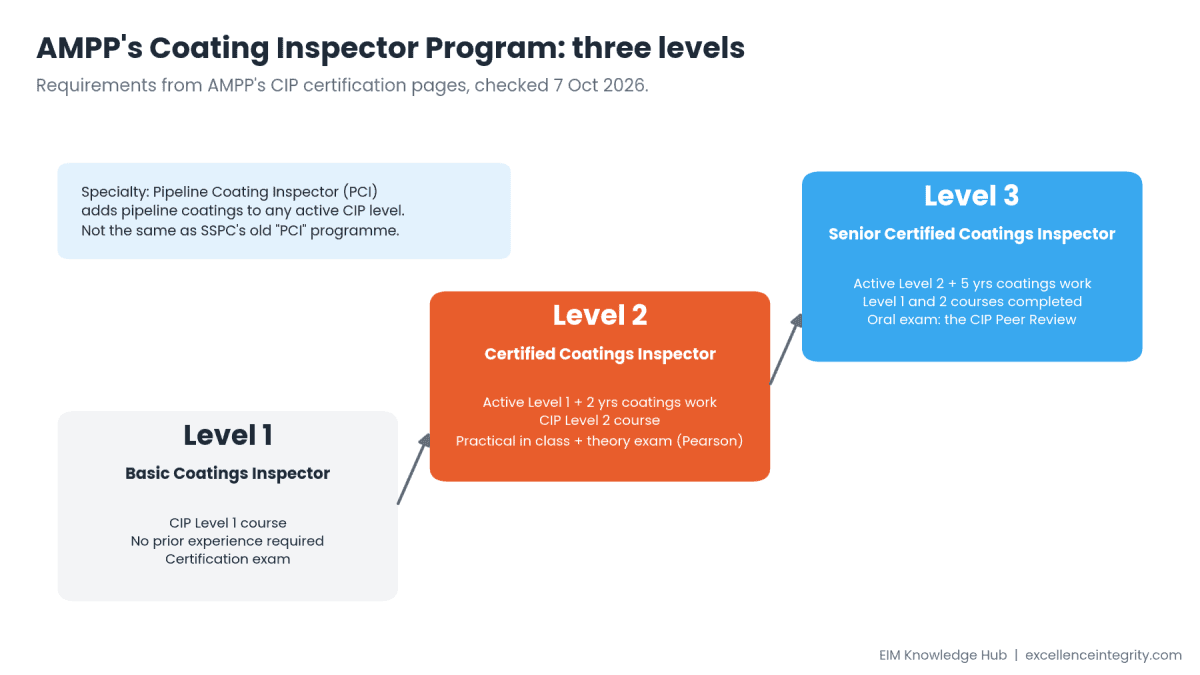
The program has three levels. This guide sets out what each one requires, what it allows you to do, and how long the climb realistically takes. Requirements are from AMPP's pages, checked 7 October 2026.
Short answer: Level 1 is the entry point: a course and an exam, with no experience needed. Level 2 is the working credential most field inspectors hold: two years of coatings work, the Level 2 course, and practical and theory exams. Level 3 is the top: five years, both courses, and an oral exam called the Peer Review.
The three levels at a glance
| Level 1 | Level 2 | Level 3 | |
|---|---|---|---|
| AMPP name | Basic Coatings Inspector | Certified Coatings Inspector | Senior Certified Coatings Inspector |
| Experience | None required | 2 years' verifiable coatings-related work | 5 years' coatings work experience |
| Must already hold | Nothing | Active Level 1 | Active Level 2 |
| Course | CIP Level 1 course: about six days, in person, with hands-on labs | CIP Level 2 course | Level 1 and Level 2 courses completed |
| Exam | Certification exam, included with the course | Practical exam in class, plus a theory exam booked through Pearson | The CIP Peer Review, an oral exam |
At every level you also need an approved application, and AMPP gives candidates four years to complete all requirements.
What each level is trusted to do
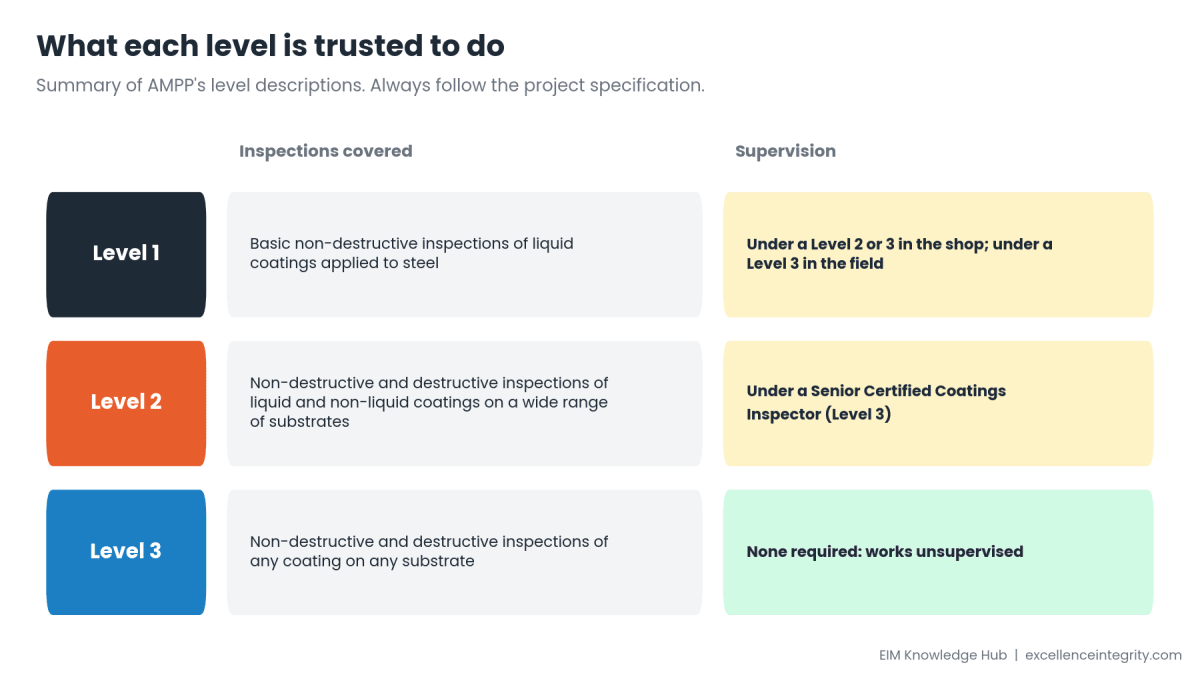
This is the practical difference employers care about. A Level 1 inspector does basic non-destructive checks under supervision. A Level 2 inspector performs and documents both non-destructive and destructive tests across many kinds of coatings and substrates, under a Senior Certified Coatings Inspector. A Level 3 inspector can work unsupervised on any coating and any substrate, which is why lead inspector and coatings specialist roles often ask for it.
Level 1: getting started
Level 1 suits new inspectors, QA/QC engineers moving into coatings, painting supervisors and coating sales engineers. The course covers coating materials, surface preparation, application methods, and inspection instruments and documentation.
Get comfortable with the core instruments before and after the course: dry film thickness gauges, surface profile measurement, psychrometers for dew point and relative humidity, and holiday detectors. And start a log of your coatings work from day one, because Level 2 needs two verified years of it.
Level 2: the working credential
Level 2 requires an active Level 1, two years of verifiable coatings-related work under AMPP's accepted work experience rules, the Level 2 course, and two exams: a practical given in class and a theory exam scheduled through Pearson.
AMPP updated the Level 2 course in October 2025, with an enhanced practical exam using standardised evaluation criteria, modern inspection equipment and revised case studies. The rollout started at AMPP's training centres in Houston, Pennsylvania and Dubai, and all public English courses were due to move to the new version by 1 January 2026. If you are studying from older notes, check them against the current course.
Level 3: the Peer Review
Level 3 is different in kind. Instead of a multiple-choice paper, it is earned through the CIP Peer Review, an oral exam conducted by AMPP. You need an active Level 2, completion of both earlier courses, and five years' coatings work experience.
Because it is oral, preparation looks different too:
- Rebuild your own case files. Pick projects where you made difficult calls: rejected surface preparation, disputed film thickness, an early coating failure. Be ready to explain what you saw, which standard or specification applied, and why you decided as you did.
- Know your standards references well enough to name the relevant one without hesitation.
- Practise explaining out loud. A colleague asking "why?" three times in a row is good rehearsal.
How long the climb takes
On AMPP's minimums: Level 1 at any time, Level 2 once you have two years of coatings work, and Level 3 once you have five. Allow extra time for course availability, scheduling the Peer Review and getting experience verified. Log projects, dates and duties as you go; reconstructing five years of work from memory is slow and risky.
Specialties beyond the ladder
Two related credentials are worth knowing. The Pipeline Coating Inspector (PCI) specialty adds pipeline coatings such as FBE, three-layer systems, field joints and holiday detection to an active CIP level; see our PCI specialty guide. The Protective Coatings Specialist (PCS) is aimed at people who design and oversee coating projects rather than inspect them.
Note the clash of initials: the legacy SSPC "PCI" was SSPC's Protective Coatings Inspector programme, now folded into AMPP's CIP. It is not the same as the Pipeline Coating Inspector specialty. Our guide to NACE becoming AMPP explains the old and new names.
Preparing with EIM
EIM is an independent training provider; the certifications belong to AMPP. EIM's exam pages explain CIP Levels 1, 2 and 3, PCI and PCS in full. For CIP Level 3, EIM's self-paced preparation material is built, with one year of access.
Frequently asked questions
Do I need experience for CIP Level 1?
No. Level 1 has no experience requirement. You take the CIP Level 1 course and the certification exam.
Is CIP Level 2 the same as NACE CIP Level 2?
Yes, it is the same credential lineage. AMPP now calls it Certified Coatings Inspector (CIP Level 2).
Is CIP Level 3 a written exam?
No. Level 3 is earned through the CIP Peer Review, an oral exam conducted by AMPP.
Can a Level 2 inspector work alone?
AMPP describes Level 2 inspectors as working under a Senior Certified Coatings Inspector. Unsupervised work on any coating and substrate is what Level 3 is for. Always follow the project specification.
How do I keep my certification?
You renew through AMPP's certification portal, logging work experience and professional development hours as set out in AMPP's renewal guide.