Pipeline Coating Inspector (PCI) Specialty: Complete Guide
The Pipeline Coating Inspector (PCI) Specialty focuses on the inspection of protective coating systems used in pipeline construction, maintenance, and integrity management. Learn about surface preparation, FBE, 3LPE, 3LPP, field-joint coating, environmental conditions, coating thickness, holiday detection, defects, repairs, documentation, and pipeline coating inspection practices.
Written by Asjad ImamReviewed by Syed Hasan
Published 21 Oct 2026Reviewed 21 Oct 20268 min read
Pipeline coatings are a critical part of corrosion control and pipeline integrity. A coating inspector must understand surface preparation, coating systems, application conditions, field-joint coating, holiday detection, coating damage, and inspection documentation.
The Pipeline Coating Inspector (PCI) Specialty focuses on the pipeline-specific aspects of protective coating inspection. It is particularly relevant to professionals involved in pipeline construction, corrosion control, QA/QC, inspection, and asset integrity management.
What Is the Pipeline Coating Inspector (PCI) Specialty?
The Pipeline Coating Inspector (PCI) Specialty is designed for professionals who inspect protective coating systems used on pipelines.
Pipeline coating inspection involves specialized coating systems, field-applied joint coatings, challenging environmental conditions, construction activities, and inspection requirements associated with buried and aboveground pipeline assets.
The specialty is relevant to professionals working with:
- Oil and gas pipelines
- Transmission pipelines
- Gathering pipelines
- Water pipelines
- Pipeline construction projects
- Pipeline rehabilitation and maintenance
- Field-joint coating operations
- Pipeline corrosion protection
Why Is Pipeline Coating Inspection Important?
A pipeline coating acts as a protective barrier between the steel substrate and its surrounding environment.
When a coating system is correctly selected, applied, inspected, and maintained, it helps reduce exposure of the steel to moisture, oxygen, salts, soil, and other corrosive conditions.
Coating problems can create locations where corrosion may initiate or accelerate.
Common causes of coating failure include:
- Poor surface preparation
- Incorrect coating application
- Surface contamination
- Unsuitable environmental conditions
- Improper curing
- Mechanical damage
- Inadequate field-joint coating
- Holiday defects
- Incorrect coating thickness
- Improper repair practices
What Does a Pipeline Coating Inspector Do?
A pipeline coating inspector may be involved throughout the coating process, from surface preparation through final inspection.
Before Coating
The inspector may verify:
- Approved coating specifications
- Coating manufacturer's requirements
- Material identification
- Storage conditions
- Surface preparation requirements
- Environmental conditions
- Surface cleanliness
- Surface profile
During Coating
Inspection activities can include:
- Monitoring coating application
- Checking coating thickness
- Monitoring environmental conditions
- Verifying mixing and application requirements
- Checking curing conditions
- Inspecting field joints
- Identifying coating defects
After Coating
The inspector may:
- Perform final visual inspection
- Conduct holiday detection where required
- Verify coating thickness
- Inspect repairs
- Review inspection documentation
- Confirm compliance with project requirements
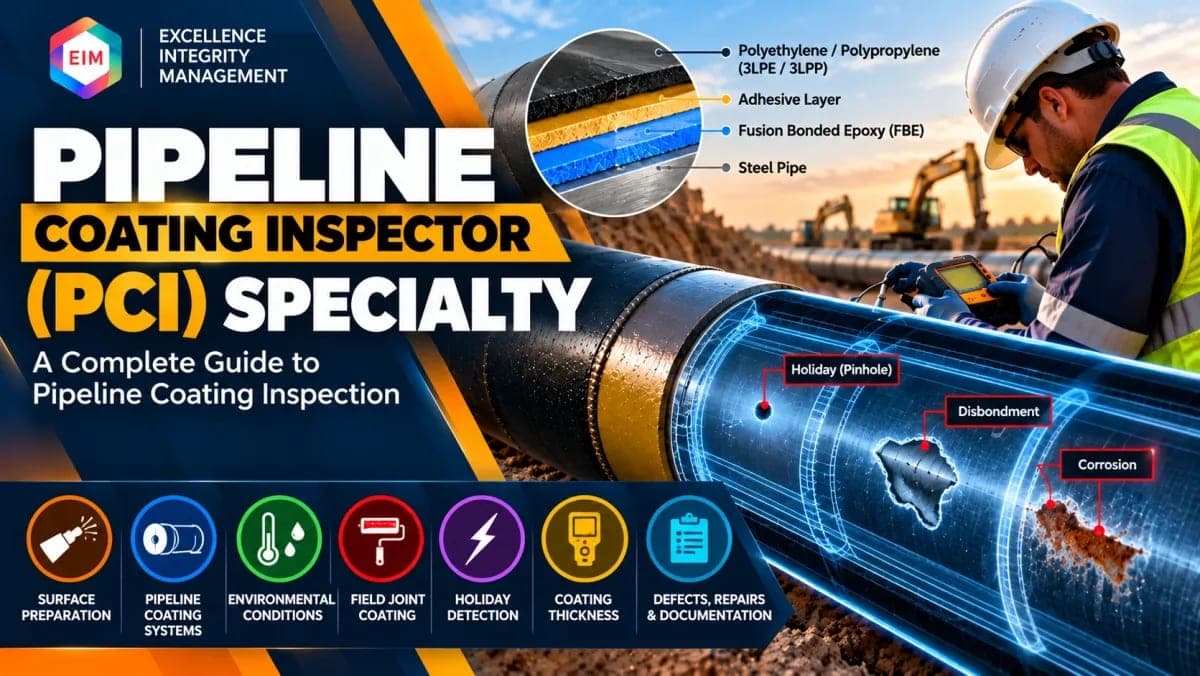
Major Pipeline Coating Systems
Pipeline projects can use different coating technologies depending on the service, operating conditions, location, construction method, and project specification.
1. Fusion Bonded Epoxy (FBE)
Fusion Bonded Epoxy (FBE) is widely used as a pipeline coating system. It is applied as a powder to a prepared and heated steel surface, where it melts and cures to form a protective coating.
Important inspection considerations include:
- Surface preparation
- Steel temperature
- Powder application
- Coating thickness
- Cure conditions
- Adhesion
- Holiday detection
- Handling damage
2. Three-Layer Polyethylene (3LPE)
Three-layer polyethylene systems generally combine a fusion bonded epoxy layer, adhesive layer, and polyethylene outer layer.
This multilayer system provides corrosion protection together with mechanical protection. Inspection requires attention to the individual layers and the finished coating system.
3. Three-Layer Polypropylene (3LPP)
Three-layer polypropylene systems are similar in concept to 3LPE but use polypropylene as the outer layer. They may be selected for applications requiring higher temperature performance or other project-specific properties.
4. Liquid-Applied Coatings
Liquid-applied coating systems can be used for pipeline applications, including field repairs, rehabilitation, and field-joint coating.
Inspection can involve:
- Mixing
- Application
- Pot life
- Environmental conditions
- Dry film thickness
- Recoat intervals
- Curing
- Holiday detection
Surface Preparation
Surface preparation is one of the most important stages of coating application. Even a high-performance coating can experience premature failure if the substrate is not properly prepared.
A coating inspector should understand requirements related to:
- Surface cleanliness
- Removal of rust
- Mill scale
- Oil and grease
- Dust
- Surface profile
- Abrasive blasting
- Surface contamination
The required preparation level depends on the coating system and applicable project specification.
Environmental Conditions
Coating application should be performed within the environmental conditions specified for the coating system.
Important parameters can include:
- Ambient temperature
- Steel temperature
- Relative humidity
- Dew point
- Surface temperature
- Wind
- Rain
- Dust and contamination
The relationship between steel temperature and dew point is particularly important. If the steel surface reaches or approaches the dew point, moisture can condense on the substrate and interfere with coating adhesion.
Field Joint Coating
Field joint coating is a critical part of pipeline construction.
Pipeline sections are often coated before transportation and installation. When pipe sections are joined in the field, the exposed area around the weld requires a suitable field-applied coating system.
The inspector may verify:
- Surface preparation
- Joint cleanliness
- Preheating where required
- Coating application
- Coating thickness
- Overlap
- Curing
- Holiday detection
- Repair of defects
The field joint should provide protection compatible with the surrounding pipeline coating system.
Holiday Detection
A holiday is an unintended discontinuity or pinhole in a coating that can expose the substrate.
Holiday detection is therefore an important inspection technique for suitable pipeline coating systems.
The inspector should understand:
- Equipment selection
- Test voltage requirements
- Coating thickness considerations
- Electrode selection
- Calibration
- Inspection procedures
- Defect identification
- Repair procedures
- Reinspection
Test voltage should be appropriate for the coating system and applicable requirements. Excessive voltage can potentially damage some coating systems, while insufficient voltage may fail to detect relevant discontinuities.
Coating Thickness Inspection
Coating thickness is another important quality-control parameter.
An inspector needs to verify that the applied coating meets the specified thickness range using appropriate inspection instruments.
Important considerations include:
- Instrument calibration
- Coating type
- Substrate condition
- Measurement location
- Required thickness range
- Number of readings
- Acceptance criteria
Insufficient coating thickness can reduce protection, while excessive thickness may also create coating-specific problems depending on the coating system.
Common Pipeline Coating Defects
Pinholes
Pinholes are small holes or discontinuities through the coating that can expose the substrate.
Blistering
Blisters can develop when gas, moisture, or other mechanisms create localized separation within or beneath the coating.
Peeling
Loss of adhesion can cause portions of the coating to separate from the substrate.
Cracking
Cracks may develop because of coating properties, application conditions, substrate movement, aging, or environmental exposure.
Holidays
Holidays are coating discontinuities that expose or electrically connect to the underlying substrate.
Mechanical Damage
Pipeline coatings can be damaged during transportation, handling, lowering-in, backfilling, and other construction activities. Such damage should be identified and repaired according to the approved procedure.
Pipeline Coating Inspection During Construction
Pipeline construction can expose coatings to several potential sources of damage.
An inspector may monitor coating condition during:
- Pipe transportation
- Pipe stringing
- Welding
- Field-joint coating
- Lowering-in
- Trenching
- Backfilling
- Crossing activities
- Final inspection
Coating inspection therefore extends beyond checking the coating immediately after application.
Coating Repair
When coating damage or unacceptable defects are identified, repairs should follow the approved repair procedure.
The repair process may involve:
- Removing damaged coating
- Preparing the affected surface
- Applying the specified repair material
- Allowing appropriate curing
- Rechecking coating thickness
- Performing holiday detection where required
- Recording the repair
Repaired areas should be inspected before final acceptance.
Documentation and Inspection Records
Good documentation is an essential part of pipeline coating quality management.
Records may include:
- Coating batch numbers
- Material certificates
- Surface preparation records
- Environmental readings
- Surface profile measurements
- Coating thickness readings
- Holiday detection results
- Repair records
- Calibration records
- Inspection reports
- Non-conformance reports
- Final acceptance documentation
Proper traceability helps demonstrate that coating activities were performed according to applicable project requirements.
Standards and Specifications
Pipeline coating inspection can involve multiple standards, specifications, project documents, and coating manufacturer requirements.
The applicable requirements depend on the pipeline, coating system, jurisdiction, owner specification, and project.
Inspectors should identify:
- Applicable project specifications
- Coating manufacturer's technical data
- Inspection and test plans
- Applicable industry standards
- Pipeline construction requirements
- Repair procedures
- Acceptance criteria
Pipeline Coating Inspector vs General Coating Inspector
| Area | General Coating Inspector | Pipeline Coating Inspection Specialty |
|---|---|---|
| Surface preparation | Yes | Yes |
| Coating application | Yes | Yes |
| Environmental monitoring | Yes | Yes |
| Coating thickness | Yes | Yes |
| Holiday detection | Yes | Yes |
| Pipeline coating systems | General knowledge | Specialized focus |
| Field-joint coating | General | Pipeline-specific |
| FBE | General knowledge | Pipeline-specific application |
| 3LPE / 3LPP | General knowledge | Pipeline-specific |
| Pipeline construction conditions | Limited | Specialized |
Who Should Consider Pipeline Coating Inspection Training?
Pipeline coating inspection training can be relevant to professionals working in:
- Pipeline construction
- Pipeline inspection
- Coating inspection
- Corrosion control
- QA/QC
- Asset integrity
- Oil and gas projects
- Petrochemical projects
- Engineering inspection
- Pipeline maintenance
How to Prepare for Pipeline Coating Inspection Specialty
Step 1: Understand Coating Fundamentals
Study corrosion basics, coating functions, coating types, surface preparation, and application methods.
Step 2: Study Pipeline Coating Systems
Focus on FBE, 3LPE, 3LPP, liquid-applied coatings, and field-joint coating systems.
Step 3: Learn Field Inspection
Practice understanding environmental measurements, surface profile, coating thickness, holiday detection, visual inspection, and repair inspection.
Step 4: Understand Pipeline Construction
Learn how coating inspection interacts with welding, field joints, pipe handling, lowering-in, backfilling, and construction damage.
Step 5: Study Documentation
Become familiar with inspection reports, coating records, repair documentation, calibration records, and project acceptance requirements.
Step 6: Practice Scenario-Based Questions
Coating inspection involves practical field decisions. Scenario-based practice can help develop the ability to interpret field conditions and determine appropriate inspection actions.
Career Relevance
Pipeline coating inspection combines corrosion control, coating technology, inspection, and pipeline construction knowledge.
Professionals working in this area may participate in pipeline construction projects, coating application inspection, QA/QC activities, corrosion prevention, and asset integrity programs.
Final Thoughts
The Pipeline Coating Inspector (PCI) Specialty focuses on the pipeline-specific aspects of protective coating inspection, including coating systems, surface preparation, field-joint coating, holiday detection, coating damage assessment, and inspection documentation.
For professionals working in pipeline construction and integrity, understanding these areas can help them evaluate coating quality and identify conditions that may contribute to corrosion or premature coating failure.
For certification or training decisions, candidates should always check the latest program requirements, course structure, and certification information from the relevant certification body.
About Excellence Integrity Management
Excellence Integrity Management (EIM) provides professional training and technical learning solutions for engineers, inspectors, and professionals working across the oil & gas, petrochemical, pipeline, corrosion, and asset integrity sectors.
EIM's training portfolio includes specialized inspection, asset integrity, corrosion, reliability, and industry-recognized certification preparation programs.