API 577 vs CSWIP 3.1: Which Welding Credential Should You Get?
API 577 or CSWIP 3.1? How the two welding credentials differ in purpose, eligibility, training, exam format and where employers ask for them.
Written by Nilanjan SenReviewed by Deepak Rawtal
Published 21 Oct 2026Reviewed 21 Oct 20263 min read
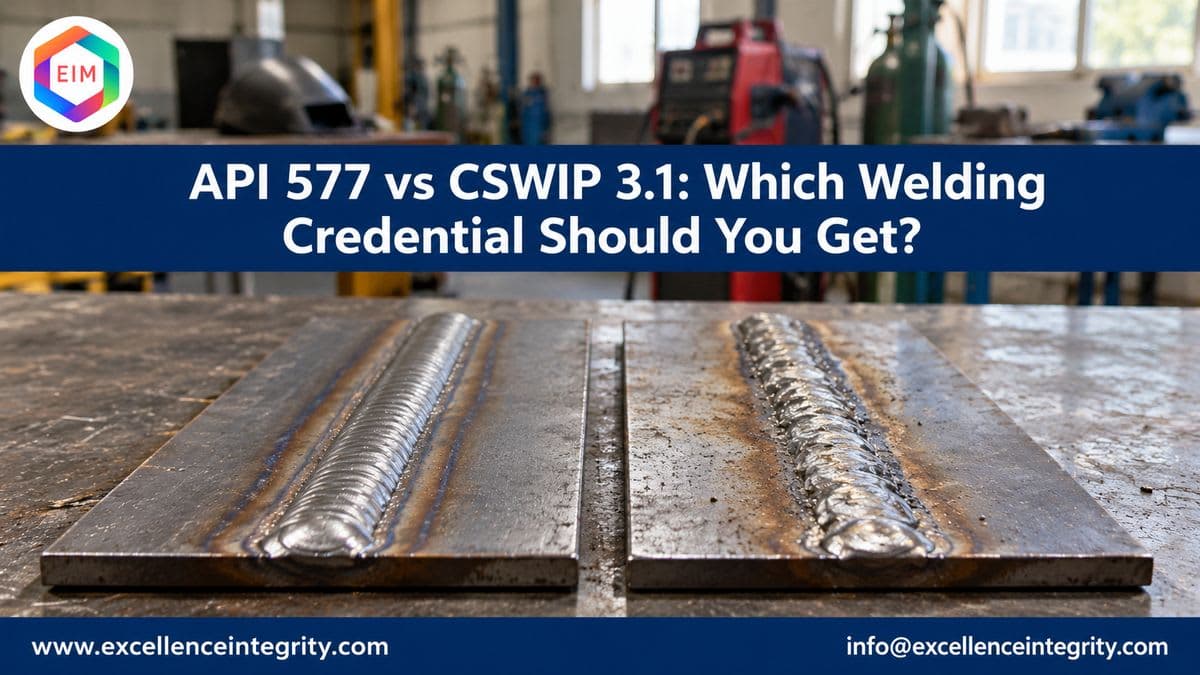
API 577 and CSWIP 3.1 both deal with welding inspection, so they are often weighed against each other. They are built for different jobs. API 577 certifies welding and metallurgy knowledge that supports in-service inspection under API's codes. CSWIP 3.1 certifies a working welding inspector, with a hands-on practical. Which one helps you depends on the work you do and what your employer or client asks for.
Short answer: If you inspect refinery and petrochemical equipment under API 510, 570 or 653, API 577 adds the welding and metallurgy depth behind those codes, and you qualify for it automatically. If your work is fabrication, construction or welding QA/QC, and job postings name CSWIP 3.1, take CSWIP 3.1. Many inspectors end up holding both.
Side by side
| API 577 | CSWIP 3.1 | |
|---|---|---|
| Awarded by | API (American Petroleum Institute) | TWI, under the CSWIP scheme |
| What it certifies | Welding processes, ASME IX qualification, welding metallurgy and inspection techniques, supporting API 510, 570 and 653 work | Mid-tier welding inspector competence: defect recognition, code acceptance criteria and welding procedure review |
| Training course required | No. You apply to API directly | Yes. An approved TWI training course is part of the pathway, typically 4 days of training and 1 day of exam |
| Eligibility | Automatic for current API 510, 570 or 653 holders; otherwise education plus experience in the last 10 years | 3 years of verified welding inspection experience, or 2 years holding CSWIP 3.0, or 1 year as a welding instructor or supervisor; plus an eyesight and colour vision certificate |
| Exam | 110 multiple-choice questions (100 scored), 3.25 hours, closed-book | Several written papers (general welding technology, plate practical, pipe practical, macro examination) plus a practical inspection assessment |
| Pass rule | Overall exam result | At least 70% in each individual paper, not just overall |
| Validity | 3 years | Commonly cited as 5 years; confirm with your training provider |
The real difference: what each is for
API 577 does not give you authority over any equipment type. It certifies the knowledge underneath inspection decisions, which is why API RP 577 describes itself as helping inspectors who apply API 510, 570, 653 and 582. It is mostly taken by inspectors already in, or heading into, in-service inspection of refinery and petrochemical plant.
CSWIP 3.1 is the welding inspector qualification itself, the middle of TWI's ladder between CSWIP 3.0 (visual welding inspector) and CSWIP 3.2 (senior welding inspector). It is one of the welding inspection credentials most often named in job postings and client requirements, including by operators across the Middle East, often alongside AWS CWI.
How the exams feel different
API 577 is a single closed-book paper. You need to recall ASME IX rules and metallurgy without any reference, and apply them to short scenarios.
CSWIP 3.1 is hands-on as well as written. You inspect real plate and pipe samples and macro sections, and each paper must reach 70% on its own, so one weak paper can fail the whole attempt even if your average is fine.
Which should you take first?
- You hold, or are working towards, API 510, 570 or 653: API 577 fits naturally, and you are already eligible if you hold one of them.
- You work in fabrication, construction or welding QA/QC: CSWIP 3.1 is usually what the job asks for.
- You are early in your career with no inspection experience yet: neither is the first step. CSWIP 3.0 has no formal experience requirement, and two years holding it is one route into CSWIP 3.1.
- Your client or employer names one: take that one. Job requirements decide more careers than any comparison table.
Next step
Full details, eligibility and sample questions for each are in our API 577 certification guide and our CSWIP 3.1 welding inspector guide.